

With the government preparing a bill for the Digital Asset Act that includes the introduction of won-denominated stablecoins and with the implementation of the security token system scheduled for February next year, changes are expected in the investment targets and trading methods of domestic investors. In the U.S., it is already possible to make small investments in blockchain-based Treasury funds and transfer rights digitally, while in Japan, security tokens that allow investors to invest in real estate such as hotels and rental housing and receive profit distributions are on the rise.
However, for domestic investors to enjoy new investment opportunities and trading convenience similar to those in the U.S. and Japan, it must be supported by the issuance of diverse products, the activation of distribution markets, and the construction of payment infrastructure. Investors should consider not only the profitability of new products but also legal rights, liquidity, and transaction costs.
Expansion of U.S. Treasury funds and Japanese real estate investments… Korea faces commercialization challenges
According to the financial investment industry on the 25th, in the U.S., products that combine blockchain technology with existing Treasury funds to enhance the convenience of investors’ rights management and transfer have already been commercialized. These products manage investment shares as tokens, facilitate transfers between investors, and calculate returns based on holding periods.
A representative example is Franklin Templeton’s “Franklin Onchain U.S. Government Money Market Fund (FOBXX),” offered by the U.S. asset management firm Franklin Templeton. Depending on the blockchain used, investments can start from a minimum of 20 dollars. As of the end of September last month, the 7th-day annualized yield was 3.73%. If one invests 1,000 dollars and the same yield is maintained for one year, it amounts to earning approximately 37 dollars before tax. Actual returns vary depending on management performance, and token transfers are only possible between approved investors.
In Japan, security token products that allow small investments in high-value real estate and the receipt of distributions from rental income are increasing. They also offer additional benefits linked to underlying assets, such as hotel lodging vouchers. The investment product for “Shizutetsu Hotel Prezioso” in Kyoto, raised by Japanese digital securities firm Renga in June last month, has a minimum investment amount of 100,000 yen and an expected annual distribution rate of 6.5% before tax. The Nagoya rental housing security token raised in July last month by a digital asset management company affiliated with Mitsui & Co. also allows investments starting from 100,000 yen, with an expected annual distribution rate of 4.5% before tax.
South Korea also allows small investments in buildings through real estate fractional investment and the receipt of distributions from rental income. This means that small-scale investment itself is not a unique advantage of security tokens. While the U.S. and Japan are utilizing blockchain-based product issuance, management, and trading services for actual investments, South Korea remains in the early stages of commercialization within the regulated system.
Although the security token system will be implemented starting next February and the government has prepared a plan to institutionalize stablecoins, the scope of initial security token products is limited. The schedule for tokenizing existing listed stocks and blockchain-based securities settlement has not yet been determined. For institutional preparations to lead to an expansion of actual investment opportunities, it must be supported by the supply of diverse products, sufficient investment demand, and the activation of distribution markets.
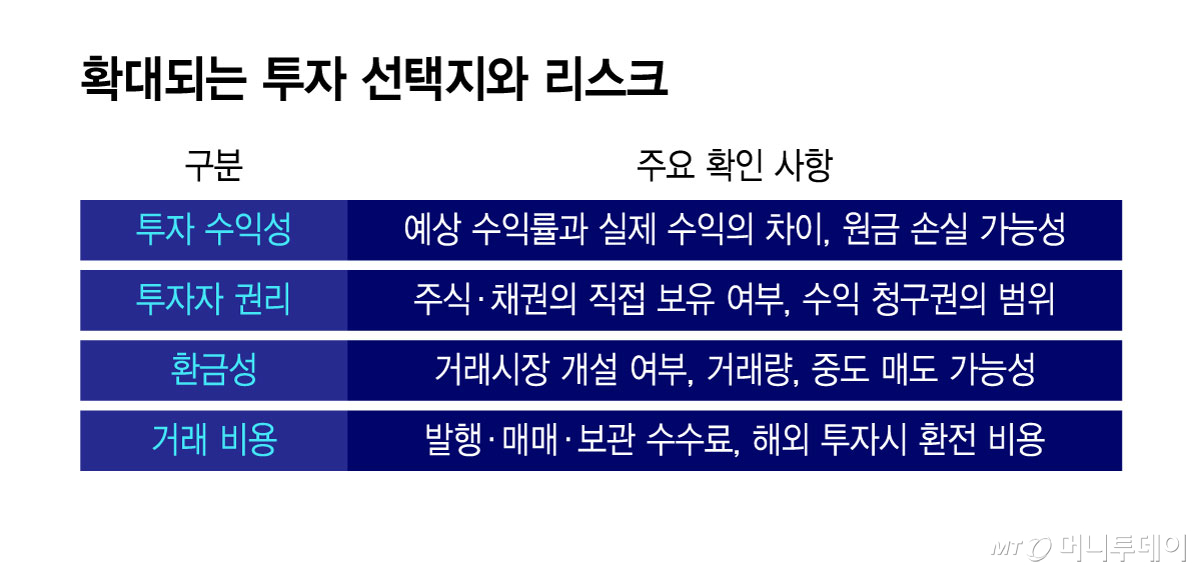
When investing in security tokens, consider profitability, rights, liquidity, and costs
As security tokens and blockchain-based payment infrastructure develop, not only investment targets but also trading methods may change. The transfer of rights for stocks and bonds, as well as the payment of dividends and interest, can be automated, and in the long term, the time required for settlement after a transaction can be reduced. However, increased trading convenience does not necessarily mean higher investment returns or lower investment risks.
What investors should examine first is the profitability of the underlying asset. The returns from U.S. Treasury funds come from the management performance of Treasuries and other assets, while distributions from Japanese real estate products come from rental income and other sources. In particular, for real estate products, the money paid to investors may include not only profits but also a portion of the principal, so actual investment gains must be distinguished. Calculating all received funds as investment gains can lead to an overestimation of the actual rate of return.
The legal rights acquired by investors are also important. Even for tokens based on the same stock, products that grant shareholders dividends and voting rights differ from those that only allow claims to returns linked to the stock price. It is also necessary to check how rights are protected in the event of the issuer’s bankruptcy.
Liquidity, which refers to the ability to recover investment funds, should also be considered. As the security token trading market grows, trading opportunities may increase, but if trading volume is low, it can be difficult to sell at desired prices. In Japan as well, not all security tokens are freely traded in dedicated trading markets.
Costs incurred during the transaction process should also be taken into account. While blockchain may reduce the costs of issuing, managing, and settling securities, it does not necessarily mean that fees paid by investors will decrease. Issuance and distribution fees, custody costs, and foreign exchange costs for overseas investments should be compared with existing financial products.

 in STOCK
