

It was tallied that approximately 550,000 cases of human skin tissue were distributed (sold) to hospitals and clinics domestically last year. This skin tissue is human tissue obtained from donated corpses. It is estimated that a significant portion of this tissue was manufactured as "human tissue ECM (extracellular matrix)-based skin boosters" and used in the domestic cosmetic medical market. While these ECM skin boosters are effectively used like medical devices such as "Botox," they are being used without government approval, prompting calls for a separate management system.
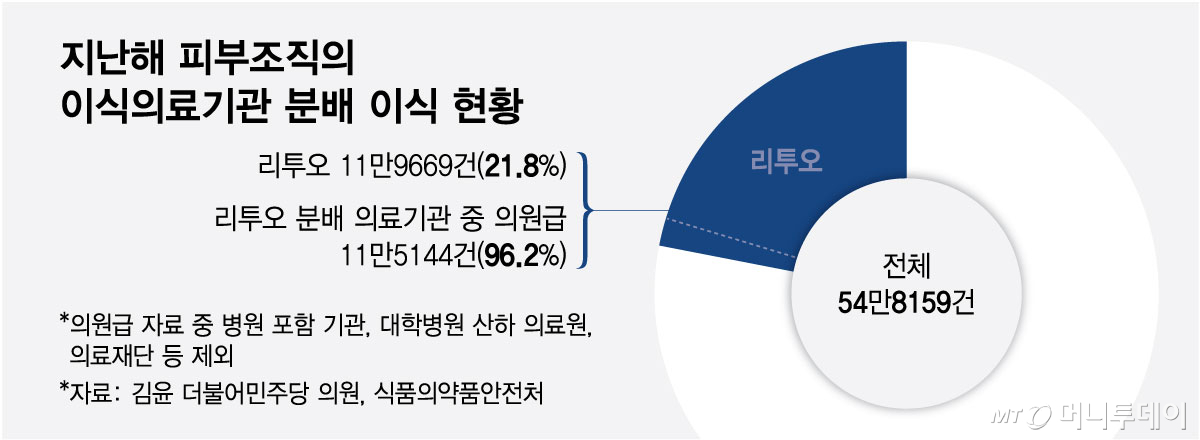
According to data on the "Status of Distribution of Processed Human Tissue Derived from Skin" provided by the Ministry of Food and Drug Safety to Kim Yun, a Democratic Party of Korea lawmaker on the National Assembly Health and Welfare Committee, 548,159 cases of skin tissue were distributed to hospitals and clinics last year.
Data for the previous year is unavailable because the relevant statistics were not properly aggregated, but skin tissue transplantation is estimated to be on an upward trend. According to the Ministry of Food and Drug Safety's "Number of Transplants by Human Tissue Type" statistics, a total of 215,146 human tissues were distributed in 2023, with only 22,950 (10.7%) being skin. However, approximately 548,159 cases of distribution, roughly 24 times that amount, occurred last year alone.
Skin tissue obtained from donated corpses appears to be largely utilized for the administration of ECM skin boosters for cosmetic purposes. An ECM skin booster is a cosmetic procedure in which dermal tissue harvested from a corpse is frozen or dried, powdered, diluted in saline solution, and then injected into the skin with a syringe. The cost per procedure is known to be around 600,000 won.
It is primarily sourced from human tissues of donors who consented to use for cosmetic procedures in the United States, and manufactured and distributed domestically. Because it is human tissue distributed under the "Human Tissue Safety Act," it is not classified or managed as a medical device like Botox or other skin boosters such as "Rejuran." However, it is classified as a medical device in countries such as China and Thailand.
In the case of "Lituo," an ECM skin booster by L&C Bio (distributor Humedics), which holds the top market share for ECM skin boosters, it accounted for 119,669 cases, or 21.8% of total skin tissue distribution.
The majority of Lituo, 96.2% (115,144 cases), was distributed to clinic-level medical institutions that primarily handle cosmetic procedures. Looking at the status of top institutions receiving Lituo, excluding Live Cell Instruments Co., Ltd. (2,202 units, tissue bank), they were mainly clinics related to skin and plastic surgery in areas such as Gangnam and Myeong-dong.
ECM skin boosters like Lituo are subject to the Human Tissue Safety Act. Article 1 of the Act states, "The purpose of this Act is to prescribe matters necessary for the donation, management, and transplantation of human tissue in order to maintain physical integrity and restore physiological functions." This mandates the use of human skin tissue for purposes other than cosmetics, such as for burn patients. Under the Act, tissue banks and transplanting medical institutions are required to record investigations from tissue distribution to transplantation, but the recipient's information is often left blank.
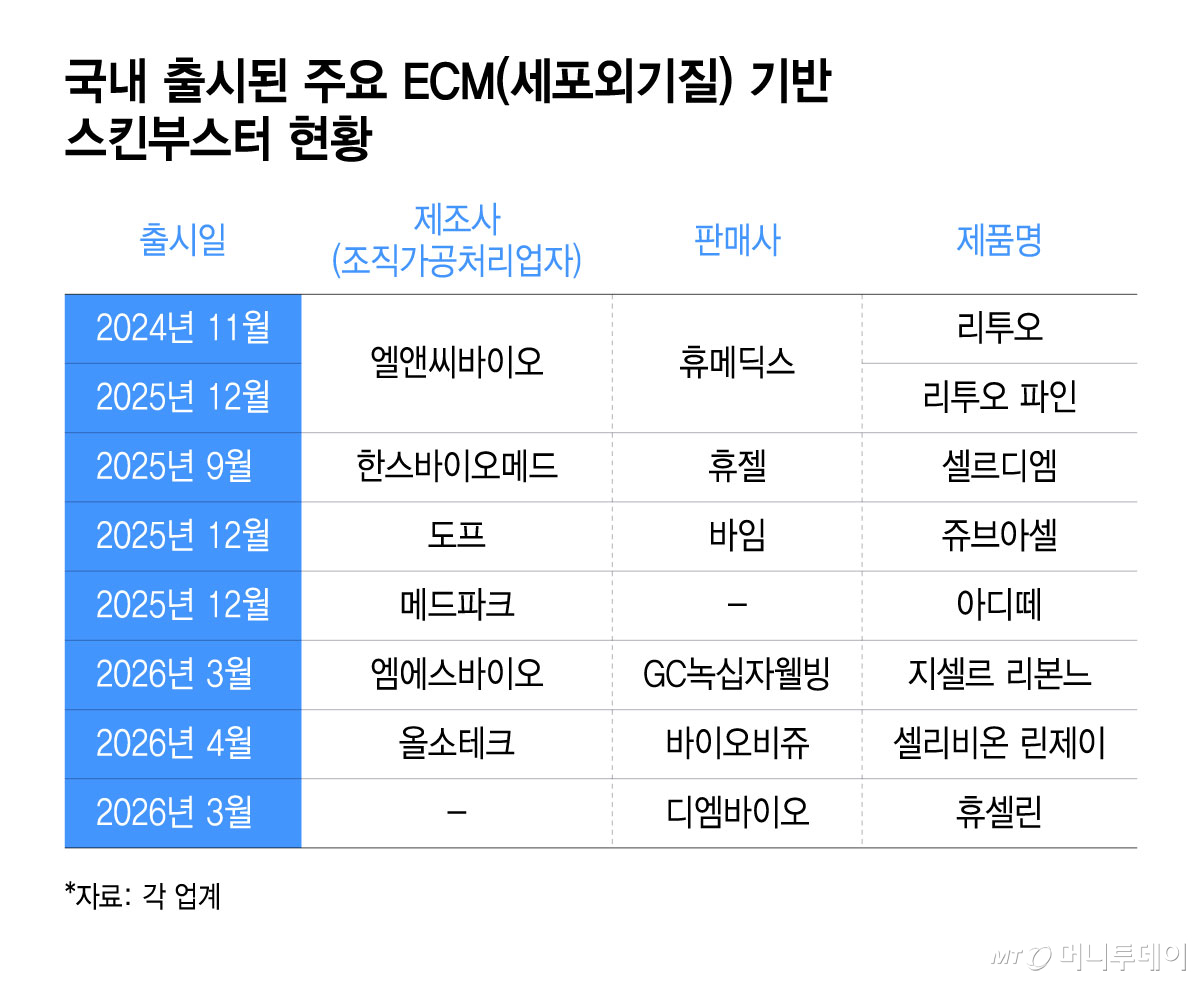
Furthermore, although ECM skin boosters are effectively utilized in medical settings like medical devices, they are classified as "tissue grafts" and do not require separate approval from the Ministry of Food and Drug Safety like medical devices. This is the background for the increase in related companies as the ECM skin booster market has recently expanded. In addition to L&C Bio, companies such as Hans Biomed (distributor Hugel), MS Bio (distributor GC Green Cross Wellbeing), and Doff (distributor Baim) have launched ECM skin boosters. Other companies are also waiting to enter the market.
Accordingly, there are calls that the government, including the Ministry of Food and Drug Safety and the Ministry of Health and Welfare, needs to establish a management system for ECM skin boosters in line with changes in the market environment. In July last year, the Ministry of Food and Drug Safety published a legislative notice for an amendment to the "Rules on Human Tissue Safety," adding requirements to include the purpose of transplantation and whether patients were informed about the fact of human tissue transplantation before the procedure in the transplant result record, but these are not mandatory items.
Kim Yun (Rep.) emphasized, "Donated human tissue is being processed into high-priced skin boosters and distributed on a large scale to the cosmetic medical market, yet management of this remains in a blind spot," adding, "The management system must be strengthened to verify the safety and efficacy of donated human tissue as a whole and manage side effects."
In response, an official from L&C Bio stated, "The raw materials used for Lituo are secured through U.S. tissue banks, and we selectively use only human tissues that include in their donation consent scope the possibility of being utilized for the development and manufacturing of products for cosmetic and reconstructive purposes." The official added, "We have established and are operating a management system covering the entire process from import to processing and distribution under the supervision of the Ministry of Food and Drug Safety." The official further stated, "We actively agree with policy directions aimed at enhancing the safety and transparency of human tissue," adding, "We will actively cooperate with government policies and flexibly respond to changes in related systems to enhance the trust of medical professionals and patients in the human tissue industry."
An official from GC Green Cross Wellbeing stated, "While we use raw materials that are legally managed in accordance with relevant laws and standards," adding, "Given the recent expansion of the market for injectable skin ECM products, I believe discussions on reasonable institutional supplements to enhance consumer safety and the right to know are necessary." The official further added, "We plan to actively cooperate with the direction of institutional improvements by authorities in the future and operate our business with safety and quality as top priorities."

 in THEBIO

