


# Office worker Hwang Eun-seok (pseudonym, in his 40s) has developed a habit of binge drinking every day off. Especially during long holidays lasting two days or more, such as traditional festivals, gatherings with family and friends are frequent, and out of excitement, he often drinks twice his usual limit. However, recently, he has felt worried due to abnormal symptoms such as an unusually pounding chest or a feeling of stuffiness immediately after binge drinking. Hwang said, "On holidays, I tend to drink more because I don't have to consider the next day's schedule," adding, "I will try to be careful during this Chuseok (Korean Thanksgiving) holiday, but I am worried that I may easily lose self-control once I start drinking."
The state of feeling particularly physically exhausted on the day one returns to work after a long holiday is commonly referred to as "Monday blues." However, if abnormal heart symptoms appear after a long holiday, they should not be taken lightly. This could be a sign that the risk of arrhythmia has increased due to a sudden surge in alcohol intake.
In fact, there is a concept in the medical field known as "Holiday Heart Syndrome." This is a clinical syndrome in which a healthy person without heart disease develops arrhythmia after consuming more alcohol than usual during a short holiday. It was first reported in a U.S. cardiology journal in 1978.
Binge drinking is considered the most powerful risk factor for inducing acute arrhythmia. A study conducted by researchers at the University of Munich in Germany, which measured smartphone electrocardiograms and alcohol consumption among 3,022 participants at the beer festival Oktoberfest, found that 30.5% of the participants developed cardiac arrhythmias such as atrial fibrillation. According to a paper published in the international academic journal Cureus, research results reported that the risk of developing arrhythmia increases by up to two times when consuming six or more drinks per day.
South Korea also has a relatively high rate of binge drinking. Based on an analysis of alcohol-related health behaviors using data from the 2025 Community Health Survey, KDCA found that six out of 10 adults (57.1%) drink at least once a month, three engage in binge drinking (33.7%), and one engages in high-risk drinking (12.0%). In particular, 59% of those who drink monthly engage in binge drinking, and among them, 35.6% qualified as high-risk drinkers by binge drinking at a frequent frequency (two or more times per week).
Symptoms that may suggest cardiovascular diseases such as arrhythmia include: △a feeling of the heart pounding and an irregular pulse; △a chest pressure sensation at the center of the chest, as if it is tightly blocked, squeezed, or pressed down; △pain starting in the chest and radiating to the left arm and jaw/teeth; and △difficulty breathing, cold sweats, dizziness, and a feeling of fainting due to loss of strength.
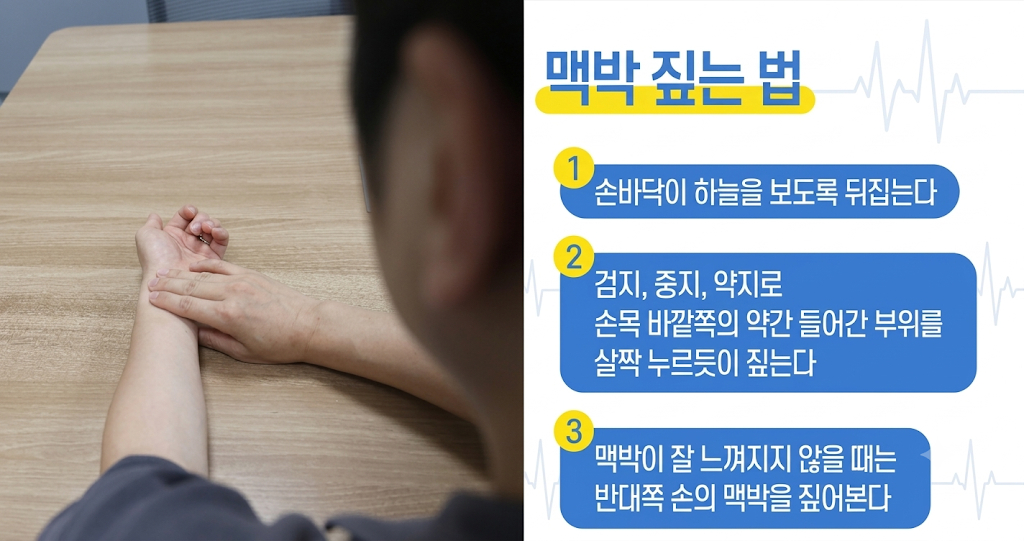
When arrhythmia is suspected, there is a self-check method that can be confirmed in 10 seconds. First, turn your palm upward so it faces the sky, then slightly bend your wrist downward. Next, place the index, middle, and ring fingers of the opposite hand on the slightly recessed area on the outer side of the wrist and press gently to take the pulse. Focus and count the pulse for 10 seconds, then multiply by 6 to calculate the beats per minute.
If the intervals between pulses are irregular, or if the beats per minute are too fast or slow, exceeding the normal range (60 to 100 beats) even in a resting state, arrhythmia should be suspected. Kim Ju-won, a professor of cardiology at Samsung Seoul Hospital, said, "It is also a good method to check using the electrocardiogram recording function built into smartwatches."
Park Kyung-min, a professor of cardiology at Samsung Seoul Hospital, warned, "A pounding heart may be a simple symptom, but if one has been binge drinking, it should not be taken lightly," adding, "If symptoms persist for more than 10 minutes, one must receive accurate diagnosis and treatment at a medical institution."
Meanwhile, in the event of an emergency situation such as acute arrhythmia symptoms during a holiday, one can check nearby open hospitals, clinics, and emergency rooms through the Ministry of Health and Welfare's Emergency Medical Portal "E-Gen" or the mobile application (app) "Emergency Medical Information Provision." If using the internet is difficult, one can call 119 (Emergency Situation Management Center) or 129 (Health and Welfare Call Center) for guidance.

 in THEBIO

