

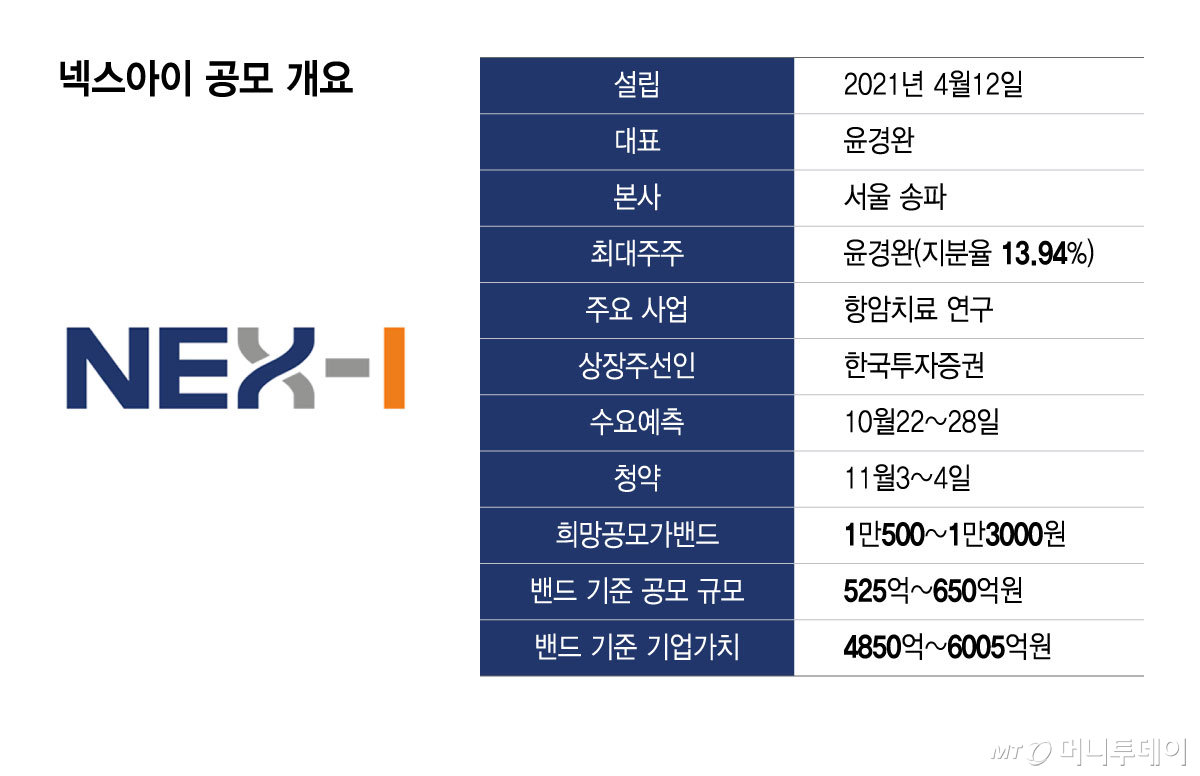
As Nexi aims for a listing on the KOSDAQ market, it has set a corporate valuation of up to over 600 billion won. Attention is turning to how the market will evaluate this major biotech IPO candidate, which is developing immunotherapy drugs.
Nexi announced on the 4th that it will conduct demand forecasting for institutional investors from the 22nd to the 28th of this month, followed by a general investor subscription period from the 3rd to the 4th of next month. The company is currently proceeding with the KOSDAQ technology special listing process.
Nexi is a new drug research company established in April 2021. Beyond simply enhancing anti-tumor immune activity, it developed platform technology (NEXORA) that identifies causal factors associated with immunotherapy resistance and derives antibody-based new drug candidates capable of effectively controlling them. Based on this platform, the company has discovered multiple immunotherapy pipelines.
The representative pipeline is the immunotherapy pipeline ‘NXI-101.’ In March 2024, it was licensed out to Japan’s Ono Pharmaceutical in the preclinical stage. Ono Pharmaceutical is a major player in immunotherapy, having developed Yervoy (ipilimumab) and Opdivo (nivolumab). Ono Pharmaceutical is currently conducting Phase 1 clinical trials for NXI-101. Specific contract terms have not been disclosed.
The follow-up pipeline ‘NXI-201’ received Orphan Drug Designation (ODD) from the U.S. FDA (Food and Drug Administration) in March of last year for the indication of hepatocellular carcinoma. Subsequently, it received approval for a Phase 1/2 clinical trial plan (IND) from the Ministry of Food and Drug Safety in December of last year. Additionally, it received approval for a clinical trial plan from the U.S. FDA in August of this year.
In addition to these, Nexi is researching bispecific antibody pipeline ‘NXI-M501’ and ADC (antibody-drug conjugate) pipelines ‘NXI-S301’ and ‘NXI-S160.’ All are in the preclinical stage.
Nexi’s desired offer price band is 10,500 to 13,000 won. Based on this band, the offering size is 52.5 billion to 65 billion won, and the corporate valuation (including stock options) is 485 billion to 600.5 billion won. It can be considered a major IPO among new drug development biotech companies.
Nexi calculated its corporate valuation at 820.3 billion won by applying a PER (price-to-earnings ratio) of 19.15x based on estimated future performance for 2030. It then set the desired offer price band after reflecting a discount rate.
However, considering the relatively sluggish investment demand for biotech in the domestic stock market this year, some analysts question whether the valuation is somewhat aggressive. The absence of pipelines at Phase 2 or later stages could also act as a variable affecting investor sentiment during the IPO process.
Nexi projected that it will turn profitable in 2028 and achieve revenue of 132.1 billion won and operating profit of 95.1 billion won by 2030. It expects to generate revenue of 9.4 billion won in 2028 and 18.8 billion won in 2030 from the licensing out of NXI-101. Additionally, it forecasts that licensing out NXI-201 in 2028 will generate revenue of 45 billion won.
In addition, it estimated that multiple pipelines, including neutralizing antibody pipeline ‘NXI-401’ and NXI-M501, NXI-S301, could enter licensing agreements between 2027 and 2030. Of course, future estimated performance for new drug development biotech companies may differ significantly from reality depending on the success of licensing deals and clinical outcomes of new drug pipelines.
A Nexi official stated, “The corporate valuation was determined by comprehensively considering Nexi’s technological capabilities, the development status and value of its pipelines, and future commercialization potential.” The official added, “While we do not currently have pipelines at Phase 2 or later stages, Nexi is discovering new ‘targets’ involved in the causes of immunotherapy resistance and continuously expanding into follow-up pipelines.”
The official further stated, “Nexi’s new drug candidates are based on novel targets related to resistance that differ from existing immunotherapies. We have confirmed increased anti-tumor efficacy not only as monotherapy but also in combination with various immunotherapies and chemotherapies.” The official added, “We have improved the development efficiency of each pipeline through a biomarker-based patient selection strategy, and we possess licensing experience, giving us competitiveness.”

 in THEBIO
