

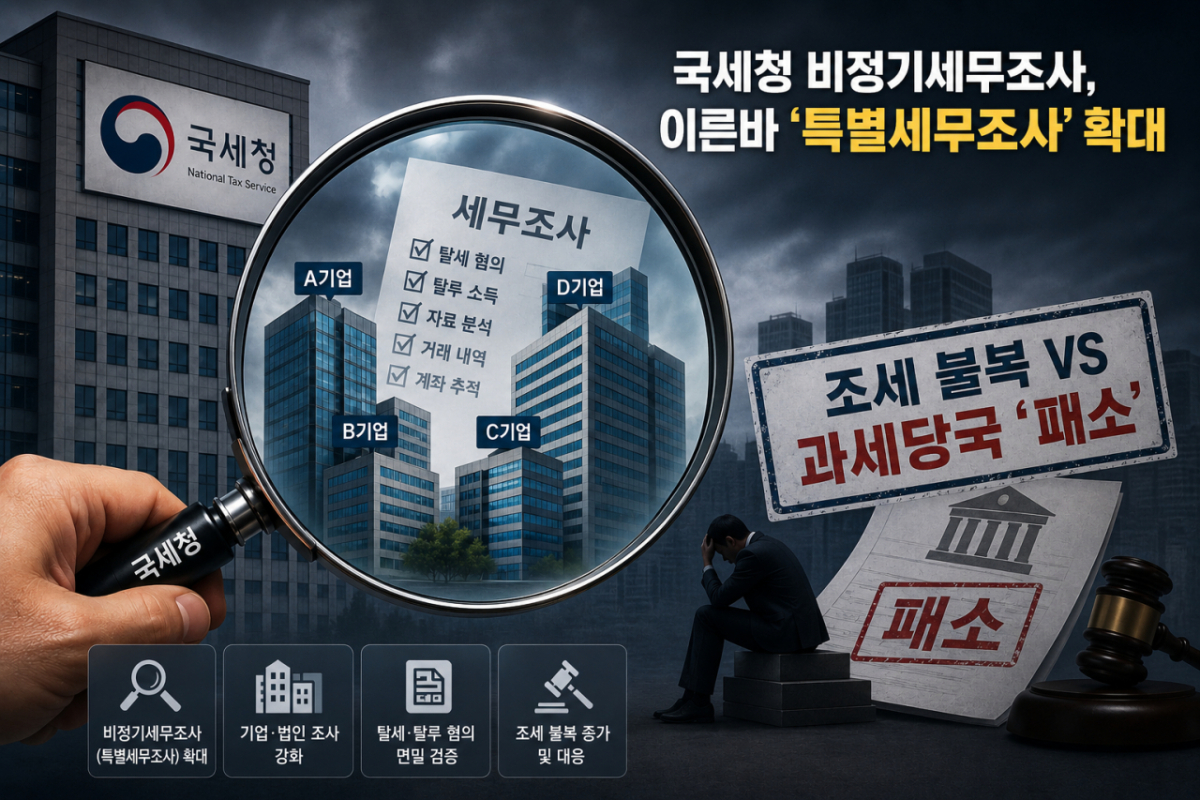
It has been confirmed that the number of irregular tax audits (special investigations) conducted by the National Tax Service increased over the past three years from 2023 to 2025. Press releases related to tax audits also rose nearly fourfold year-on-year in the first half of this year alone.
While there are positive perspectives that these audits meticulously investigate allegations of corporate tax evasion and other illegal activities, there is also significant backlash against the mass audits driven by a "strike first" mentality. This explains why tax dispute lawsuits continue to pile up. Moreover, as courts increasingly rule in favor of companies in these disputes, the reputation of the tax authorities has been tarnished.
According to the National Tax Service, irregular tax audits increased from 2,928 cases in 2023 to 3,095 in 2024 and further rose to 3,323 in 2025.
Notably, public announcements related to tax audits by the National Tax Service in the first half of this year surged nearly fourfold compared to the same period last year. This shift occurred after Lee Jae-myung assumed office and the administration led by National Tax Service Commissioner Im Kwang-hyun began. Data on regular and irregular tax audit cases for the first half of this year have not yet been released.
However, even looking solely at press releases related to tax audits published on the National Tax Service website reveals a clear difference from the same period last year.
In the first half of 2025, there were only three announcements regarding tax audits and related press releases. Typically, audit bureaus would conduct thorough investigations and hold quarterly briefings to disclose results based on specific issues.
This trend was already anticipated following the appointment of Im Kwang-hyun Hyeon (Commissioner), known as a "tax audit veteran" who served six times as head of Audit Bureau 4—the bureau nicknamed the "grim reaper of business circles"—in July last year.
Reflecting this, from July to the end of last year, tax audit briefings and press releases totaled six cases, doubling compared to the first half of the previous year. The expansion of tax audits began immediately upon his appointment. This year alone, 12 announcements related to tax audits were made by early September.
The National Tax Service has consistently used public disclosures as a message to issue warning pressure regarding allegations of tax evasion and other violations. In this context, the increase in public "warnings" (announcements) related to tax audits signals an escalation in efforts to crack down on illegal enterprises. Strict investigations into unlawful activities are indeed welcome.
The problem lies in the rushed nature of these tax audit announcements. When Cheong Wa Dae issues messages on specific issues, the National Tax Service immediately follows up with announcements on the initiation and results of tax audits. While aligning policy responses with government messaging may seem reasonable at first glance, criticism arises that such frequent immediate reactions overly prioritize the government's direction.
The same applies to the public bid corruption briefing released by the National Tax Service on the 3rd. Ten days after President Lee Jae-myung held his first Anti-Corruption Policy Council meeting (on the 21st of last month) and directed comprehensive action against various forms of corruption, including public contract fraud and improper subsidy receipt, the National Tax Service hastily inserted a briefing on public bid corruption into its weekly plan. This appears to be another instance of the National Tax Service responding immediately after receiving a message from Cheong Wa Dae.
A National Tax Service official explained, "The investigation was already ongoing continuously, just like previous cases," and added, "It was simply omitted from the weekly plan due to an administrative error; we did not hastily include it in the briefing."
Since Lee Jae-myung assumed office, the National Tax Service has consistently responded immediately after Cheong Wa Dae issues messages.
From the second half of last year onward, numerous cases followed this pattern: tax audits on unfair tax evaders in the stock market (July), foreign tax evaders acquiring high-priced apartments in Gangnam's three districts (August), tax evasion in industries closely tied to daily living costs under the pretext of rising raw material prices (September), tax audits on ultra-luxury homes along the Han River Belt (October), ticket scalpers (November), and market-disturbing price-fixing activities (December). In each instance, the National Tax Service issued announcements immediately after Cheong Wa Dae released a message.
This year also saw immediate announcements following Cheong Wa Dae messages throughout the first half, from verifying inheritance practices in large bakeries in January to the August announcement on investigations into "emperor residences."
This marks a stark departure from the National Tax Service's past approach of quietly operating within annual plans. The criticism that aligning too closely with the government outweighs the positive perception of rigorous tax audits is gaining traction.
In this context, lawsuits challenging tax assessments and losses by tax authorities have continued to mount.
For example, a court recently ruled that approximately 12.9 billion won in taxes imposed on SM Entertainment by tax authorities must be canceled. The National Tax Service lost the corporate tax lawsuit, which was based on its argument that payments made by SM Entertainment to former chief producer Lee Soo-man were excessively large.
Similarly, Netflix Korea secured a court ruling canceling 68.7 billion won out of the 76.2 billion won in taxes imposed, though this was only a first-instance verdict and not final. Google Korea also won a second-instance administrative lawsuit filed in May challenging a corporate tax bill exceeding 150 billion won. Additionally, the National Tax Service lost a corporate tax lawsuit involving over 310 billion won filed by Oracle Korea against it, further damaging its reputation.
An industry official noted, "While we support the National Tax Service's strict tax audits on various issues concerning companies and individuals, rushed investigations and announcements can become a burden for the agency itself. If conducted excessively, loopholes may be exposed, ultimately leading to appeals and painful defeats—a boomerang effect."
Meanwhile, another National Tax Service official stated, "As an institutional investor responsible for enforcing tax laws, we conduct tax audits consistently and in accordance with legal principles at all times. However, to deter tax evasion psychology by clearly conveying a strong message against loopholes and tax evasion, we periodically inform the public about tax audit-related matters."

 in ECONOMY
