

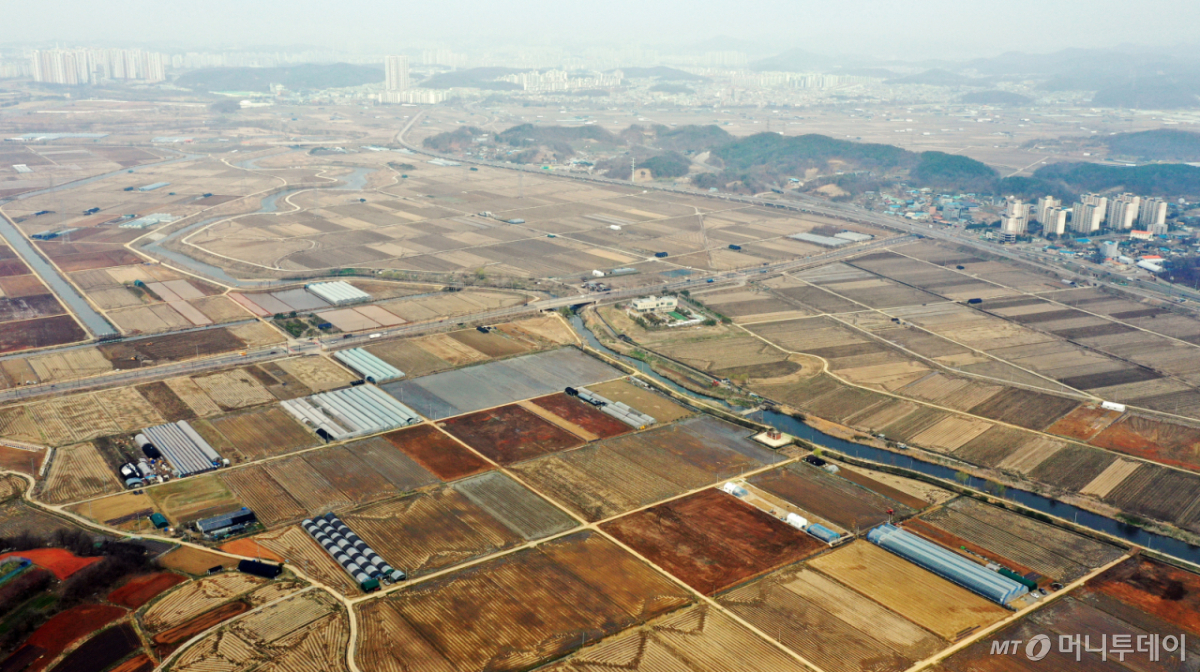
As anxiety spread over the unprecedented farmland survey, the government and ruling party unveiled follow-up measures. The core of these measures is to clearly state that the focus of the survey is on curbing speculation. Speculative acquisition of farmland will be dealt with according to law, while inheritance-related farmland, farmland owned by elderly farmers, and customary lease agreements will be brought into the institutional framework.
A special measures law will also be enacted this year to prevent even non-speculative violations from being punished. This is because the current Farmland Act lacks provisions to delay or rectify penalties after the fact. Budgets for farmland bank purchases and farmland pension programs will also be increased during deliberation by the National Assembly.
The Ministry of Agriculture, Food and Rural Affairs discussed the progress of the farmland survey and future action plans at a government-party coordination meeting on the morning of the 21st, announcing these follow-up measures.
In accordance with the constitutional principle of "cultivators shall own land," the government is conducting its first nationwide farmland survey since the establishment of the government to grasp the actual status of farmland ownership and usage. The basic survey will be completed by July this year, and in-depth surveys focusing on field verification will begin in August.
The Core Issue: Whether It Is Speculation… Not Judged Solely Based on Uncultivated Status
The central issue of the current survey and follow-up measures is whether it involves speculation. President Lee Jae-myung emphasized at a press conference on the 18th that the survey aims to "clearly identify real estate speculation" amid growing backlash over the farmland survey.
However, anxiety spread in the field that customary lease agreements and uncultivated farmland could also become targets for disposal. Concerns were further heightened by recent amendments to the Farmland Act, which changed penalties for violations from discretionary measures by local governments to mandatory requirements.
This is because in rural areas, there are many cases where the farmland owner and the actual cultivator are different. Representative examples include parents continuing to farm after gifting farmland to children who have moved to cities, or elderly farmers unable to cultivate directly due to age.
The government made it clear in these measures that disposal targets will not be determined solely based on whether the land is actually cultivated. Instead, factors such as whether there was an intention to farm at the time of acquisition, whether false or improper actions occurred during the qualification certification process for farmland acquisition, and how the farmland has been utilized since acquisition will be comprehensively considered.
Yoon Won-seop, Agriculture Policy Officer at the Ministry of Agriculture, Food and Rural Affairs, explained in a follow-up briefing on the 18th that "administrative penalties will be imposed after comprehensively reviewing various circumstances, followed by a hearing process conducted by each local government." He added, "If it is determined during the hearing that the party has sufficiently justified their position, the penalty may be revoked."
The typical types of farmland speculation identified by the government are: (1) acquiring farmland by submitting false farming plans in land transaction permission zones and then leaving it fallow without authorization or illegally leasing it; (2) agricultural corporations acquiring farmland and engaging in real estate business; and (3) acquiring only shared ownership shares of farmland through auctions and then leaving it fallow without authorization or illegally leasing it.
In contrast, customary lease agreements practiced in rural areas will not be immediately subject to disposal. Affected parties will first be given a voluntary correction period during which they can either cultivate the land directly or convert the arrangement into a legal lease. If correction proves difficult, the lease relationship will be normalized through the farmland bank, and the obligation for disposal will be suspended.
Cases include farmers exchanging farmland for convenience to cultivate it among themselves, parents gifting farmland to children while continuing to farm, or one person consolidating farmland from multiple farms for cultivation. If the owner entrusts the farmland to the farmland bank, priority leasing will be granted to the current actual cultivator to ensure continued farming.
Farmland related to inheritance and out-migration will also be rectified through the farmland bank. For farmland owned by heirs or those who have left rural areas, portions exceeding 1 hectare may be entrusted for lease to the farmland bank. In cases where ownership is unclear due to unregistered inheritance, designated representatives such as property tax payers will entrust the land on behalf of the owner, allowing actual cultivators to lease it.
The special correction period for lease agreements will be extended until November 15 this year. If farmland is entrusted to the farmland bank during this period to normalize customary lease arrangements, such cases will be excluded from supplementary surveys.
No Legal Basis for Suspension of Penalties Under Current Law… Special Law to Be Enacted This Year
The problem lies in the fact that even when attempting to normalize violations not motivated by speculation, the current Farmland Act has limitations. There is no legal basis under existing law to mitigate or suspend penalties for violations identified during the survey.
The government aims to prepare a special measures law within this year and complete its approval by the National Assembly. The special law will be implemented in the first quarter of next year, with detailed measures introduced according to violation types.
Concurrently, amendments to the Farmland Act will be pursued to address the gap between rural realities revealed during the survey and the current farmland system. Regulations that do not align with rural conditions such as inheritance and aging, and customary lease agreements, will be revised, with a proposed amendment bill scheduled for introduction in the second quarter of next year.
Regarding illegally converted farmland, normalization efforts will be launched for the first time in 38 years since 1988. For facilities that could have been installed through normal conversion procedures if not for serious violations such as damage to agricultural promotion zones, post-facto applications will be accepted. If requirements are met, a farmland conservation burden fee will be imposed before ratification.
Budgets related to the expanded role of the farmland bank will also be increased. During National Assembly budget deliberations, plans to additionally increase budgets for farmland purchases, restoration of idle farmland, and farmland pension programs are being reviewed.
The government plans to build a database (DB) using farmland information secured during this survey for future utilization in farmland policy formulation.
Minister Song Mi-ryeong of the Ministry of Agriculture, Food and Rural Affairs stated, "We have heard many opinions from farmers on the ground and listened to voices hoping that the farmland survey would yield positive and constructive results, leading us to prepare post-survey measures." She added, "Measures will be taken to ensure no disadvantages or inconveniences for well-intentioned farmers and citizens."

 in ECONOMY
