

An analysis by the Bank of Korea indicated that large-scale performance bonuses and dividend payments resulting from the semiconductor boom will support consumer recovery next year. Expanded government household support and a decline in exchange rates are also expected to boost the spending power of middle- and low-income households. However, household debt, sluggish construction activity, and stock market corrections were cited as factors that could constrain recovery.
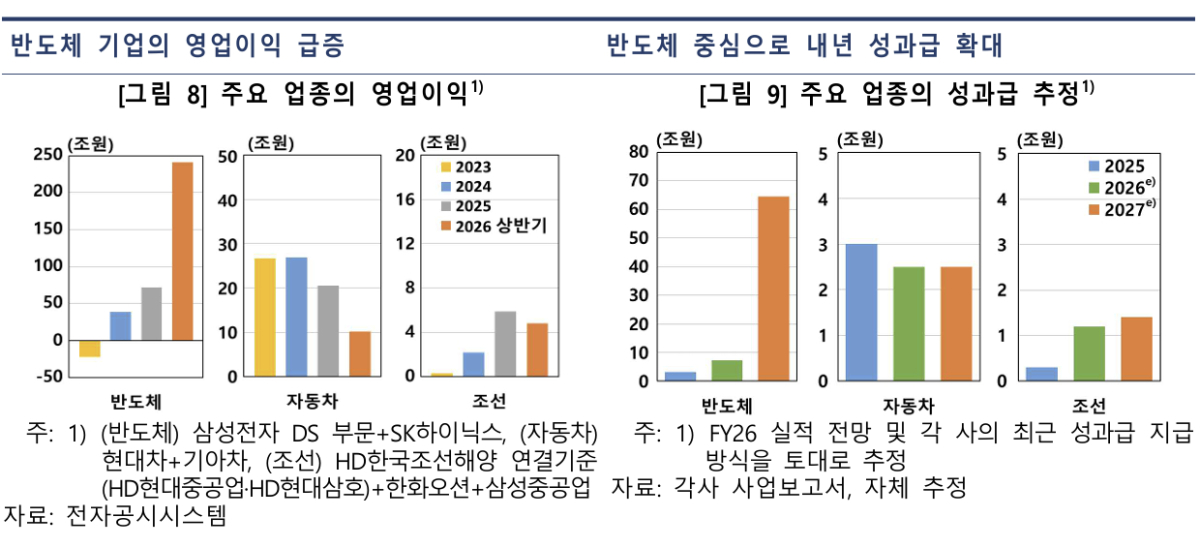
According to a report titled "Review of Conditions for Future Private Consumption Recovery" released by the Bank of Korea on the 22nd, performance bonuses for major companies in the semiconductor, automotive, and shipbuilding industries are estimated to reach 60 trillion to 70 trillion won before tax next year, approximately six times this year's amount (1.09 trillion won). Among these, Samsung Electronics and SK Hynix are expected to pay performance bonuses totaling 60 trillion won in the first quarter of next year.
The Bank of Korea analyzed that the expansion of performance bonuses will raise the annual private consumption growth rate next year by 0.1 to 0.15 percentage points. This estimate is based on the premise that a 1 million won increase in temporary income leads to an approximate 110,000 won increase in consumption. The bank noted that because payments are concentrated at the beginning of the year, the stimulus effect on consumption will fully materialize in the first half of next year, and it is expected to help consumption in sectors with slower recovery, such as household goods and appliances, food and accommodation, and entertainment and culture.
A Bank of Korea official stated, "Because the scale of this performance bonus is quite unusual, it is difficult to estimate how much will be spent using past data," while adding, "If performance bonuses are paid repeatedly, the consumption effect may appear larger compared to simple temporary income."
The possibility that part of the performance bonuses will flow into real estate was also raised. A Bank of Korea official said, "We do not have data analyzing whether the portion left after consumption goes to financial assets or real estate, but I think a certain amount could go to real estate."
Expanded dividends from semiconductor companies are also expected to support consumption. The Bank of Korea predicted that Samsung Electronics will implement additional dividends of 40 trillion to 60 trillion won after the first quarter of next year, following a special dividend of approximately 30 trillion won in November this year. It was noted that the market forecasts SK Hynix's dividends for next year at 10 trillion to 30 trillion won. The effect of expanded dividend income on raising the private consumption growth rate next year was estimated at approximately 0.05 percentage points.
Since the direct benefits of performance bonuses and dividends are concentrated among high-income earners, it is expected to take time for these effects to spread across all households. A Bank of Korea official explained, "Revenue will first be generated where goods or services are sold, and the impact on consumption will spread through production-induced effects," adding that improvements in wages and household income in semiconductor-related industries can also be expected.
The spending power of middle- and low-income households is expected to improve through government support and a decline in exchange rates. Based on next year's government budget, the Bank of Korea estimated that household transfer payments will increase by around 20 trillion won compared to this year, raising the private consumption growth rate next year by 0.2 to 0.25 percentage points. This result reflects expanded support for pension and retirement beneficiaries, households with children or those giving birth and raising children, and basic livelihood security recipients.
It was analyzed that a 10% decline in the won/dollar exchange rate would improve household real purchasing power by approximately 0.35% through lower import prices. The improvement in purchasing power relative to disposable income exceeded twice as much for the bottom 20% of income earners (the first quintile) at 0.46%, compared to the top 20% (the fifth quintile) at 0.20%.
High household debt and sluggish housing construction are obstacles to consumption recovery. The ratio of household debt to disposable income for indebted households last year was 196.1%, up from 189.0% the previous year. The Bank of Korea viewed that sluggish housing construction is shrinking employment and income in the household goods and appliances demand sector and related industries, and that additional stock market corrections could also constrain consumption.

 in ECONOMY
