

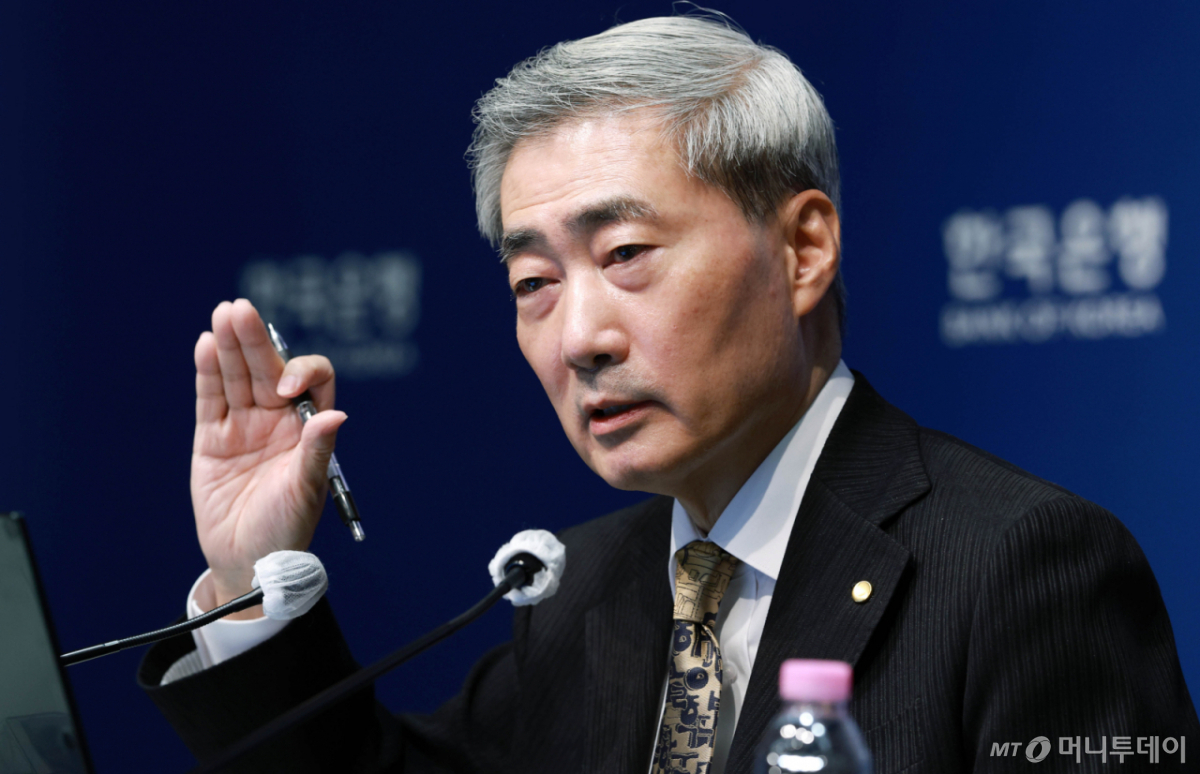
Although the Bank of Korea held its base rate at 3% per annum, it maintained a tightening stance. With both growth and inflation outlooks revised upward, BOK Governor Shin Hyun-song emphasized that monetary tightening is necessary until inflation converges stably to the target level of 2%. Market participants are placing significant weight on the possibility of resuming rate hikes in November.
At the press conference on the direction of monetary policy held at the bank in Jung-gu, Seoul, Thursday, Governor Shin described this hold as “the fruit of meticulous groundwork.” This means that by taking preemptive action through two consecutive rate hikes in July and August, financial markets have stabilized, buying time to assess additional indicators.
He explained, “By raising rates twice consecutively in July and August, we secured policy room at that time.” He stated that it is not too late to decide on further hikes after reviewing the third-quarter gross domestic product (GDP) to be released on the 27th and October consumer price data to be disclosed early next month.
Despite this hold, the Bank of Korea’s assessment of the economy and inflation has actually become firmer. Economic growth rates for this year and next are expected to significantly exceed previous forecasts of 3.3% and 2.9%, respectively.
Next year’s consumer price and core inflation rates are also projected to surpass previous forecasts of 2.3% and 2.5%. The bank judged that demand-side inflationary pressures are intensifying as improved income conditions translate into consumption recovery, amid continued strong semiconductor exports and investment.
Shin said, “Because the growth momentum and inflation trend are actually stronger than in August, I believe it is necessary to continue the current policy stance.” He also emphasized the need to maintain a tightening stance until there is confidence that inflation will converge stably to the target level.
Financial imbalances remain a basis for additional rate hikes. In its monetary policy decision statement released on the day, the BOK noted that “the upward trend in housing prices in the metropolitan area has expanded again” and stated that “from a financial stability perspective, continued attention is needed to financial imbalance risks related to the metropolitan housing market and household debt.”
The key variable determining future rate hike paths will be inflation trends. Shin predicted that core inflation will remain above the 2nd% target next year but is expected to approach the target level around 2028. He explained that policy will be managed to ensure inflation converges stably to the target level over the medium term.
The possibility of a rising neutral rate is also a variable. Citing increased long-term funding demand due to expanded AI investment and potential productivity gains, Governor Shin said, “If the growth rate rises, the equilibrium rate will follow suit.” However, regarding whether this will actually occur, he refrained from judgment, stating, “We cannot yet provide a definitive answer.”
If the neutral rate rises, the tightening effect at the same base rate could weaken. Kim Jin-wook, an economist at Citibank Korea, suggested the possibility that the nominal neutral rate could rise from approximately 2.5% to 2.7–3.0%.
He analyzed that if core inflation remains above the mid-2% range after the second quarter of next year, there is a risk that the final policy rate will exceed 3.50%.
In the bond market, the prevailing view is that additional hikes of 0.25 percentage points each in November and early next year will bring the final rate to 3.50%. However, Shin said that while he refers to the final rate expected by the market, there is no need to follow it strictly, drawing a clear line regarding specific terminal levels.

 in ECONOMY
