

The streets of France are boiling with anger. Protests that began with unrest among high school students protesting the poor educational environment have spread into a massive blaze as young people and low-income residents facing financial hardship joined in. The weight of this movement is distinct, as the next generation has begun to directly crack a stagnant structure.
In contrast, the resistance of Korean youth follows a different trajectory. Instead of heading to the plaza, they give up on job hunting and quietly withdraw from the labor market. They even postpone or abandon marriage and childbirth, which are tasks of the life cycle. This is the image of young people who repeatedly experience negativity, anger, compromise, and depression, yet ultimately end up in resignation.
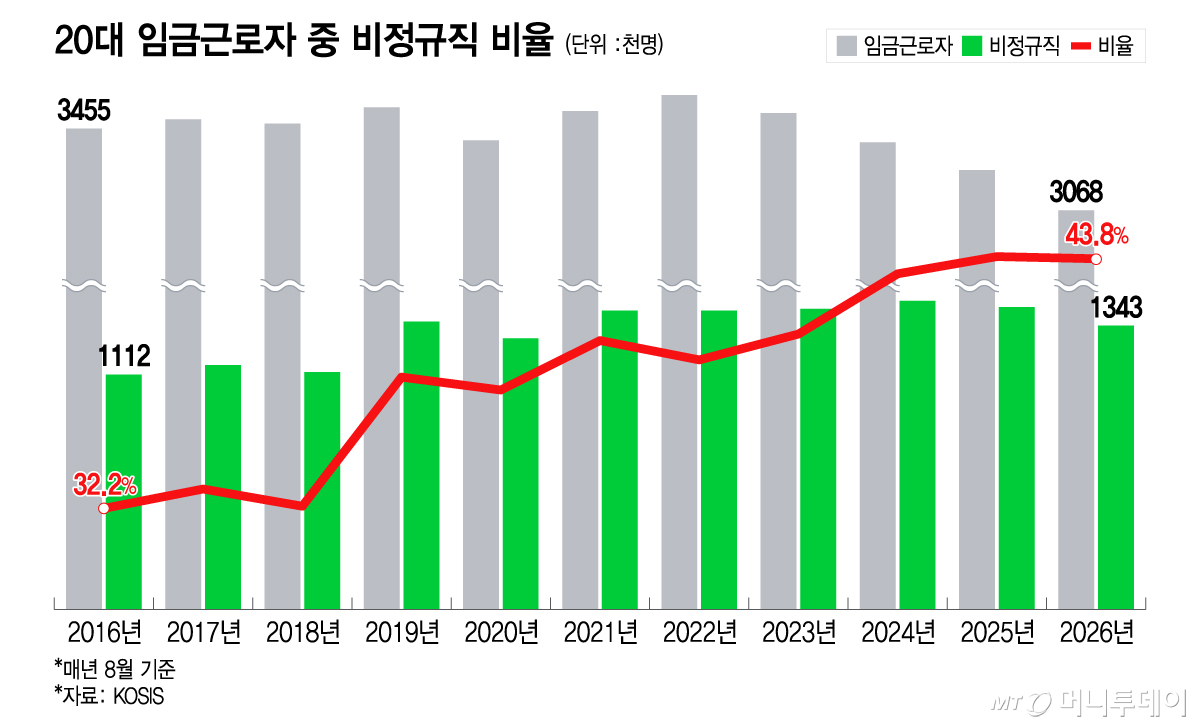
According to the National Statistics Portal (KOSIS) on the 24th, there were 1.343 million non-regular workers in their 20s as of August this year. More than four out of every 10 (43.8%) of the total 3.068 million wage earners in their 20s are non-regular workers. This figure exceeds the proportion of non-regular workers across all age groups (38.5%).
Five years ago, in 2021, the non-regular worker ratio across all age groups was 38.4%, showing little difference from now. However, during the same period, the non-regular worker ratio for those in their 20s rose relatively significantly from 40.0% to 43.8. Compared with 10 years ago, while the number of wage earners in their 20s decreased by 387,000, the number of non-regular workers increased by 231,000.
The issue of non-regular work among those in their 20s is not a temporary phenomenon. As companies abolished regular recruitment and maintained a preference for experienced hires, the youth demographic was exposed to a job drought. It is a vicious cycle where they cannot enter without experience, and cannot gain experience because they cannot enter.
The barrier to housing is high as well as employment. The dream of owning one's own home is, literally, in the realm of dreams. Many young people struggle just to pay their monthly rent. Based on 2023 data, 31.6% of young households have a ratio of monthly rent to monthly income exceeding 30%. This is more than double the overall average (15.8%).
Young people who were angry at the bleak reality lower their expectations and seek alternatives such as investing in virtual assets, attempting private compromises, but they become frustrated with the unsatisfactory reality. Frustration leads to depression again, and depression connects to exclusion from the labor market, such as becoming part of the "inactive" population.
Kwak Geum-ju, a professor at Seoul National University, said, "The way Korean youth express frustration tends to be internalized through depression and lethargy rather than expressing dissatisfaction and anger externally through violence or protests," adding, "The state of Korean youth is one of being angry, but in the form of depression and resignation."

 in ECONOMY
