


Behind the large-scale protests unfolding in France lie the grievances and anger of young people. The situation for Korean youth is not significantly different. Only the methods of resistance differ. Instead of taking to the streets, an increasing number of young people are delaying or giving up on marriage and childbirth, and stepping back from the competition for employment and asset formation.
What frustrates young people is not simply the reality of narrow job opportunities and high housing price barriers. It is also that the belief that studying hard and working diligently will lead to a better life is being shaken. When the perception accumulates that effort does not yield rewards, frustration turns into anger. While some place their hopes on a "big break," if even that proves difficult to achieve, feelings of helplessness can deepen further.
This process can be examined by analogy with Elisabeth Kübler-Ross's five-stage model: "denial, anger, bargaining, depression, and acceptance." Although this model does not precisely match the lives of young people, it offers a metaphorical look at how young people who believed in and followed traditional success paths are hitting barriers of reality.
◇ Denial: "If I live honestly, it will be fine"… The first illusion before the broken ladder
When entering society, young people face barriers such as asset gaps and a shortage of jobs. However, it is difficult to acknowledge this bleak reality. They maintain the belief that by attending a good university and working diligently, they will eventually be able to secure their own home. This is a stage of denying structural social problems, or an inability to let go of expectations.
High university enrollment rates illustrate this. According to the "Basic Education Statistics" from the Korea Education Development Institute, the higher education enrollment rate was 76.3% as of last year. The university enrollment rate, which remained at 11.4% in 1980, has been steadily rising. It has also increased significantly compared to 2015 (67.9%). This means that today's young people are following the success equation of the older generation.
◇ Anger: Raised thresholds and skyrocketing rents… Frustration turned into anger
However, the employment market after university graduation is not easy. Last month, the number of employed young people (aged 15 to 29) decreased by 147,000 compared to the same month last year, continuing a downward trend for 47 consecutive months. In particular, the number of employed people in their 20s dropped by 170,000. This contrasts with the increase of 172,000 in the number of employed people aged 60 and above. The youth employment rate was also recorded at 44.0%, down 1.1 percentage points from a year earlier.
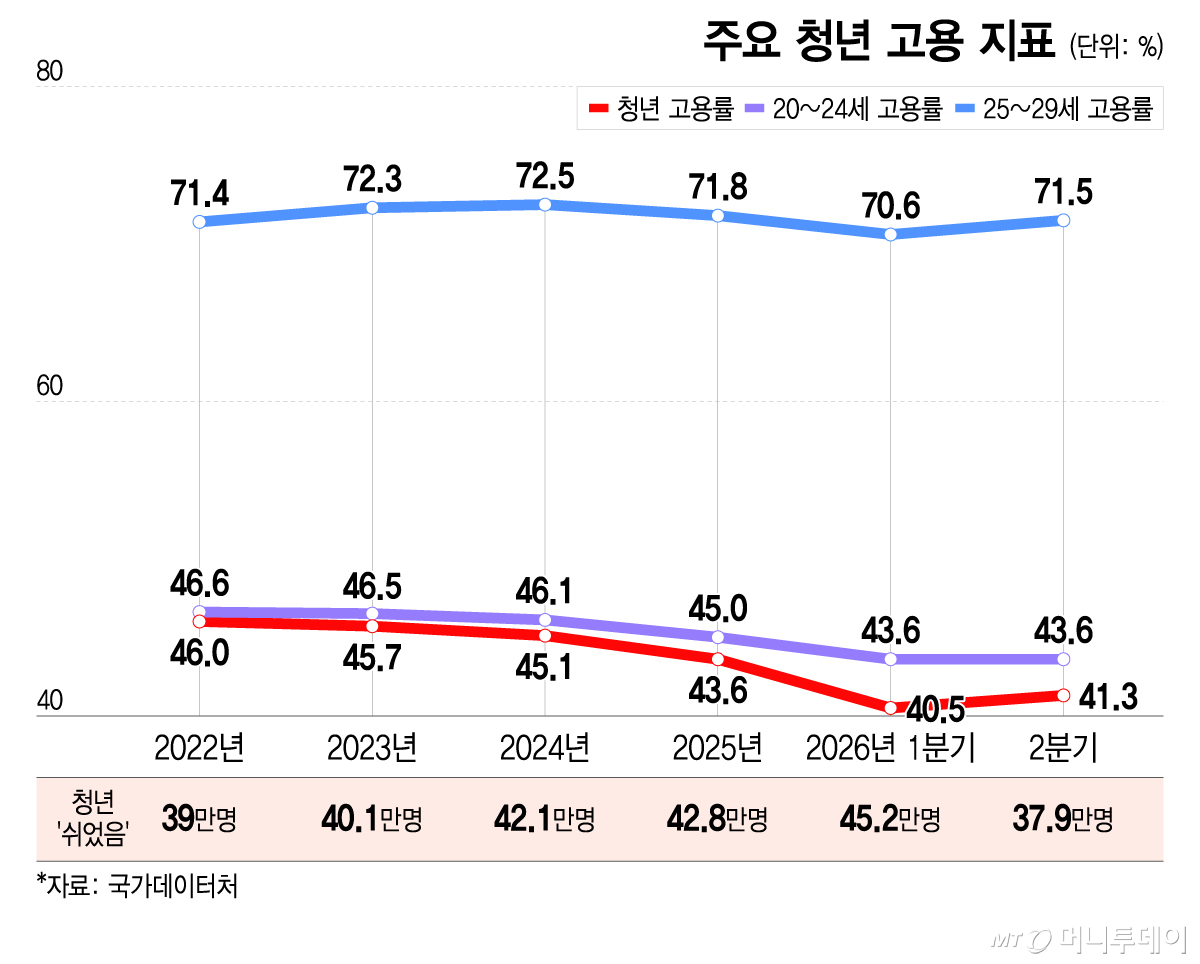
The threshold for employment is becoming increasingly high. The time taken to secure the first job increased from 9.5 months in 2010 to 11.2 months this year. As employment is delayed, graduation is also postponed. The time taken to complete a university degree increased from 48 months to 53.7 months over the same period. The Ministry of Economy and Finance assessed the recent situation as a "vicious cycle where people cannot get jobs because they lack experience, and they lack experience because they cannot get jobs" in its "Plan for Recovering Youth Employment" released last August.
Corporate recruitment methods are also working against young people. According to the "2026 New Hire Survey Results" by the Federation of Korean Industries, only 10.2% of companies responded that they conduct only regular open recruitment. The most important evaluation factor in new hiring was cited as "job-related work experience" (67.6%).
The Bank of Korea analyzed this phenomenon in its report "Increase in Experienced Hire Recruitment and Youth Employment," released last February, stating it is a trend that emerges "as the concept of lifetime employment weakens from the worker's perspective and required skills become more sophisticated from the company's perspective." It explained that companies have come to prefer hiring experienced workers as the cost burden of educating and training inexperienced candidates has grown.
Employment difficulties are not limited to the problem of earning income. The very life path of securing a job, accumulating income, and then acquiring a home and assets is being shaken. According to the "Housing Status Survey" by the Ministry of Land, Infrastructure and Transport, 31.6% of young households had a monthly rent-to-income ratio exceeding 30% as of 2023. This is more than double the average for all age groups (15.8%).
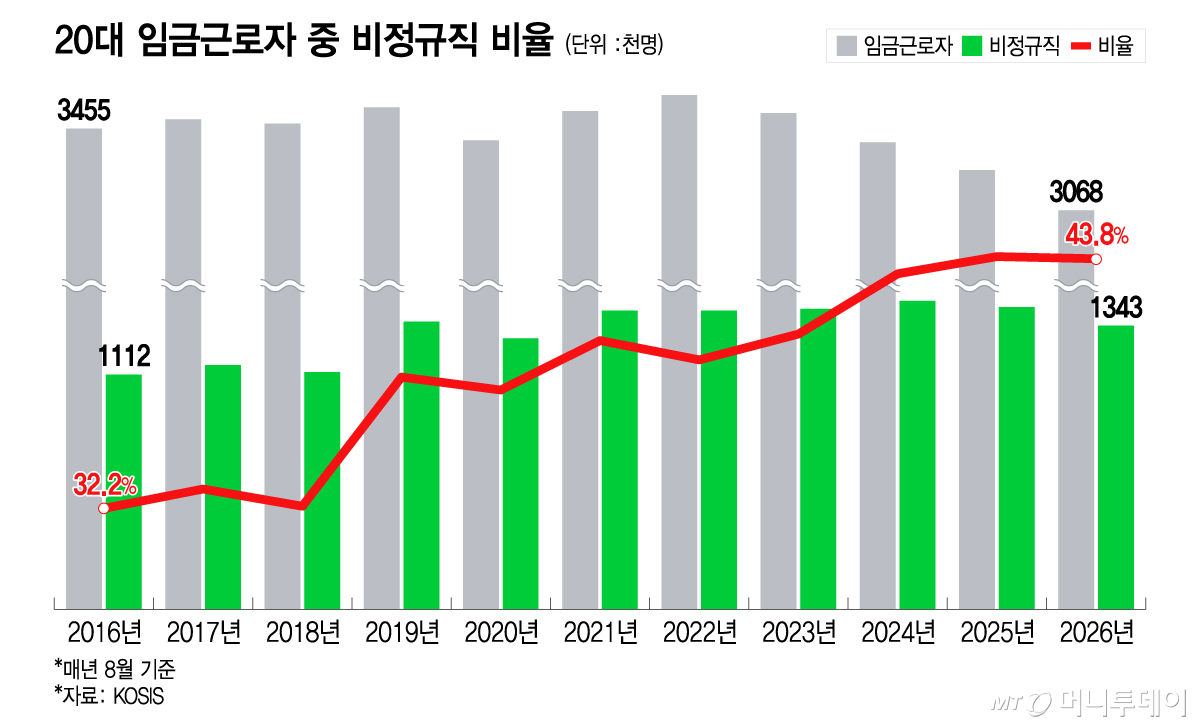
Even with a salary, if a significant portion is spent on rent, it is difficult to accumulate assets. Meanwhile, as housing prices rise and starting lines differ depending on whether parents provide asset support, the perception inevitably grows that working diligently alone cannot close the gap. As the ladder leading from employment and income to housing and asset formation wobbles, young people's frustration turns into anger.
◇ Bargaining: Coins… Dangerous "private compromise"
Young people who find it difficult to catch up with the gap have turned their eyes to virtual asset investment, aiming for a "big break." According to Dunamu, which operates Upbit, there were 5.48 million accounts of users in their 20s and 30s who had used Upbit as of last December. This amounts to 44% when compared with the resident population of that age group.
Considering that the cumulative number of registered accounts is 13.26 million, the participation rate of young people stands out. They are placing their hopes in new opportunities to grow assets, even if it means taking on high risks. However, the possibility of successfully forming assets through virtual asset investment, which has high price volatility, is limited. Although this is a private compromise to catch up with reality's gap, it may instead lead to results that deepen frustration.
◇ Depression and Acceptance: Young people erased from the labor market… The era of cynical acceptance
Anger that fails to find compromise turns into collective depression and cynical acceptance. The number of "inactive" young people aged 15 to 29 was 364,000 as of last September. Although this is a decrease compared to 452,000 in the first quarter of this year, it remains at a high level. The "inactive" population refers to those who are not working and resting without any particular reason. Some respond with voluntary low birth rates. This takes the form of a "birth strike."
Kim Yun-tae, a professor of sociology at Korea University, said, "Social movements can only be made when there is optimistic expectation, but Korean young people do not even have the capacity for that," adding, "The abandonment of romance, marriage, and childbirth, along with the surge in depression, are not personal choices but structural social problems."

 in ECONOMY


