

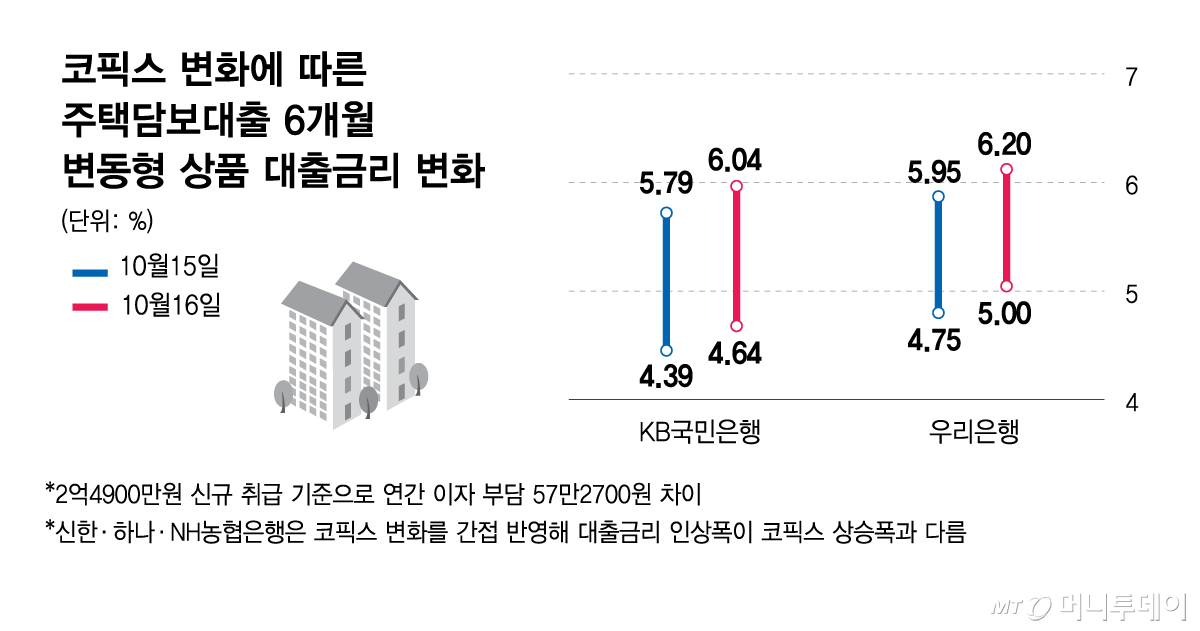
#Mr. A, who took out a 249 million won home loan from a bank on the 15th, and Mr. B, who borrowed the same amount the next day on the 16th. Assuming both received six-month variable-rate home loans under identical terms, Mr. B will pay approximately 570,000 won more in annual interest than Mr. A. This is because loan rates for some home loan products at certain banks rose by 0.23 percentage points (p) starting on the 16th. The increase follows a sharp rise in COFIX (Cost of Funds Index), the benchmark for variable-rate home loans in the banking sector, which recorded its largest jump in three years and ten months.
According to the Korea Banking Finance Association on the 15th, the new-contract-based COFIX for September stood at 3.43%, up 0.25%p from the previous month (3.18%). This is the largest increase since November 2022 (0.36%p). COFIX is the weighted average interest rate on funds raised by eight domestic banks through deposits, savings accounts, and bank bonds, among others, and it affects variable-rate home loan rates that use it as a reference rate.
Immediately, KB Kookmin Bank and Woori Bank will raise their six-month variable-rate home loan rates, based on the new-contract COFIX, by 0.23%p each starting on the 16th. Based on the average home loan amount of 249 million won used by financial authorities to calculate the contribution rate for the Housing Credit Guarantee Fund last year, a 0.23%p increase in interest rates would raise the annual interest burden by approximately 572,700 won.
The recent surge in COFIX is interpreted as being driven by banks' consecutive increases in deposit interest rates last September. As corporate funds flowed out en masse due to corporate tax payments and other factors, banks raised deposit rates to secure deposits from relatively stable individual customers.
Bank funding costs also spiked sharply at the end of 2022, when COFIX last rose by such a large margin. At that time, the Bank of Korea raised its base rate by 0.50%p in October and 0.25%p in November, while the bond market tightened due to the Legoland incident, prompting banks to successively raise deposit rates. Consequently, COFIX surged by 0.58%p in October 2022 and 0.36%p in November.
The issue is that there is a possibility COFIX will rise further. Banks are raising deposit interest rates in October as well, following September. In particular, Shinhan Bank launched the "Super SOL Welcome Time Deposit" on the 6th, offering interest rates of up to 4.0%, and Nonghyup Bank released a special deposit product with rates of up to 3.9% on the 13th.
The interest burden for home loan borrowers is already growing. According to the Korea Banking Finance Association, the average interest rate on new installment-repayment home loans handled by the five major banks—KB Kookmin, Shinhan, Hana, Woori, and Nonghyup—in August was 4.94%, up 0.28%p from the previous month (4.66%). This is the largest increase in one year and ten months since October 2024 (0.40%p).
As of this day, the loan rates for six-month variable-rate home loan products at the five major banks ranged from 4.36% to 6.29%, with the lower end rising by 0.34%p compared to two months ago (4.02% to 6.37%). The decrease in the upper limit is attributed to Nonghyup Bank independently lowering its rates, while loan rates at the other four banks rose at both the lower and upper ends.
In addition, attention is focused on whether further increases will occur, as the Bank of Korea's Monetary Policy Board decisions on the base rate for October and November remain pending. If the base rate rises further, upward pressure will be added to bank funding costs and home loan rates.
A banking industry official said, "We are seeing a high likelihood that the average variable-rate home loan interest rate will surpass 5% by year-end," adding, "While the growth in household loans is slowing, the burden on borrowers who have already taken out loans will increase significantly."

 in FINANCE

