

The presidents of the five major banks will take the witness stand at the National Assembly audit for the first time in four years. Focused questioning is expected regarding the circumstances of the recent wave of hacking incidents that have swept through the financial sector and failures in internal controls. In particular, Shinhan Bank President Jeong Sang-hyuk, whose bank suffered a leak of approximately 25,000 customer information records, is expected to face questions about his responsibility for internal controls as well as the issue of reducing his performance bonus, which amounts to approximately 5.3 billion won.
The National Assembly Political Affairs Committee will summon Lee Hwan-ju, President of KB Kookmin Bank; Jeong Sang-hyuk, President of Shinhan Bank; Lee Ho-seong, President of Hana Bank; Jung Jin-wan, President of Woori Bank; and Kang Tae-young, President of NH NongHyup Bank, as witnesses to the Financial Supervisory Service audit on the 19th. This marks the first time in four years that all five major bank presidents have been selected as audit witnesses, following the 2022 audit when financial incidents such as embezzlement and internal controls were at issue.
The Political Affairs Committee approved the witness selection motion for these bank presidents at its plenary session on the 8th. The stated reason is "review of hacking incident issues in the financial sector." Given that customer information leaks have occurred successively at Shinhan Bank, KB Kookmin Bank, and Hana Bank recently, it appears there will be a focused examination of financial institutions' management of security vulnerabilities, initial response to incidents, and the state of information protection investments.
Questioning is likely to focus particularly on President Jeong Sang-hyuk. At Shinhan Bank, 25,727 customer information records were leaked at the end of last month through an inquiry service provided to external loan solicitors. Kim Hyun-jung, a member of the Democratic Party of Korea and the National Assembly Political Affairs Committee, pointed out that Shinhan Bank failed to prevent additional intrusion for approximately 15 hours after recognizing the attack, arguing that responsibility for internal controls must be pursued.
The issue of President Jeong's performance bonus is also a point of contention. According to an analysis by Kim (Rep.) of the semi-annual reports of Shinhan Financial Group and Shinhan Bank, as of the end of June last year, President Jeong Sang-hyuk held 54,761 shares of unpaid performance-linked stock, valued at approximately 5.3 billion won. President Jeong received a 400 million won performance bonus in the first quarter of this year, recognized for his internal control performance among other achievements from the previous year.
Kim (Rep.) takes the position that it is necessary to strengthen executive accountability for failures in internal controls at financial institutions through measures such as clawback of performance bonuses and compensation for damages. With President Jeong's term expiring at the end of this year, and Shinhan Financial having initiated the process of selecting its next bank president last month, his future position may also be discussed.
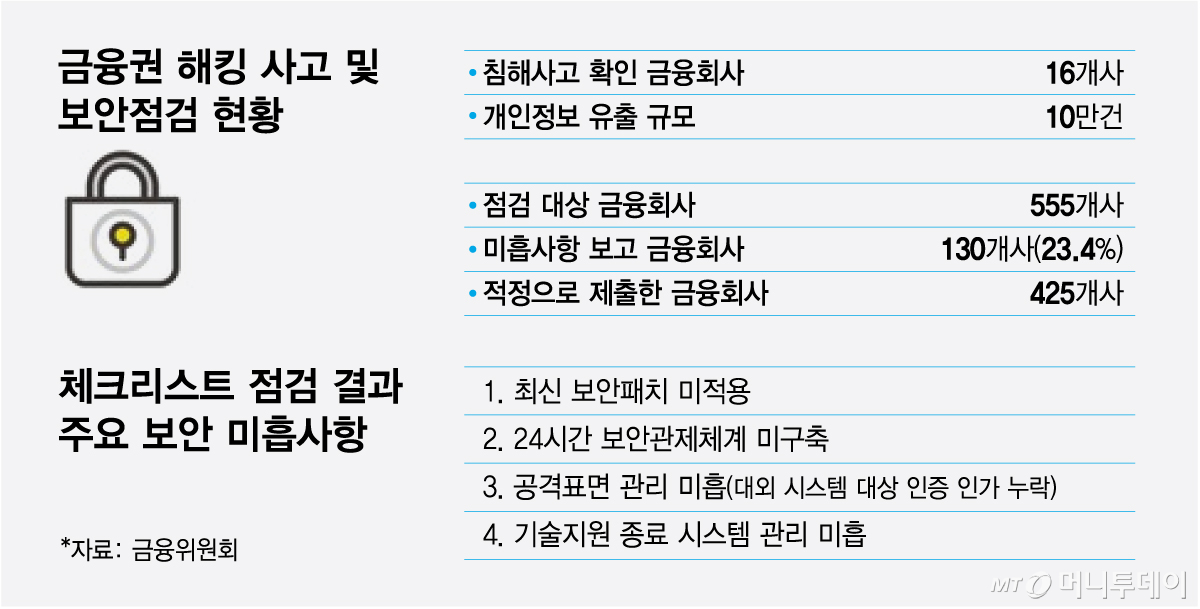
The state of security management across the financial sector is also expected to come under scrutiny. According to the Financial Services Commission, 16 financial institutions have recently confirmed hacking incidents, with a total personal information leak volume of approximately 100,000 records. In self-conducted security inspections targeting 555 companies across the entire financial sector, 130 companies reported deficiencies. Questions are expected regarding whether financial institutions' management of security vulnerabilities was adequate and whether pre-inspections and supervision by financial authorities were appropriate.
Beyond hacking incidents, major issues include trust fees for exchange-traded funds (ETFs) in the banking sector and household loan management. Since the Financial Supervisory Service has inspected the ETF trust sales practices of major banks, discussions may arise regarding sales practices centered on upfront commissions and consumer protection measures. Total volume management of household loans and improvements to the governance structure of financial holding companies are also expected to be discussed.

 in FINANCE
