

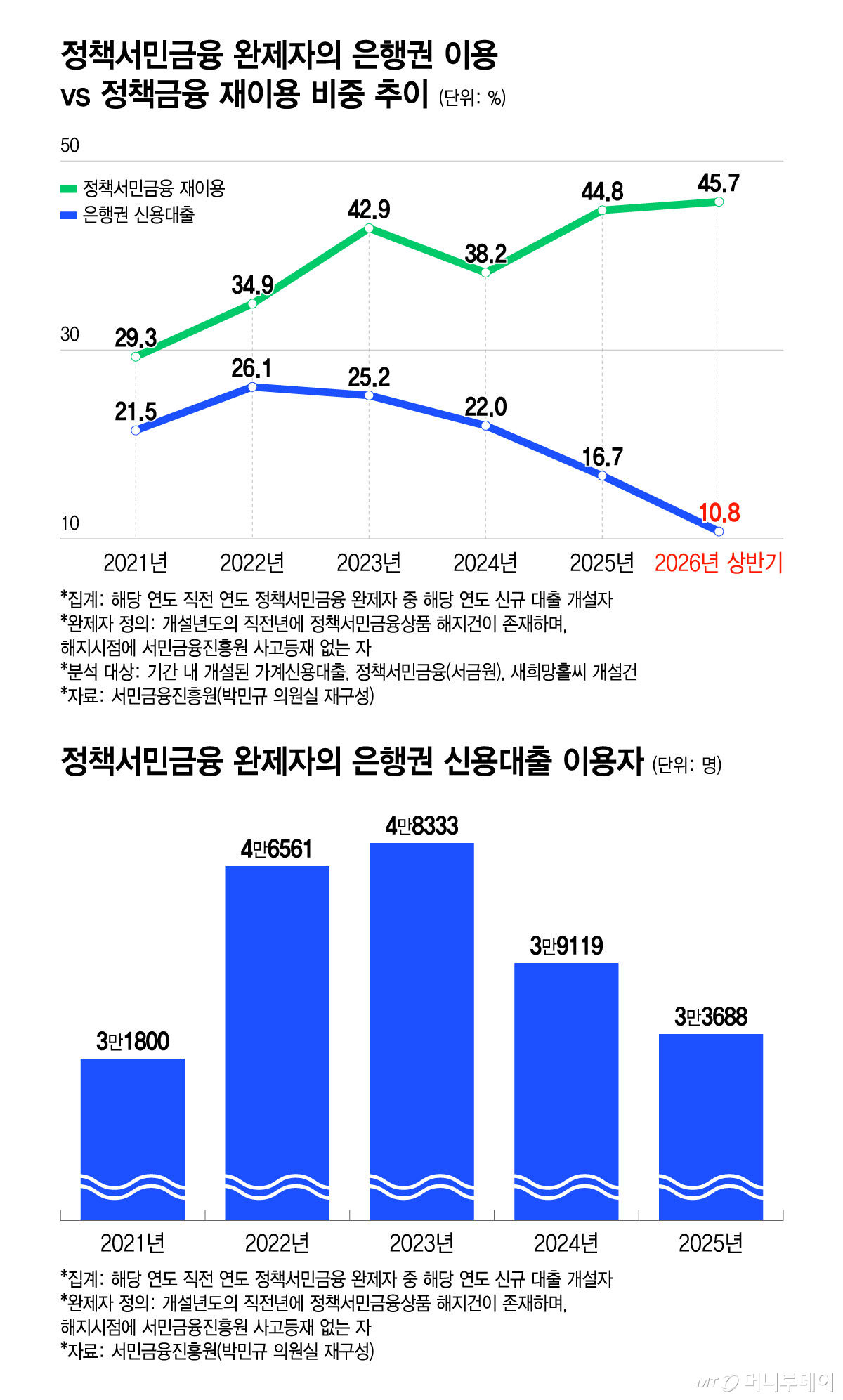
Among individuals who received a credit loan within one year after fully repaying policy microfinance, only 16.7% utilized bank sector credit loans last year. In the first half of this year, the number of completed borrowers of policy microfinance who reused policy microfinance reached 4.3 times the number of those who used bank sector credit loans. Critics point out that the government's "credit buildup" initiative, which aims to guide borrowers to the banking sector after they build their credit history through diligent repayment of policy loans, is failing to materialize.
According to an analysis of data submitted by the Korea Microfinance Promotion Corporation (K-Microfin) and reviewed on the 18th by Park Min-gyu, a Democratic Party of Korea lawmaker on the National Assembly's Political Affairs Committee, 201,903 borrowers who repaid policy microfinance in the previous year and received credit loans in 2025 were recorded. The total loan amount was calculated at 465.04 trillion won.
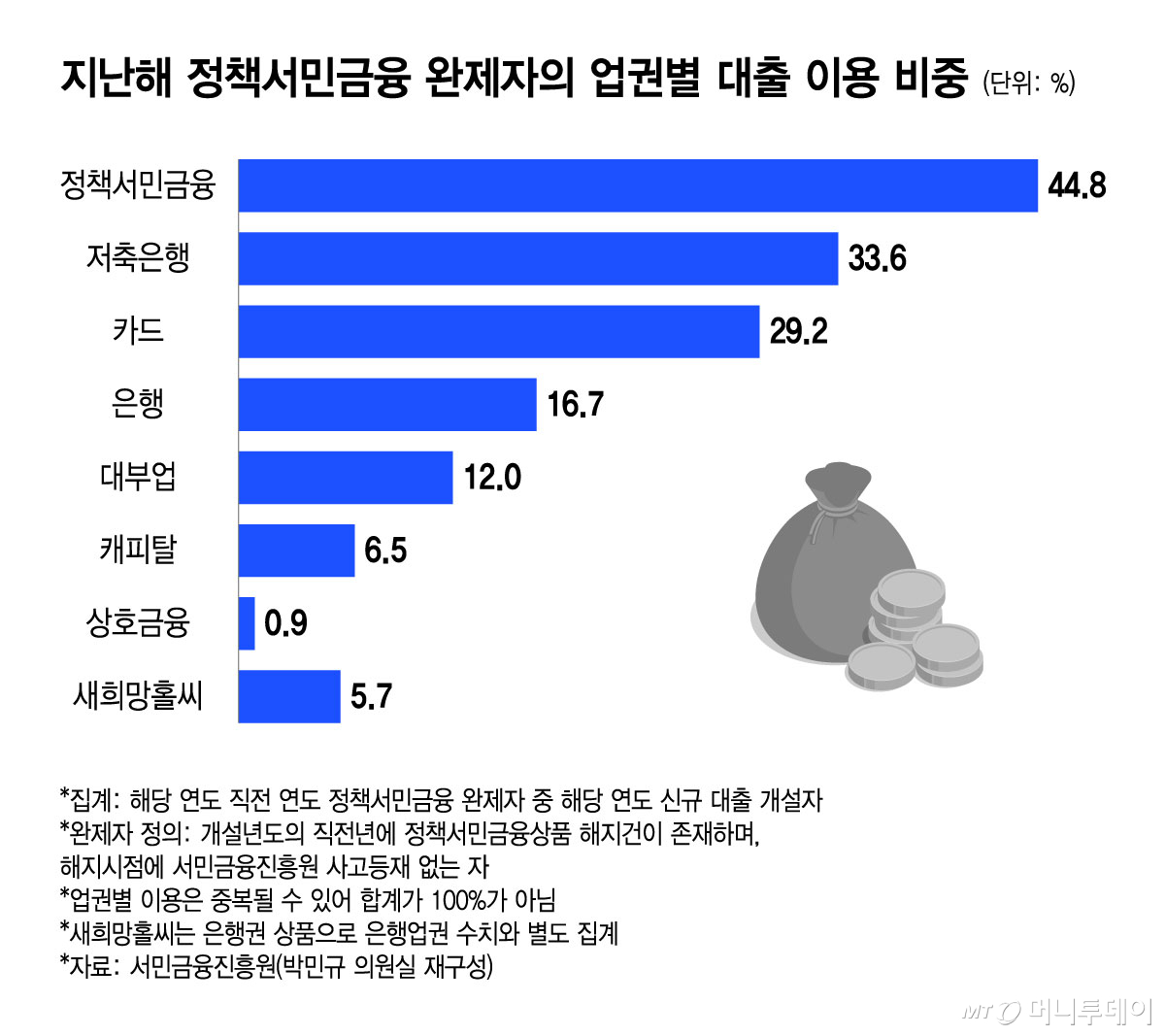
By financial sector, 33,688 individuals opened bank sector credit loans, accounting for 16.7% of completed policy microfinance borrowers. The loan amount was 679 billion won. Both savings banks and the card industry had more credit loan users than the banking sector. Savings bank users numbered 67,931 (33.6%), while card industry users were 58,967 (29.2%). Loan sharks accounted for 24,260 (12.0%), and finance companies for 13,191 (6.5%).
Loan amounts also exceeded the banking sector in other sectors: savings banks at 137.46 trillion won and the card industry at 909.7 billion won, compared to 679 billion won for the banking sector. Loan amounts for loan sharks and finance companies were 275.5 billion won and 198.5 billion won, respectively.
In the first half of this year, among 164,967 completed borrowers of microfinance, bank sector users numbered 17,747 (10.8%), showing a further decline in share.
Bank sector users have decreased over the past two years. Among completed policy microfinance borrowers, those who opened bank sector credit loans fell from 48,333 in 2023 to 33,688 in 2025, a decrease of 30.3%. During the same period, the share of completed policy microfinance borrowers using the banking sector dropped by 8.5 percentage points, from 25.2% to 16.7%.
Conversely, the scale of reusing policy microfinance after completing repayment has grown. The number of policy microfinance reuse cases increased by 108.1%, from 43,426 in 2021 to 93,064 in 2025. During the same period, the reuse rate among completed policy microfinance borrowers rose from 29.3% to 44.8%. In the first half of this year as well,
policy microfinance reuse cases reached 75,447 (45.7%), approximately 4.3 times the number of bank sector users.
Critics argue that this is a result of the banking sector supplying loans primarily to high-credit and prime borrowers for soundness management and household loan volume control. Even after completing microfinance loans, KCB and NICE credit scores do not rise significantly, making it difficult to gain advantages in each bank's proprietary credit rating system. In fact, for "Stepping Stone Loans," which allow policy microfinance users who repay diligently to access bank sector credit loan products at interest rates within 9% per annum, the number of executed cases at the four major banks (KB Kookmin, Shinhan, Woori, and Hana) was only nine as of August this year.
A commercial bank official stated, "Because we are lowering interest rates for diligent repayors of the New Hope Seed loan and supporting refinancing for customers in affiliated second-tier financial institutions, the supply amount of 'Stepping Stone Loans' with similar characteristics is limited."
Critics point out that a structure where completed policy microfinance borrowers fail to transition to the banking sector and instead repeatedly use policy finance funded by public finances is undesirable from the perspective of policy sustainability. This is because only when borrowers who have proven their repayment capacity settle into the banking sector can limited policy finance resources be concentrated on supporting new vulnerable borrowers. In fact, according to K-Microfin, the "policy microfinance supply ratio relative to demand" rose from 4.7% in 2021 to 10.4% in 2025. It is expected to reach around 14.3% this year.
Park (Rep.) pointed out, "Cases are increasing where borrowers who have proven their repayment capacity after using policy microfinance fail to settle into bank sector loans and instead reuse policy microfinance. A considerable number also use loan sharks or finance companies." They added, "If diligent repayment does not lead to the next stage of financial usage, the purpose of credit buildup becomes meaningless."
They further emphasized, "For credit buildup to succeed, it is necessary to reflect diligent repayment history in credit evaluations and consider introducing basic loan products for medium- and low-credit borrowers who have proven their repayment capacity."

 in FINANCE

