

A (27), who graduated from university and is preparing for employment, carries a 15 million won student loan from the Korea Student Aid Foundation. Although he earned about 1 million won per month through part-time work at a cafe, 600,000 won went toward rent and management fees. After deducting food and transportation costs, almost no money was left for job preparation. He ultimately took out a 5 million won credit loan from a savings bank to cover academy fees, qualification exam fees, and insufficient living expenses. He thought he could repay it once employed, but the job search period exceeded one year. As he reduced part-time work hours to prepare for interviews and exams, his monthly income dropped to around 800,000 won. After paying rent and living expenses, he lacked the funds to repay the savings bank loan and eventually defaulted on a portion of the installment payments. Before receiving his first paycheck, his debt had already exceeded 20 million won.
In cases like A’s, money borrowed to complete education, find a job, and secure housing is hindering young people’s independence. It was found that youth loan borrowers have a higher proportion of multiple debts and low-credit individuals compared to middle-aged and older adults, and their long-term delinquency rate is rising faster than other generations.
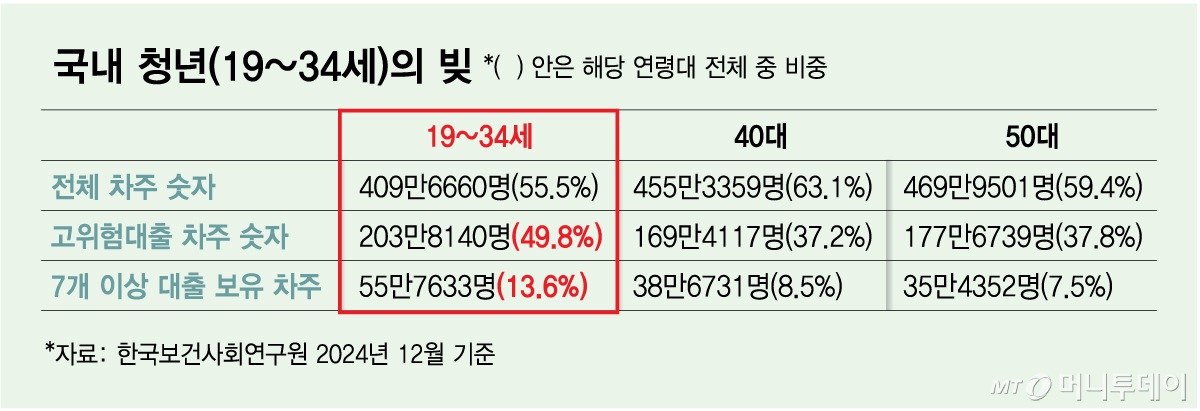
According to the Korea Institute for Health and Social Development on the 24th, as of the end of 2024, 4,096,660 youth aged 19–34 held loans, accounting for 55.5% of young people with credit information. In particular, among youth holding loans, 2,411,587 (58.9%) were multiple debtors carrying two or more loans, and 557,633 (13.6%) had seven or more loans.
Young people not only carried multiple debts but also had low credit scores. Among youth holding loans, 2,038,140 (49.8%) were low-credit individuals with a credit score of grade 7 or lower. In particular, this ratio reached 60.7% among those aged 19–29. This is up to 25 percentage points higher than the 37.2% for those in their 40s, 37.8% for those in their 50s, and 35.8% for those aged 60 and above.
A bigger problem is that the delinquency situation among youth is deteriorating rapidly. The proportion of low-credit youth borrowers expanded from 49.3% (1,987,989 people) at the end of 2020 to 49.8% (2,038,140 people) at the end of 2024. This contrasts with other age groups, where the ratio of low-credit borrowers decreased over the same period: from 39.0% to 37.2% for those in their 40s, from 38.4% to 37.8% for those in their 50s, and from 38.1% to 35.8% for those aged 60 and above.
The increase in youth taking out loans and defaulting is interpreted as being due to rising prices while employment is delayed. According to the real estate platform Dabang, the average monthly rent for a one-room apartment with a 100 thousand won deposit near Seoul’s top 10 university areas rose from 514,000 won in January 2023 to 622,000 won in January this year, an increase of about 21% over three years. In contrast, according to the Ministry of Employment and Labor, the average period to secure a first wage-earning job after university graduation increased from 10 months in 2020 to 11.5 months in 2024.
Given these circumstances, policy finance aimed at relatively low interest rates or for youth with unstable incomes is gaining traction, but cases of failing to repay policy loans are also increasing.
For Hetsaron Youth, a low-interest policy loan targeted at the youth demographic, the subrogation rate—the ratio where the guarantor repays the bank on behalf of the borrower who fails to repay—rose from 4.8% in 2022 to 9.4% in 2023, 12.7% in 2024, and 13.6% in 2025. Among Bojeumjari loans, a policy-based mortgage loan, the number of new low-income youth delinquents increased from 16 in 2023 to 103 in 2024, and 234 last year. This year alone, 282 people defaulted between January and May, surpassing the annual total of last year.
Financial authorities are expanding financial support and counseling to prevent young people from giving up on independence due to debt burdens. In March last year, they launched the "Youth Future Bridge Loan," which lends up to 5 million won at an annual interest rate of 4.5% to unemployed or early-career youth who meet certain low-credit and low-income criteria. The limit for operating capital loans under the Miso Finance program for self-employed youth aged 34 and under was also increased from 20 million won to 30 million won. Starting in July, they expanded customized financial counseling available to anyone aged 19–34, establishing a system capable of providing over 100,000 consultations per year.
A financial industry official said, "Policy loans are necessary to meet the urgent funding needs of young people, but if stable income does not back them up, the repayment burden will inevitably remain." The official added, "We must support young people by improving their repayment capacity through quality jobs while providing financial education and customized financial counseling before entering society, so they can borrow and repay according to their income."

 in FINANCE
