

[Exclusive] Left Chinese-made EVs Unprotected... Domestic Market Share '50%' Collapses for First Time
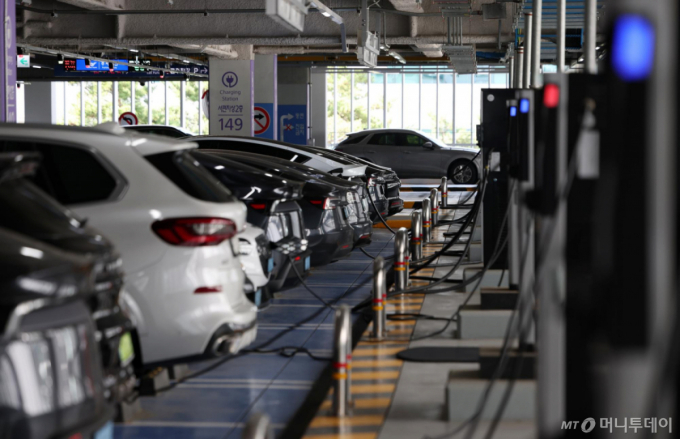
The Korean electric vehicle market is also being rapidly eroded by Chinese-made vehicles. Due to low tariff rates that have lost their function as import barriers and generous subsidies that do not distinguish between imported and domestic vehicles, the market share of domestically produced electric passenger cars has fallen below the "50% wall" for the first time in history.
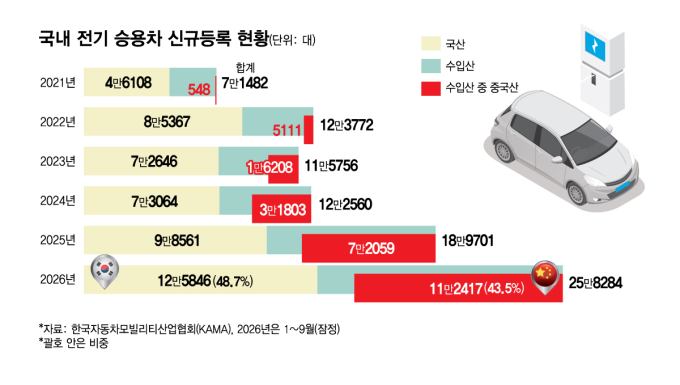
According to data compiled by the Korea Automotive Mobility Industry Association (KAMA) on Thursday, among newly registered domestic electric passenger cars from January to September this year (258,284 units), imported vehicles accounted for a 51.3% share (132,438 units), pushing the domestic share (48.7%) below 50%.
This is the first time since 2022, when annual new registrations of electric passenger cars exceeded 100,000 units and diffusion began in earnest, that the domestic market share has fallen short of 50%. Judging by the trend, there is a high probability that the proportion of imported vehicles will rise further during the remaining three months.
Chinese-made electric vehicles back this up. Chinese-made electric passenger cars sold a total of 112,417 units from the beginning of the year through September, accounting for the majority of imports with a 43.5% market share. Major vehicles from Chinese brands such as BYD and Zeekr, along with Tesla, which produces most of its volume in China and exports to Korea, are gaining attention in Korea as "cost-effective models." In fact, according to the Korea Automobile Importers Association (KAIDA), Tesla sold a total of 89,148 units, while BYD sold 20,137 units.
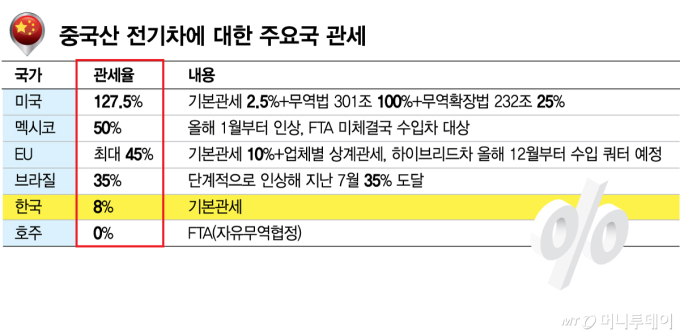
In this regard, it is pointed out that while Chinese-made EVs are accelerating their global market offensive using low prices as a weapon and major countries such as the United States and the EU (European Union) are simultaneously raising import barriers, Korea is effectively standing by. The tariff rate Korea imposes on Chinese-made EVs is 8%, which is significantly lower compared to the United States (up to 127.5%) and the EU (up to 45%). There is also criticism that by providing large-scale purchase subsidies regardless of whether vehicles are domestic or imported, Korea is encouraging the spread of Chinese-made EVs domestically.
Kim Pil-soo, Professor in the Department of Future Automotive Engineering at Daelim University Cha Gong-hak-bu (Prof.), stated, "If it is difficult for the government to raise tariffs due to concerns over trade disputes, it must devise domestic support measures at the pre-completion stage of vehicles where there are no dispute concerns," and emphasized, "The recent decision by the government to introduce a domestic production tax credit while excluding electric vehicles from the target scope is a major mistake that must be corrected by including them."
Surrendering Home Turf One After Another to 'Low-priced Chinese EVs'... Korea Also in Emergency
The only country that has effectively stopped the offensive of Chinese electric vehicles is the United States, which has erected high tariff barriers. Southeast Asia, South America, and Australia, where entry thresholds were low, have already surrendered their home markets. The European Union (EU), which started locking the door late, is also struggling to stop Chinese cars avoiding tariffs. This is why voices are emerging that Korea must hurry to prepare defensive measures against Chinese EVs.
According to industry sources on the 22nd, the tariff the United States imposes on Chinese-made EVs reaches 127.5%, combining a base tariff of 2.5%, a 100% tariff under Section 301 of the Trade Act, and a 25% imported vehicle tariff under Section 232 of the Trade Expansion Act. As a result, Chinese brands such as BYD have not been able to enter the U.S. market. The United States is effectively defending its home turf with tariffs.
On the other hand, markets with low entry thresholds were rapidly eroded. According to market research firm MarkLines, 90.8% and 91.6% of electric vehicles sold in Thailand and Indonesia in the first half of this year, respectively, were Chinese brands. Thailand was once called a "Japanese car stronghold," where Japanese brand market share reached as high as 90%. Australia does not impose tariffs on Chinese-made cars under its FTA (Free Trade Agreement). Last month, the proportion of Chinese-made vehicles in the Australian new car market was 35.5%, significantly ahead of Japanese-made (22.5%) and Korean-made (9.6%).
Brazil locked the door late, but Chinese-made vehicles have already taken over the market. Although it gradually raised tariffs on imported EVs to reach 35% in July last month, 93.4% of Brazil's EV market in the first half of this year was occupied by Chinese brands. BYD has even started local production by purchasing the factory site left by Ford.
Mexico also raised tariffs on imported vehicles from countries without an FTA to 50% starting this January, but sales of new Chinese brand vehicles in the Mexican market in the first half of this year increased by 27.7% compared to the same period last year. It is predicted that even with higher tariffs, it will be difficult to push out Chinese cars that have already taken root in the market.
The EU left a low threshold for HYBE lead vehicles and is now raising it late. Although it imposed tariffs of up to 45% on Chinese-made pure electric vehicles starting October 2024, HYBE lead vehicles only had to pay the base tariff of 10%.
As Chinese companies exploited this gap, the market share of Chinese-made vehicles in the EU plug-in HYBE lead vehicle market jumped from 2% in 2024 to 25% in the first half of this year. Ultimately, the EU agreed on the 9th last month to adjust exports of HYBE lead vehicles with China. Starting December this year, imports of Chinese-made HYBE lead vehicles will be capped at 350,000 units annually for four years, with the cap increasing by 6% each year.
Chinese companies are breaking through even this with local production. BYD entered its Hungary factory in Yangsan in mid-year, and Changan Automobile plans to start European production in early next year. The EU also introduced the Industrial Acceleration Act (IAA) in March last month, which requires a 70% intra-regional component share to qualify for EV subsidies, but Chinese companies are responding by building local supply chains before regulations are even finalized.
In the domestic market as well, it is not easy for domestic cars to compete with Chinese cars on price. China, with lower labor costs and production prices, is analyzed to have finished vehicle costs 30% to 40% lower than other countries like Korea.
Lee Sang-soo, a researcher at iM Securities, said, "Electric vehicles are a field where technical overtaking is relatively easier compared to internal combustion institutional investor cars," and predicted, "It will be difficult to compete with Chinese cars without policy support."
He added, "Incentives for Korean cars alone are insufficient; penalties to block Chinese cars are also needed," and suggested that a "Korean version of the IAA" and exclusive policies like those in the United States are necessary together.

 in INDUSTRY


