

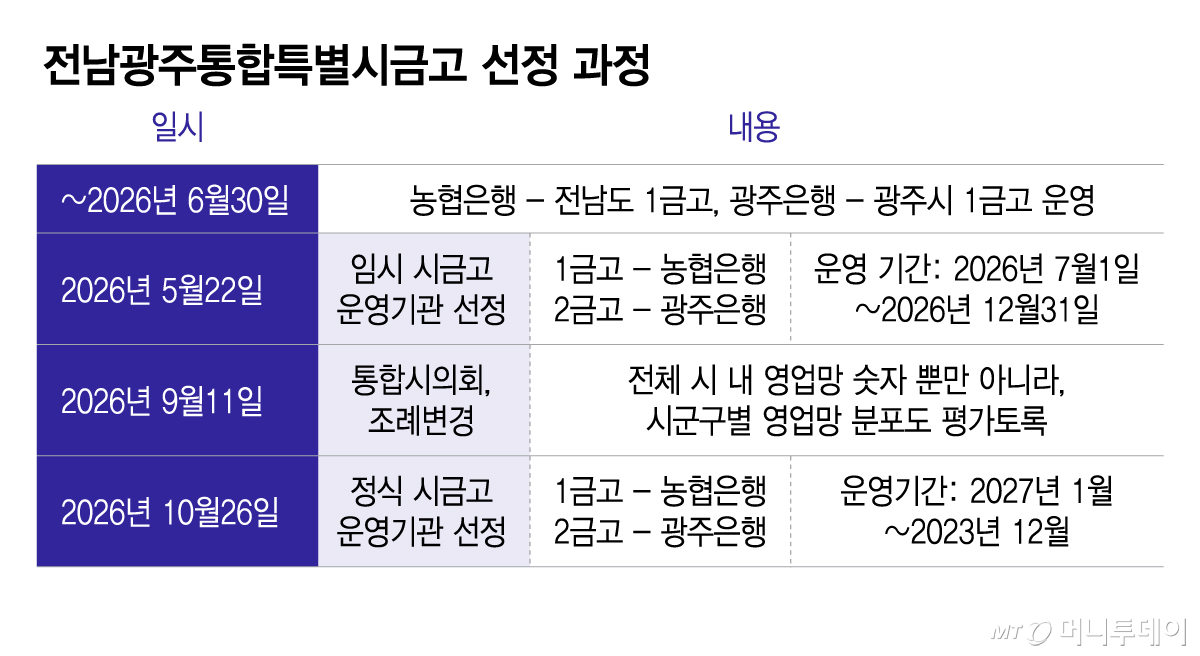
NH NongHyup Bank was selected as the official first treasury bank operator for the Jeonnam-Gwangju Metropolitan City. Gwangju Bank, which had aimed to become the first treasury bank, will serve as the second treasury bank following its role as the interim treasury bank. It is interpreted that the results were determined by changes to the ordinance requiring detailed regulations on branch distribution and differences in branch networks including local agricultural cooperatives.
The Jeonnam-Gwangju Metropolitan City held a Treasury Designation Review Committee meeting on the 26th, selecting NH NongHyup Bank as the first treasury bank and Gwangju Bank as the second. The contract period runs from January 2027 to December 2030.
Prior to the integration, NH NongHyup Bank operated as the first treasury bank for Jeonnam Province, while Gwangju Bank served as the first treasury bank for Gwangju City. With administrative integration pitting the two existing first treasury bank operators against each other for a single position, NH NongHyup Bank was selected as the first treasury bank and Gwangju Bank as the second in the interim treasury selection in May. They have been managing finances from July 1, the launch date of the integrated city, through the end of this year.
With this official treasury selection, NH NongHyup Bank will manage the general account, regional development fund, and administrative integration financial support funds for the next four years. Gwangju Bank will manage special accounts and funds.
The integrated city's budget for next year is expected to exceed 25 trillion won. This figure is based on a total of 20.8 trillion won, combining Gwangju City's current-year budget of 8.1 trillion won and Jeonnam Province's budget of 12.7 trillion won, plus the government's annual administrative integration financial support fund of 5 trillion won.
Evaluation criteria that were changed to reflect branch network distribution by city, county, and district are considered a key factor in NH NongHyup Bank retaining the first treasury position. The Integrated City Council amended the Treasury Designation and Operation Ordinance on September 11 last month to evaluate not only the simple number of branches, unmanned stores, and automated teller machines (ATMs) installed, but also how evenly the branch network is distributed across Gwangju's five autonomous districts and Jeonnam's 22 cities and counties.
While Gwangju Bank leads in the number of branches, NH NongHyup Bank holds a structural advantage in scoring when distribution is taken into account. This is because NH NongHyup Bank has branch networks in all 22 cities and counties of Jeonnam, whereas Gwangju Bank has no branches in three counties: Gokseong, Gure, and Jindo.
The point allocation for this treasury selection evaluation totals 100 points, comprising 'Creditworthiness and Financial Structure Stability (27 points),' 'Loan and Deposit Interest Rates (20 points),' 'Convenience for Residents (24 points),' 'Treasury Business Management Capability (22 points),' and 'Regional Community Contribution and Cooperative Projects (7 points).' Branches are directly linked to 'Convenience for Residents.'
Additionally, it is analyzed that including local agricultural cooperative performance in the evaluation of NH NongHyup Bank also had an impact. Gwangju Bank has more branches on its own, with 103 locations (67 in Gwangju and 36 in Jeonnam), compared to NH NongHyup Bank's 93 locations (29 in Gwangju and 64 in Jeonnam). However, if the 580th local agricultural cooperative branches are included, the total for the broader NongHyup group expands to 673 locations. Nevertheless, whether local agricultural cooperative performance was reflected has not been immediately disclosed regarding the treasury selection results on this day, so it cannot be definitively stated that it influenced the outcome.
The issue of aggregating local agricultural cooperatives has been a point of contention between the two banks since the interim treasury selection in May last year. At that time, the Gwangju City and Jeonnam Province Treasury Selection Evaluation Committee voted to reflect the number of local agricultural cooperative branches in the evaluation. The regional community contribution performance of local agricultural cooperatives was not reflected. Gwangju Bank had warned of legal action, arguing it was unfair to include the performance of local agricultural cooperatives, which are separate legal entities, in NH NongHyup Bank's evaluation, but subsequently suspended this plan.
An official from NH NongHyup Bank said, "We believe this result came about because our overwhelming treasury management capabilities and the roles we have consistently played in the Jeonnam-Gwangju region were recognized." The official added, "Going forward, as the primary treasury bank, we will make every effort to ensure the success of the Jeonnam-Gwangju Metropolitan City."

 in FINANCE
