

[For more diverse corporate information on startups mentioned in this article, please visit Unicorn Factory's big data platform 'Data Lab'.]
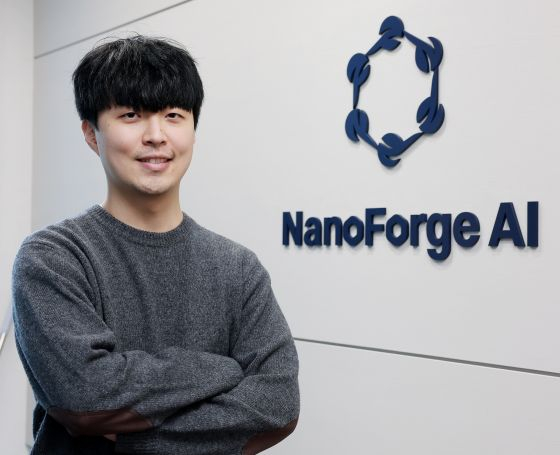
"Singapore demonstrated clear determination not merely to treat this as a research project but to advance it to a stage where it can be practically applied in industrial settings."
Recently, the Singaporean government has designated an 'AI-based automated new material development system' as a national strategic task and is directly building relevant infrastructure within its Agency for Science, Technology and Research (A*STAR). To ensure the system operates effectively, it is actively recruiting entrepreneurs from around the world who possess both research expertise and hands-on industrial experience.
Kim Dong-hyun, CEO of NanoForge AI, was officially invited after his company's technical capabilities in ceramics and solid-state materials were recognized. He stated, "We presented our technologies on-site and held business discussions with major material companies."
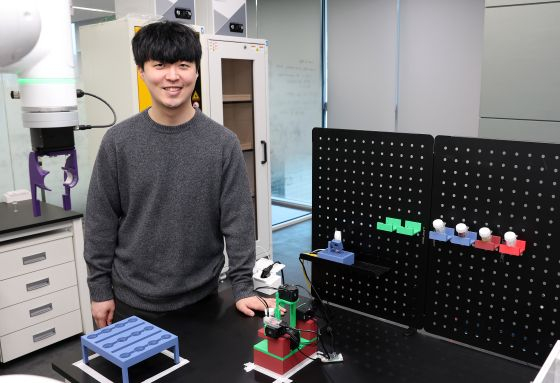
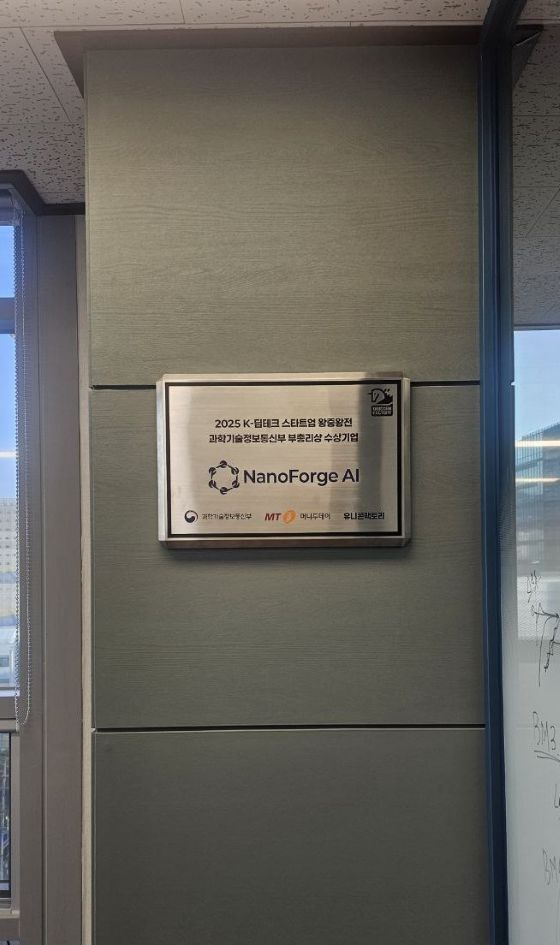
NanoForge AI is a startup that won the Grand Prize (Ministry of Science and ICT Deputy Prime Minister Award) in the Student Startup Category at the finals of the '2025 K-DeepTech Startup King of Kings' tournament, held by MoneyToday's startup platform Unicorn Factory on October 17 last year at Seoul COEX. The company is developing and building a digital materials research institute that automates the entire R&D process—from material design to synthesis and process optimization—by combining AI and robotics automation technologies. Its goal is to shorten the R&D period, which previously took over seven years, to within one month while reducing costs by up to 80%.
Kim (CEO) has been rapidly accelerating business expansion by quickly concretizing collaborations with domestic mid-sized material companies following its Singapore visit. A representative example is DNK Mobility, a mid-sized company that supplies aluminum frames to Hyundai Motor and Tesla and has built competitiveness in aluminum die-casting and structural rigidity design. Recently, DNK Mobility decided to expand its business scope into aluminum-based heat-dissipation materials and selected NanoForge AI as its technology partner for this initiative. Kim (CEO) stated, "We have agreed to conduct a PoC (Proof of Concept/Technology Validation) with DNK Mobility to discover new compositions for aluminum heat-dissipation materials and are continuing discussions this year to concretize commercialization directions."
The company has also established a cooperative relationship with Daeju Electronic Materials, a leading domestic mid-sized company that produces anode materials for secondary batteries. NanoForge AI has completed PoC discussions with the company on exploring new solid-state electrode materials for small- and medium-sized secondary batteries and plans to begin actual validation efforts starting this year.
The U.S.'s Strategic Move: 'Genesis'
Kim (CEO) recently diagnosed that competition in new material development is expanding beyond the corporate level to become a national-level rivalry. When materials change, so do product performance, form, and even the fundamental competitive landscape of entire industries. This is precisely why countries worldwide are increasingly emphasizing 'material sovereignty.'
The United States' actions stand out particularly. Kim (CEO) cited the 'Genesis Program,' launched in the U.S. last October, as a symbolic case of global new material hegemony competition. This project brings together major American tech companies and approximately 27 AI-driven material startups into a single large consortium. Its objective is to discover 'game-changer' materials that are several times to dozens of times superior to existing materials through AI and automated synthesis systems.
Kim (CEO) explained, "Improvements in performance by only 10–20% compared to existing materials will not easily trigger production line changes. However, if materials with performance exceeding tenfold the current standard emerge, the situation changes completely. At that point, existing production lines cannot be maintained; entirely new lines must be built." According to Kim (CEO), the U.S. is planning to use this program to discover new materials and establish new processes and manufacturing lines tailored to those materials within the country.
He added, "Many manufacturing lines currently in China are designed around existing materials. If new materials developed by the U.S. emerge, those existing lines will lose all competitiveness. This is essentially a declaration to change the rules of the game and secure advantageous ground for the U.S. in the manufacturing sector."
To Ensure South Korea Does Not Fall Behind…
Kim (CEO) emphasized that since new material competition is evolving beyond mere technology development into a national strategy determining future manufacturing leadership, South Korea must never fall behind in this trend. He stated, "Materials are the foundational roots at the forefront of the industrial ecosystem; falling behind in this battle will inevitably shake the overall competitiveness of our country, which is a global manufacturing powerhouse."
The core of the response that Kim (CEO) particularly stressed involves advancing the AI-based automated new material development system while establishing a structure for accumulating and sharing materials research data at the national level. He noted, "AI-driven new material development ultimately relies on vast experimental data and automated synthesis infrastructure; it is difficult for individual companies or laboratories to keep up with global competition alone."
Against this backdrop, changes are also emerging in government policy environments. While research data generated through government-supported projects was not previously required to be registered in a national database, this structure is expected to change starting this year. Kim (CEO) stated, "Going forward, registering data from government-funded projects into the national database will become mandatory. Moreover, if policies shift toward processing and sharing already accumulated data with companies or startups lacking sufficient capabilities, new material R&D will gain further momentum."
[MoneyToday Startup Media Platform Unicorn Factory]

 in FUTURE


