

“We are in discussions with some customers who have signed long-term supply agreements (LTAs) about contract extensions, and additional demand is also significantly exceeding expectations.”
Samsung Electronics and SK hynix signaled the prolonged nature of the memory semiconductor boom. Amid growing artificial intelligence (AI) demand, they assessed that expanding investment would make it difficult to increase supply in the short term.
By demonstrating sold-out HBM (high-bandwidth memory) inventories and expanded LTAs, they dispelled concerns that the industry cycle had reached a “peak out.”
At its Q3 2026 earnings announcement on Thursday, Samsung Electronics forecasted that “the semiconductor industry’s strength will continue next year due to record AI investment and supply constraints,” adding that “a tight supply situation is expected to persist through 2028.”
SK hynix, which announced its results the previous day, also projected that an environment where demand exceeds supply would continue until 2030.
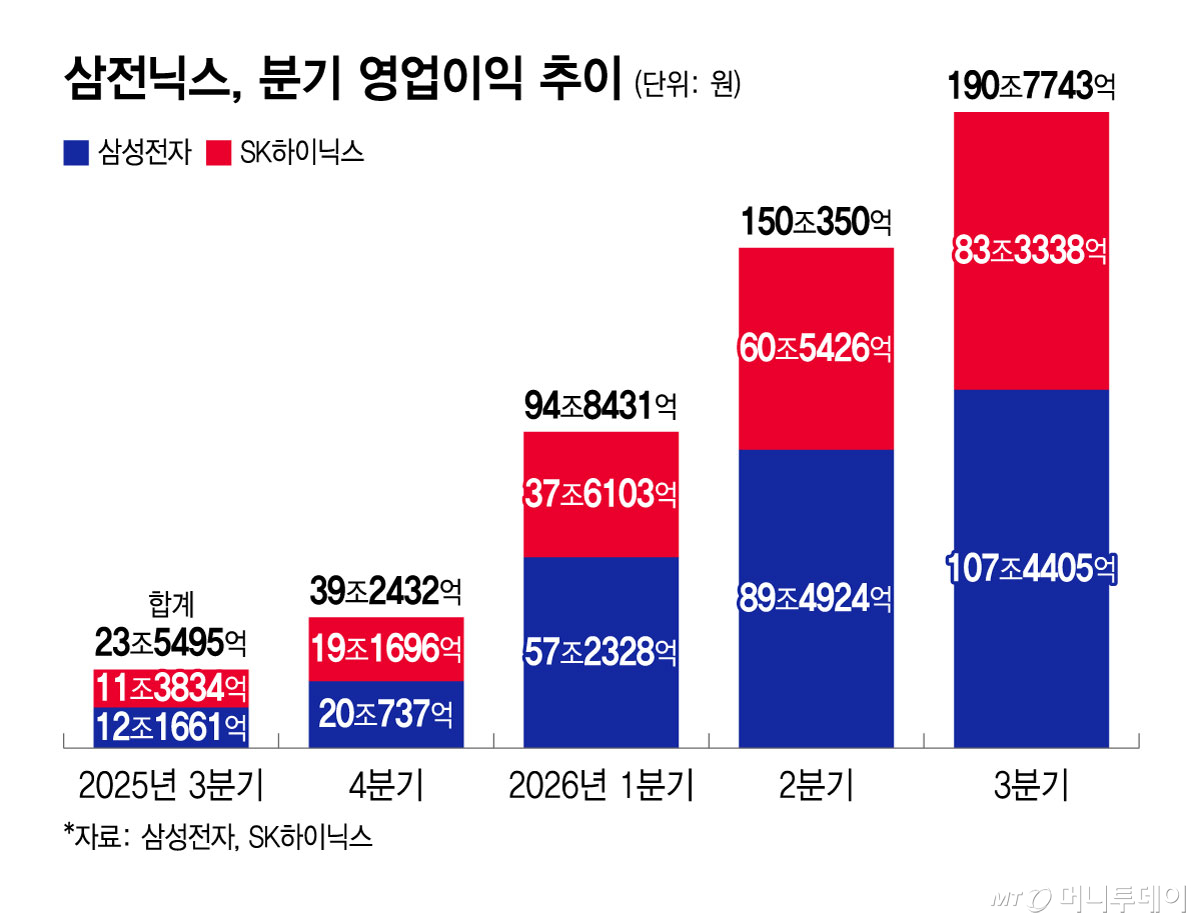
The combined operating profit of the two companies in Q3 reached 1,907.743 billion won. SK hynix’s operating profit margin is estimated at 80%, while Samsung Electronics’ memory division is estimated to be around 77%.
The securities industry predicts that Samsung Electronics and SK hynix will achieve annual operating profits of 56.1 trillion won and 40.5 trillion won, respectively, next year.
The spread of AI underpins demand. Samsung Electronics reaffirmed that “unprecedented memory demand strength will continue next year.”
SK hynix also explained that “the investment base is structurally diversifying,” noting that investment previously concentrated on a few big tech companies is expanding to general enterprises and the national level. The benefits of AI are also spreading from DRAM and HBM to NAND flash (hereinafter “NAND”).
Rising memory prices coincided with increased sales of high-value-added products like HBM. Samsung Electronics’ Q3 revenue from HBM4 (6th generation) more than tripled compared to the previous quarter, and its share of total HBM revenue rose to approximately 60%.
The company assessed that it achieved an HBM market share equivalent to the overall DRAM market level in Q3. Mass production of HBM4E (7th generation) is set to begin in the first half of next year.
Samsung Electronics has completed negotiations on both supply volumes and prices for next year’s HBM. SK hynix emphasized that “DRAM and HBM volumes for the next three years are effectively all sold out” and that “requested HBM volumes exceed available supply by more than double.”
LTAs are also expanding. Samsung Electronics has completed contracts with 10 major customers and is in negotiations with another 10 key customers. It can fill 60% to 70% of its production capacity through long-term contracts until 2030. SK hynix has secured volumes corresponding to more than 50% of its 2027–2028 production capacity through contracts with 14 customers.
Conversely, increased capital investment does not immediately translate into expanded supply. Samsung Electronics expects this year’s capital investment to reach 844 billion won, an increase of 317 billion won from the previous year.
Although industry investment is expected to rise significantly next year, the company analyzed that there are limits to contributing to production expansion by 2028 due to the long time required from new factory construction to production. Rising construction and equipment costs, along with extended equipment lead times, are factors constraining supply expansion.
The increased chip area and complex processes of next-generation HBM are also heightening production burdens. SK hynix drew a clear line, stating that “supply does not increase in direct proportion to the scale of investment or the number of new fabs (factories).”
Both companies are adopting a strategy of proactively securing production space while adjusting equipment installation and mass production expansion according to demand. This alleviates concerns that capacity expansion investments will directly lead to oversupply.
Meanwhile, Samsung Electronics also previewed growth in its foundry (semiconductor contract manufacturing) business driven by AI demand.
Vice President Kang Seok-jae, head of the Foundry Strategy Marketing Division, said, “The number of 2-nanometer order tasks for this year is expected to more than double compared to last year,” adding that “growth centered on advanced 4-nanometer and 2-nanometer processes is anticipated next year amid strong AI demand.”

 in INDUSTRY
