

[For more diverse corporate information on startups, you can view it on the Unicorn Factory big data platform 'Data Lab'.]

"People don't carefully examine the plastic wrapping when buying fresh food. Even when opening a delivery box or throwing away salad containers, packaging materials are merely seen as something 'used because it exists.' However, this trivial presence accounts for a significant portion of global waste and carbon emissions."
Go Ui-seok, CEO of NeuroPack, stated, "Packaging is a consumer good that goes unnoticed in daily life, but since everyone worldwide uses it, it constitutes a substantial part of environmental pollution issues."
According to the United Nations Environment Programme (UNEP), food waste generated globally reaches approximately 1 billion tons annually. Notably, about 70% of food waste occurs during the production, distribution, and storage stages before reaching the consumption phase. Furthermore, as the food distribution structure evolves, the volume of packaging waste is also increasing significantly, with current global municipal solid waste estimated at around 35% being packaging waste. In Korea, total annual food waste is approximately 5 million tons, accounting for about 22% of municipal solid waste.
Established in April 2022, NeuroPack is a startup that develops functional and eco-friendly packaging materials using Busan byproducts such as ginkgo leaves, fruits, and oyster shells. It was founded on the awareness that simply changing unnoticeable packaging can contribute to solving environmental problems. Ginkgo leaves and fruits are urban headaches during autumn. Due to foul odors, slipping accidents, and various complaints, local governments incur costs for collection and disposal but lack viable utilization methods. NeuroPack transforms these Busan byproducts into 'functional raw materials,' turning urban waste into industrial resources.
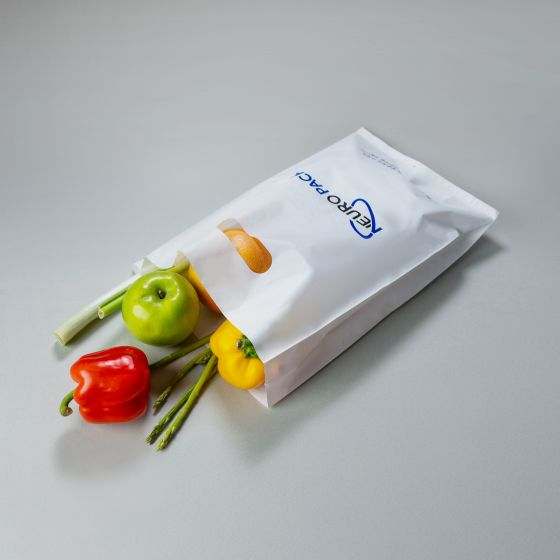
NeuroPack extracts functional substances from natural raw materials including ginkgo leaves and fruits, oak extract, oyster shells, starfish, and lotus leaves, then coats them onto the surface of packaging materials. This inhibits the proliferation of microorganisms inside the packaging, slowing down spoilage rates and reducing water droplets forming inside the packaging to maintain freshness. Furthermore, it is explained that various application products can be developed, such as absorbing meat juices and regulating ethylene gas to promote fruit ripening.
He emphasized, "If changing just one piece of wrapping paper can extend the shelf life of food by up to 50%, who would refuse?" He added, "Extending shelf life leads not only to the ability to eat for longer but also triggers a chain reaction resulting in reduced food waste, lower disposal costs, and decreased greenhouse gas emissions from waste." He further noted, "Our process's distinctive feature is that it implements functionality based on natural materials rather than applying synthetic chemical substances," adding, "We have ensured human safety by using materials that are safe for consumption."
Another differentiating factor of NeuroPack is its 'ability to design packaging.' It does not merely supply materials but collaboratively designs which packaging is optimal for which product. Recently, it also developed high-barrier paper packaging that achieves high barrier properties without an aluminum layer. Generally, cosmetic tubes, toothpaste packaging, and sterile milk cartons contain a thin aluminum layer inside. While the aluminum layer preserves products by blocking air, moisture, and light, it becomes a factor making recycling difficult because different materials are combined, making separation and disposal complicated. NeuroPack applied its self-developed high-barrier coating technology to paper materials, securing high barrier properties without an aluminum layer.
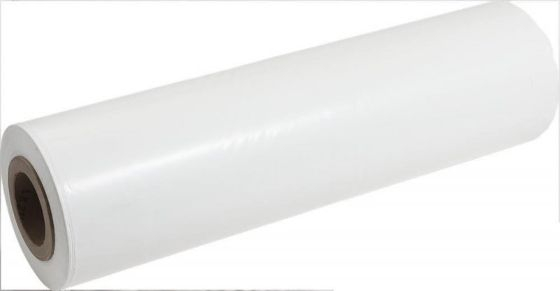
NeuroPack's biodegradable film utilizing oyster shells is also gaining attention. It is particularly being applied as a material for agricultural mulch films and receiving positive responses on the ground. The black plastic mulch films covering fields in rural areas are effective at suppressing weeds, maintaining moisture, and regulating temperature and humidity, but collection and disposal after harvest remain problematic. In aging rural areas, labor costs are high, and some films are left abandoned or illegally incinerated and landfilled, leading to soil and air pollution. Although biodegradable mulch films have been proposed as an alternative, their high price and weak strength posed challenges for commercialization.
NeuroPack found a solution in the sea. Ko (CEO) stated, "Oyster shells contain over 90% calcium carbonate; mixing some of them increases the strength of plastic materials." He continued, "By utilizing this, we lowered the unit cost of biodegradable films while strengthening their strength." He further elaborated, "In agricultural fields, the cost of removing plastic film is significant, but with biodegradable film, recovery costs are reduced, making it competitive in terms of total cost. Additionally, fertilizer effects can be expected in the soil during the decomposition process."
As such, while securing physical property improvements and price competitiveness by utilizing marine Busan byproducts, NeuroPack has also embarked on developing materials based on forest resources to advance functionality. In particular, it expanded its technology toward simultaneously enhancing eco-friendliness and functionality by applying natural antibacterial and antioxidant components contained in oak extract to films and packaging materials.
However, raw material supply remains a significant challenge. This difficulty was alleviated when selected for the 'Youth Forest Startup Catalyst Support Project' promoted by the Korea Forest Service and the Korea Forest Industry Promotion Corporation in 2025. For oak extract, a collection system was established through plans to obtain materials free of charge from forest road sites with support from the Korea Forest Industry Promotion Corporation and to supply trees generated during road construction projects. Additionally, with about 30 million won in business development support funds, it was possible to verify and advance the antibacterial performance of oak extract-based packaging materials.
Ko (CEO) emphasized, "It is not easy for a young entrepreneur to solve research and development, raw material supply, and certification procedures alone." He added, "The support from the Korea Forest Industry Promotion Corporation was an opportunity that provided direction beyond simple financial aid, allowing us to concretize a business model utilizing forest resources." He further stated, "There are still many areas in the forestry sector close to blue oceans. I encourage young people with innovative ideas to actively utilize the 'Youth Forest Startup Catalyst Support Project.' NeuroPack itself was able to make a leap forward through this opportunity."
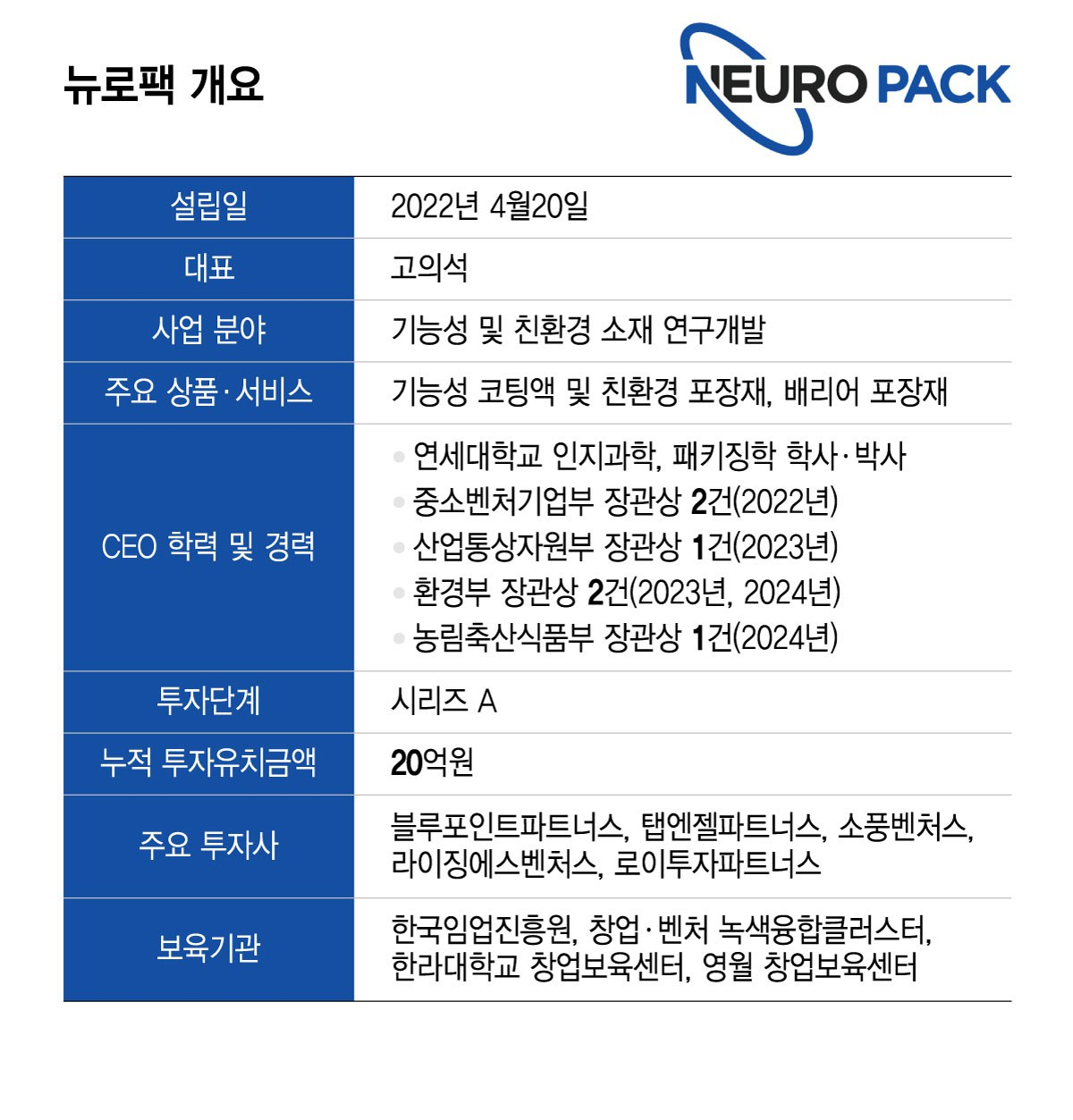
NeuroPack is also expanding collaboration with large corporations and institutional investors through the PoC (Proof of Concept) method. It has conducted various PoCs with NH Harvest, Nonghyup, Lotte, and others, and these references are positively contributing to sales expansion. It is also strengthening its production base. Ko (CEO) stated, "Developing good materials alone is not enough. To truly open the market, we must mass-produce with uniform quality and meet delivery schedules and costs." He revealed, "We began constructing our factory two years ago and have been operating in earnest since early this year, focusing on improving production efficiency."
The goal for this year is to explore overseas markets. Ko (CEO) said, "We are striving to make this year the first year of overseas exports." He explained, "Countries like Japan and some European nations with insufficient landfill space will target functional and eco-friendly packaging materials, while countries like the United States and China with high landfill proportions will target biodegradable packaging materials." He further remarked, "If just one more day is added to the shelf life, discarded food decreases; if farmers don't have to remove mulch films, labor burdens in rural areas decrease. Such small differences ultimately create greater future value."
[MoneyToday startup media platform 'Unicorn Factory']

 in FUTURE


