

More diverse corporate information on the startups mentioned in this article can be found at Unicorn Factory's big data platform 'Data Lab'.
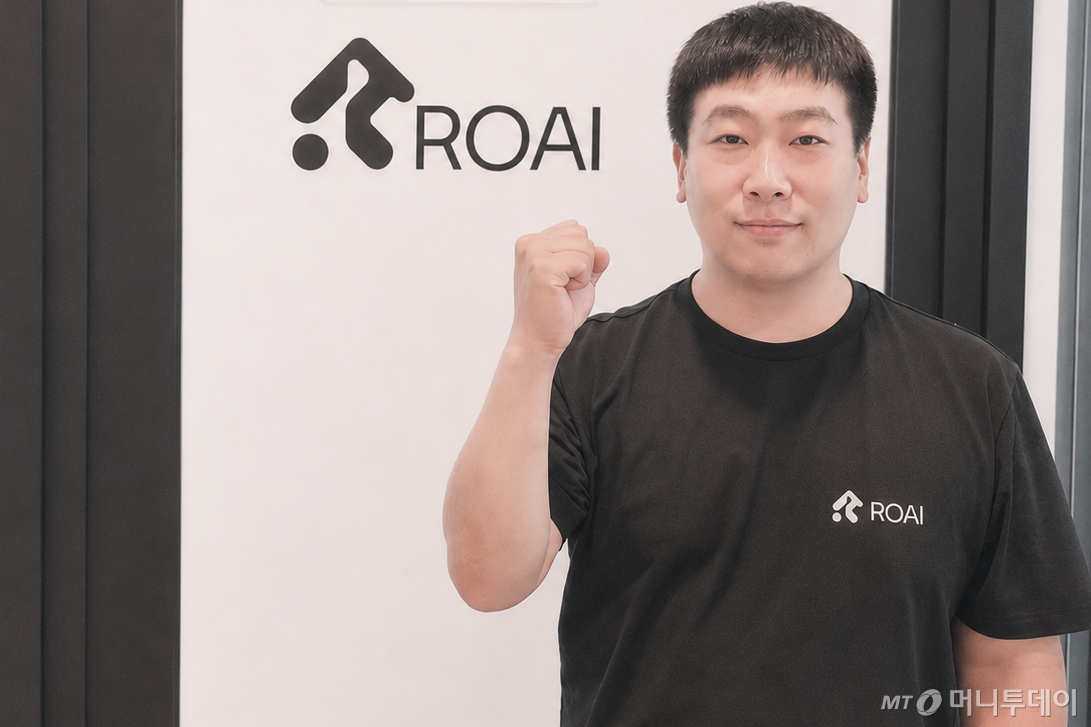
"While automotive manufacturing technology has continued to advance, robot control methods have remained largely unchanged. The biggest challenge in the field has been that every time a process changes, workers must manually reset every step from scratch. To address this issue, we conceived a solution that leverages AI (artificial intelligence) to enable easy control and orchestration of robots."
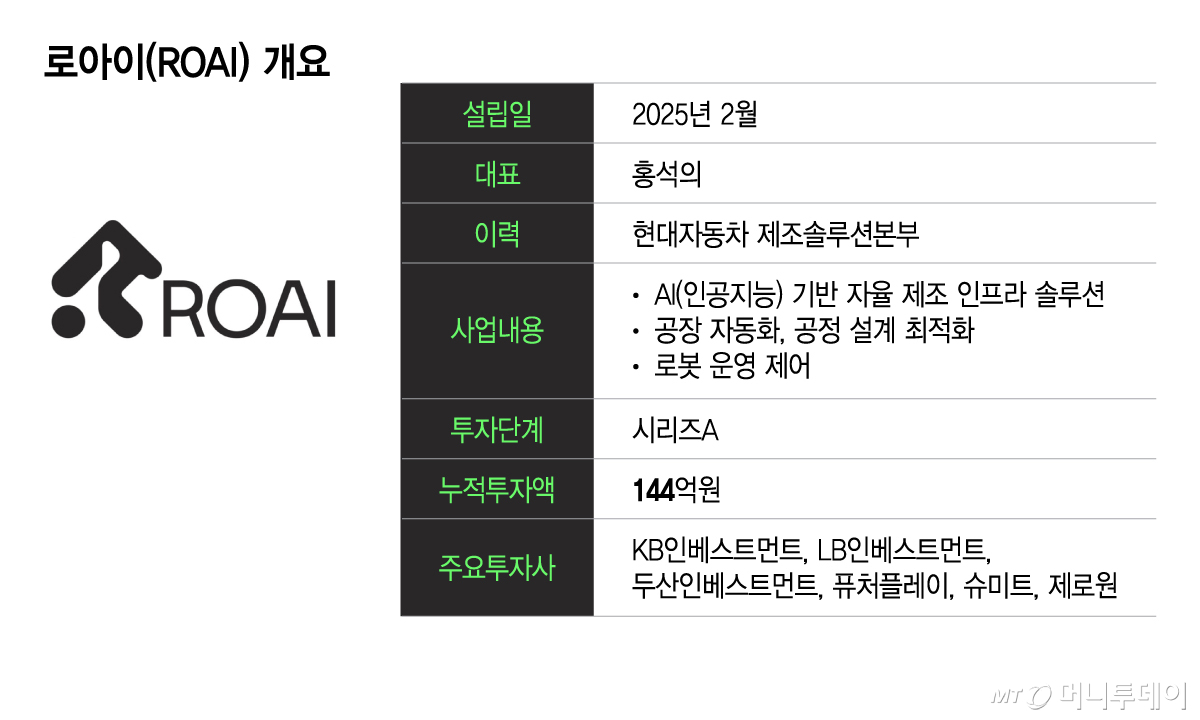
Hong Seok, the CEO of RoAI, recently made these remarks regarding the company's founding background in an interview with Money Today's startup media platform, 'Unicorn Factory.' Hong (CEO) worked at Hyundai Motor's Manufacturing Solutions Division for about 10 years, where he was responsible for developing AI-based multi-robot offline programming (OLP) prototypes, digital transformation (DX), AI manufacturing technologies, and new vehicle development production technologies. After launching the business as an internal venture at Hyundai Motor, he spun off the company in February 2025.
The initial concept for the startup was to create an AI (artificial intelligence) module that calculates robot movements. However, as AI technology has rapidly advanced, the scope of the business and the scale of Hong (CEO)'s dream have grown accordingly. He said, "We have been advancing our solutions by directly comprehensively controlling real-world robots using data calculated in virtual spaces."
Loai is a startup developing the software "XELO," which automates the entire process from factory design to robot motion control using AI. The system supports not only factory design and simulation but also automatically handles process layout and optimization.
Loai secured a seed investment of 1.4 billion won last May with Future Play as the lead investor. In April this year, it also successfully raised a Series A round totaling 13 billion won. The Series A round involved participation from KB Investment, LB Investment, Doosan Investment, and others.
Months of programming... automation focused on tasks
Hong (CEO) pointed out that the process of determining where a robot in a production factory moves which parts and which areas to weld is always the result of precise programming, adding that "the problem arises when the number of robots exceeds 200 to 300, as even minor changes require reprogramming the entire system." The speaker further noted that "once the number of robots surpasses just 30, it becomes difficult for humans to remember every task individually," and added that "optimization takes a long time, sometimes requiring several months just for programming work."
Loi aimed to solve these challenges through AI computation. He stated, "Having personally experienced the difficulties on-site, I understood the pain better than anyone else, which is why I embarked on developing a solution." Loi advanced its solution by focusing on the robot's 'task (desk).' By building the system based on individual actions such as material transport, welding, and bolt tightening, it has evolved into a versatile solution applicable not only to automobile manufacturing but also to various other manufacturing sectors.
Loai's solution is currently being utilized at domestic automakers including Hyundai Motor and Kia, as well as at Tier 1 component suppliers. According to the company, the introduction of this solution into key processes such as welding lines and vision inspection during collaboration with Hyundai Motor has reduced engineering (reprogramming) time required for new robot motion planning and verification by more than 80 percent.
Hong (CEO) stated, "Currently, the solution is being validated by applying it to specific projects and producing results," adding, "In the future, as labor costs rise and labor shortages worsen, more processes will be driven toward automation, so demand for solutions will inevitably grow."
"Aiming to deliver AI orchestration factory"
Loia ultimately aims to go beyond individual robot control and build and deliver an 'orchestration factory' where AI coordinates the entire manufacturing process. Hong (CEO) stated, "Most startups focus on automation that replaces humans with robots in factories," adding, "In contrast, our team's differentiated strength lies in exploring how to make more efficient use of robots already widely used in existing industrial sites."
Specifically, the plan is to build an autonomous stage by having AI analyze manufacturing processes based on product drawings and automatically set up robots. He stated, "Once this form is completed, aerospace and defense companies with high production volumes but frequent process changes will be able to quickly establish production bases." He added, "As the solution becomes more advanced, automated factories can be supplied even in small spaces."
Loi is currently constructing a testbed factory in Gunpo, Gyeonggi Province, to demonstrate the aforementioned solution. The company plans to continue experiments there aimed at realizing an unmanned automated factory by integrating and controlling multiple robots as a single solution. In the long term, the goal is to establish a system capable of integrating and controlling even humanoid robots that will be deployed in actual factories as one unified solution.
It is also accelerating its global expansion. Recently, it has been actively knocking on the doors of the Japanese market. Participating in a Japanese startup event through the selection of 'NextRise,' a startup support program, it opened dialogue with local automakers. Hong (CEO) said, "After speaking with Japanese automakers, we found that their pain points exactly match the problems we aim to solve." He added, "We have already applied our technology at GM in the United States and confirmed that even if the global OEM changes, the same solution can be deployed without restrictions."
In addition, the company is in discussions with German firms regarding solutions. Roa plans to focus on enhancing its solutions through the next round of fundraising and applying them to more factories. He stated, "From Series B onward, we will enter a scaling-up phase that allows for an explosive increase in AI training data."
[Money Today startup media platform Unicorn Factory]

 in FUTURE

