

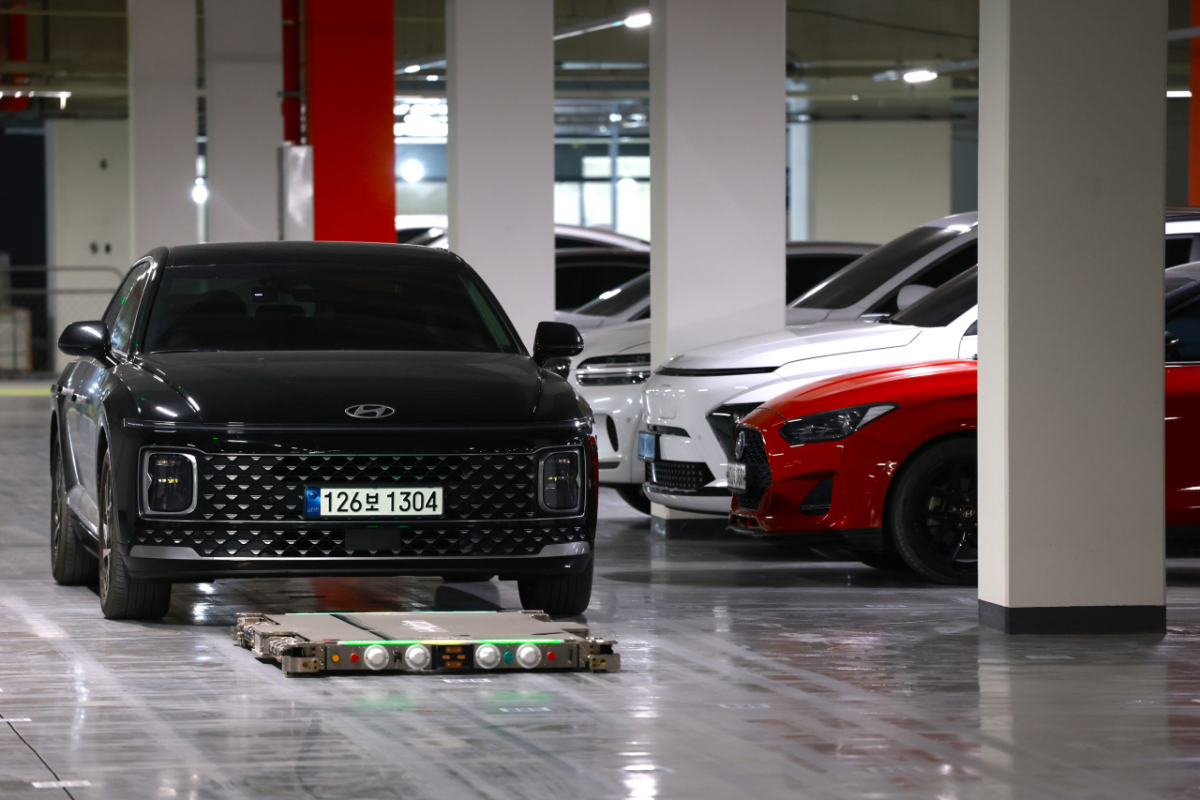
The Hyundai Motor Group verified the practical operational feasibility of a parking robot that moves vehicles in apartment complex parking lots. When a departure request is made from home, it took approximately 3 minutes for the robot to move the vehicle to the exit zone.
The Hyundai Motor Group said Friday that it held a demonstration of a joint housing parking robot by a consortium of Hyundai Motor, Hyundai Wia, and Hyundai E&C at "Hillstate The Wave City" in Siheung, Gyeonggi Province on Thursday.
This project was promoted through the Smart City Regulatory Sandbox. According to the company, this is the first domestic real-world demonstration case of operating parking robots in a parking space of 50 or more spots within an actual apartment complex.
Related agencies, including the Ministry of Land, Infrastructure and Transport, Gyeonggi Province, Siheung City, Suwon City, the Korea Land and Housing Corporation, and the Korea Airport Corporation, also visited the site.
The Hyundai Motor Group simulated three scenarios that could occur in an actual residential environment: simultaneous entry and exit, resolution of double-parking, and temporary departure. In a situation where entry and exit requests were received simultaneously, it showcased multiple robots dispatching and moving vehicles.
The departure service was linked with the apartment unit's wall pad. When a resident requested departure via the wall pad, the parking robot moved the vehicle to the exit zone; in the demonstration, this took approximately three minutes.
In double-parking situations, the vehicle was rearranged to secure movement space, and in cases where the car needed to be temporarily moved to retrieve items, the vehicle was temporarily relocated and then moved back to the parking spot.
The consortium connected the complex's barrier gate, unit wall pads, and an AI-based vehicle inspection system with the parking robot. It confirmed whether the entire parking process, from vehicle entry to storage, inspection, and exit, could be implemented as a single service. The Hyundai Motor Group stated that it has developed a smart parking control system supporting optimal route driving and vehicle dispatch up to version 2.0, which can simultaneously control up to 200 parking robots.
Jung Ho-geun, Vice President of the Future Strategy Division at Hyundai Motor, said, "This is a process that not only confirms the potential of parking robot technology but also applies robotics and mobility technology to actual urban spaces," adding, "We will develop parking spaces into smart city hubs where people, mobility, robots, and urban infrastructure are connected."
Based on this real-world demonstration experience, the Hyundai Motor Group is considering plans to expand the application space for parking robots beyond apartment complexes to transportation hubs such as airports, as well as commercial and office facilities. It also plans to discuss directions for improving standards and systems for stable operation with related agencies.

 in INDUSTRY
