

[For more diverse corporate information on startups, visit the Unicorn Factory big data platform 'Data Lab' .]
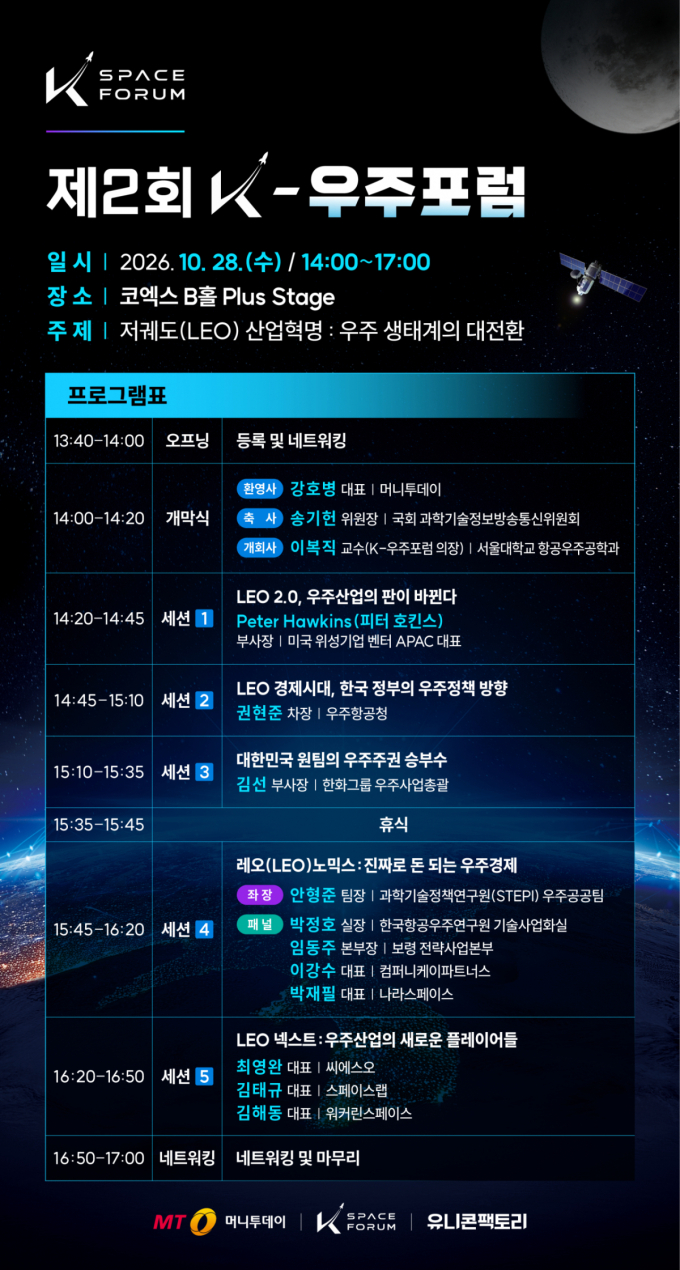
The center of gravity in the space industry is shifting from the "deep space" of the Moon and Mars to the "Low Earth Orbit (LEO)" directly above the Earth (160 to 2,000 km above the surface). This is the reason why the theme of the "2nd K-Space Forum Flagship Forum," hosted by the "K-Space Forum"—bringing together industry, academia, research, and government—and MoneyToday's startup media platform "Unicorn Factory" on the 28th from 2:00 p.m. to 5:00 p.m. at COEX in Samsung-dong, Seoul, is set as "The Industrial Revolution in Low Earth Orbit: The Daejeon of the Space Ecosystem" (Registration: https://url.kr/2hgl5j ) .
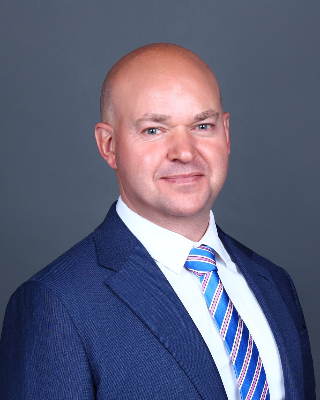
The keynote address for this K-Space Forum will be delivered by Peter Hawkins, Vice President and APAC Representative of Vantor (formerly Maxar), a global leader in satellite imagery, geospatial information, and Earth observation solutions. Hawkins will present on the topic "From Data to Decisions: What Sovereign Intelligence Means in the Modern Threat Environment."
Hawkins has accumulated over 20 years of experience in geospatial technology encompassing satellites, drones, autonomous vehicles, and spatial data systems, having worked with companies such as Esri (a geographic information system firm), HERE (a data company based on Nokia's mapping division), Microsoft, and Garmin (a GPS manufacturer). He has been overseeing Vantor's APAC regional business since last year.
Hawkins is expected to introduce how Vantor's business, which operates 10 LEO satellites, is evolving in response to the demands of global clients. Since beginning its first satellite imagery capture in 2001, Vantor now uses a constellation of satellites orbiting at an altitude of 500 km to photograph 6 to 7 million square kilometers of the Earth's surface daily. While the company previously focused on selling satellite images individually, Vantor explains that customer demand has recently shifted toward "spatial information" that fuses satellite imagery with ground data.
The "information sovereignty" described by Hawkins does not simply mean owning one's own satellites. Even for countries lacking a sufficient domestic satellite constellation, Vantor pursues a model of fully transferring control of its satellites to ensure the establishment of an independent surveillance and monitoring system. In Europe, where security crises have intensified due to the Russia-Ukraine war, a memorandum of understanding (MOU) was signed in June between German defense company Rheinmetall and Vantor to build a sovereign spatial information system. This approach combines Vantor's satellite and spatial information technology with the capabilities of local defense firms.
According to Vantor, 90% of the basic geospatial information used by the U.S. government is based on Vantor technology. The company has signed an option extension contract worth $70 million (approximately 95.6 billion won) with the National Geospatial-Intelligence Agency (NGA) and operates a geospatial information platform used by more than 250 institutional investors. In South Korea, some government ministries and public institutions are also utilizing it for defense and intelligence purposes. The service "Maritime Sentry," which tracks vessels engaged in illegal fishing at sea with their location signals turned off, is sometimes used as legal evidence for vessel seizures in certain countries.
Hawkins plans to emphasize that what customers need is not the satellite imagery itself, but rather the analysis of that information. Furthermore, amid rising geopolitical risks around the world, he intends to introduce ways in which Vantor's LEO satellites and expertise in video information analysis can contribute to government security and corporate decision-making.
Meanwhile, this forum focuses less on the launch vehicles themselves and more on what is carried on them, what data is generated, and who will purchase it. It is being promoted as a venue for connecting technology, capital, policy, and markets to find ways for domestic space companies to secure proof-of-concept track records and customers, and how they can grow.
<2nd K-Space Forum: The Industrial Revolution in Low Earth Orbit - The Daejeon of the Space Ecosystem >
Date and Time: Wednesday, October 28, 2026, 14:00 ~ 17:00
Location: Hall B Plus Stage, COEX, Seoul
Target Audience: VCoCVC reviewers and those interested in space industry investment
Key Content: Global low Earth Orbit market trends, presentation on Hanwha's space business strategy, space startup IR
Registration: https://url.kr/2hgl5j
[MoneyToday startup media platform 'Unicorn Factory' ]

 in FUTURE

