

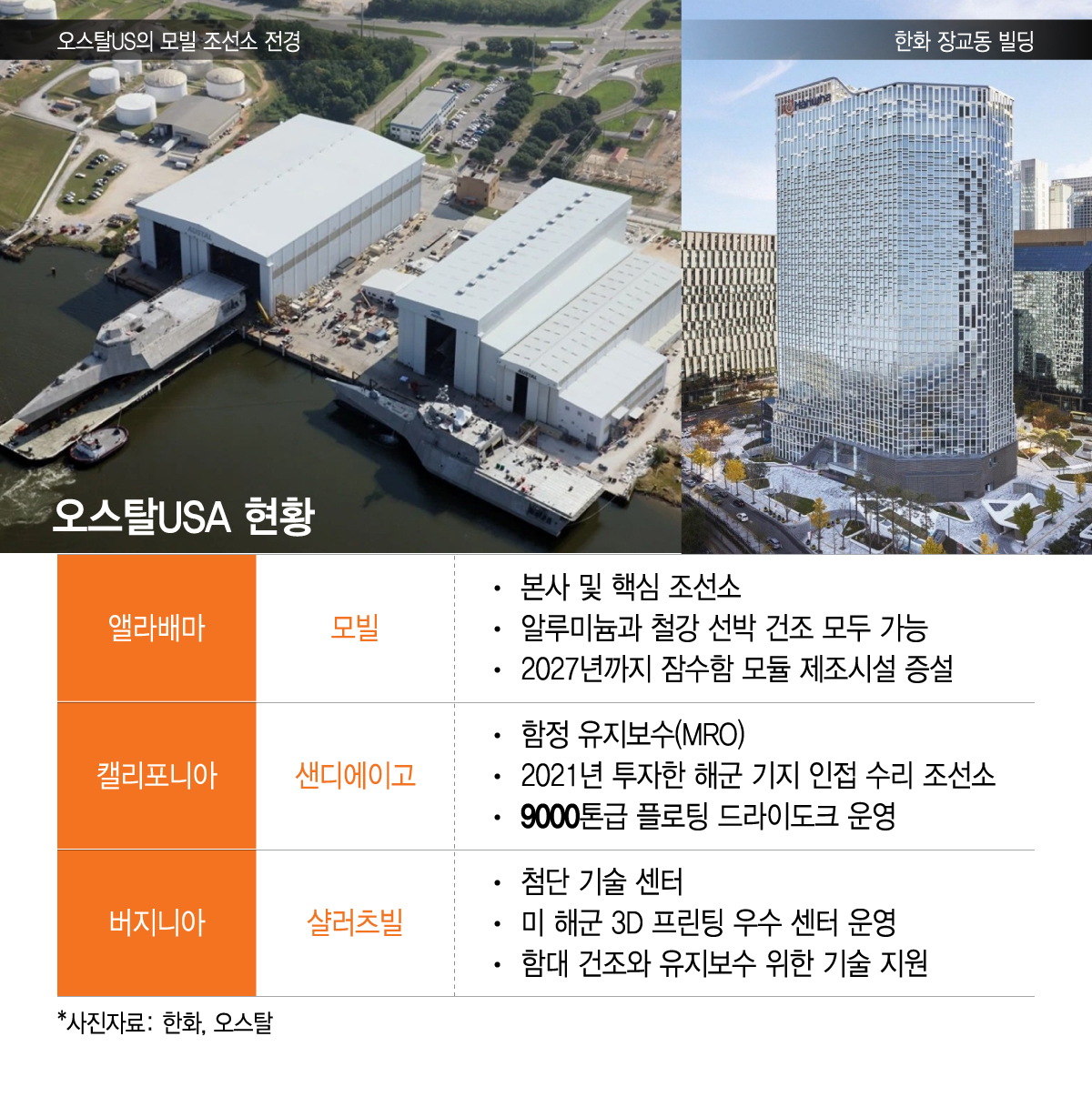
Hanwha Group has decided to invest up to 1.7 trillion won to acquire Ostal USA, driven by the "Make American Shipbuilding Great Again" (MASGA) project. If the deal is finalized, it is expected to accelerate the reconstruction of the U.S. shipbuilding industry and expand the group's business scope to include naval vessels and nuclear-powered submarine supply chains.
Ostal USA is one of the four key suppliers for the U.S. Navy. It specializes in construction for the U.S. Coast Guard and U.S. Navy ships. In fact, its backlog of orders totaling $10 billion includes not only surface ships but also modules for submarines and aircraft carriers. Its core production base, the Mobile shipyard, has extensive experience in mass-producing Littoral Combat Ships (LCS) and Expeditionary Fast Transports (EPF). It also undertakes various shipbuilding projects, including Towing, Salvage, and Rescue Ships (T-ATS), Landing Craft Utility (LCU), and Offshore Patrol Cutters (OPC).
In addition, it is currently producing modules for the Virginia-class attack nuclear submarines and Columbia-class strategic nuclear submarines built by General Dynamics Electric Boat (GDEB). The process involves manufacturing and outfitting Command and Control System Modules (CCSM) and Electronic Deck Modules (EDM), then shipping the completed modules to GDEB's shipyard in Groton, Connecticut, for final assembly. Given that South Korea and the United States have officially formalized their nuclear-powered submarine cooperation, this development carries added significance. Observers suggest it could serve as a stepping stone for accumulating capabilities for a Korean-style nuclear-powered submarine program.
Ostal USA also operates ship maintenance, repair, and overhaul (MRO) business in San Diego, California. In 2021, it acquired and invested in a repair shipyard adjacent to a naval base and is equipped with a 9,000-ton floating drydock. Additionally, its Advanced Technology Center in Charlottesville, Virginia, operates the U.S. Navy's "Additive Manufacturing Center of Excellence (AMCOE)," providing support for manufacturing technologies. Ostal USA thus has an opportunity to join the broader U.S. naval shipbuilding and defense value chain.
Hanwha has already entered the U.S. shipbuilding industry through Philo Shipyard, becoming the first Korean company to do so, and has established a foothold in both commercial shipping and defense markets. Philo Shipyard is constructing not only commercial vessels such as LNG carriers and tankers but also National Security Multi-Mission Vessels (NSMV) for the U.S. Maritime Administration. Recently, it secured an order for a Maritime Radar Instrumentation Vessel (MRIV) from the U.S. Missile Defense Agency, further expanding into defense asset construction. Acquiring Ostal USA would secure Hanwha's second U.S. shipyard and grant access to major contracts in America's most sensitive naval programs.
Recently, Hanwha faced a setback in Canada's largest submarine program, which involves up to 12 next-generation submarines. However, by achieving results through MASGA, it is tightening its grip on global market expansion. The formalization of the Ostal USA acquisition can be seen as a decisive move. This is further supported by the fact that Hanwha plans to invest more than ten times the 10 billion won spent on acquiring Philo Shipyard in 2024 into Ostal USA. Hanwha also plans to invest approximately $5 billion (about 7 trillion won) in Philo Shipyard for facility upgrades.
However, several hurdles remain before the final acquisition of Ostal USA is completed. The deal must pass through relevant procedures by U.S. regulatory authorities, including approval from the Committee on Foreign Investment in the United States (CFIUS) and the Defense Counterintelligence and Security Agency (DCSA), as well as a merger review under the Hart-Scott-Rodino (HSR) Act. Although Hanwha previously obtained CFIUS approval for holding a 19.9% stake in Ostal, it is reported that separate security reviews will be required for the full acquisition of Ostal USA.

 in INDUSTRY
