

As generative AI spreads, the burden on memory capacity is growing, bringing CXL (Compute Express Link) into focus as a technology to supplement HBM's (High Bandwidth Memory) capacity limits. Memory manufacturers including Samsung Electronics and SK Hynix are racing to secure market share by successively unveiling technologies that leverage CXL to improve memory efficiency in AI servers.
According to the electronics industry on the 11th, a research team at Samsung Electronics recently released a paper to the public stating that 'CXL memory can serve as an effective alternative to resolve GPU (graphics processing unit) memory capacity shortages in AI services.' Alongside Samsung Electronics, SK Hynix and Micron, the three major memory companies showcased CXL-related technologies and presented their potential applications at 'FMS 2026' held in the United States from the 4th to 6.
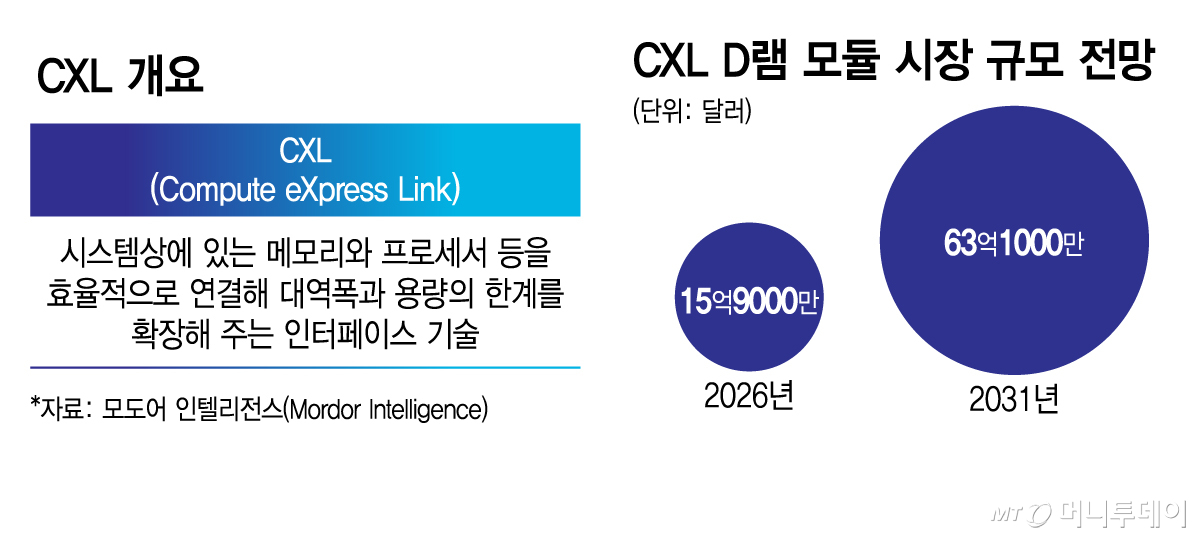
CXL is a technology that efficiently connects memory and processors within a system. By providing high bandwidth and memory consistency, it enables expansion of system memory. It allows for large-scale memory configurations that go beyond the physical limitations of conventional DRAM setups.
In particular, by utilizing CXL switches, multiple CXL memory devices can be configured into a single shared memory pool. Memory can be flexibly allocated as needed, and total available memory capacity can also be increased. With memory capacity shortages becoming more pronounced in recent AI systems, this technology is gaining attention as a means to alleviate the issue.
In generative AI, the required memory capacity increases rapidly due to the growth of KV cache (Key-Value Cache). KV cache is data that stores previously processed information for later reuse when the AI generates responses. As conversations grow longer and the number of concurrent users rises, the KV cache expands, potentially making it difficult to store everything solely in the HBM mounted on GPUs.
Memory manufacturers are focusing on the fact that by utilizing CXL memory, KV caches that cannot fit entirely into HBM can be moved and stored in a larger-capacity external memory layer. The approach involves keeping data requiring fast computation in HBM while expanding large-volume KV caches to CXL DRAM or similar technologies.
Samsung Electronics' research team also confirmed this possibility in their recent paper. Samsung Electronics' DRAM-based CXL devices demonstrated processing throughput comparable to the system's main DRAM during KV cache transmission experiments. Especially in environments with long conversation lengths, inference throughput improved by up to nine times compared to methods using only GPU memory (VRAM), and the time to generate the first token was reduced to as little as one-sixteenth of the original duration.
CXL is also evolving toward a model where multiple servers share a large-scale memory pool. This helps reduce the so-called 'stranded memory' problem, where some servers have excess memory while others face shortages, thereby improving resource utilization in data centers and lowering total cost of ownership (TCO). Samsung Electronics has unveiled its next-generation product 'MD310' following the CXL 2.0 version CMM-D 'MD220' and is currently coordinating the Yangsan timeline.
At FMS, SK Hynix showcased a memory expansion technology based on CXL that manages KV caches in distributed systems connecting multiple servers and GPUs. The company is developing technologies to reduce data movement bottlenecks compared to methods relying on existing networks.
SK Hynix is also researching CXL-based HYBE read memory technology, which combines DRAM and SSDs. This creates a hierarchical structure where large-volume data is stored in relatively inexpensive SSDs, while frequently accessed data is preloaded into DRAM. Additionally, the company has developed a technology that quickly predicts necessary KV caches based on past work history and preloads them into DRAM for processing.
Although CXL is still in the early stages of market formation, expectations for its growth are rising as memory demand for AI infrastructure surges. According to market research firm Modor Intelligence, the global CXL-connected DRAM module market is projected to grow approximately fourfold from $1.59 billion this year to $6.31 billion by 2031.
An industry insider stated, "Although still in the early stages of the market, CXL-based memory pooling technologies are gaining attention due to memory bottlenecks." They added, "These technologies not only improve AI efficiency but also reduce total cost of ownership, drawing significant interest from the industry."

 in INDUSTRY
