

Amid a "triple threat" of high prices, domestic market stagnation, and high exchange rates, Q2 results for food companies showed mixed outcomes. While struggling in the domestic market due to reduced consumer spending and rising costs, companies that rode the wave of the 'K-food' boom overseas managed to offset their weak domestic performance with gains abroad.
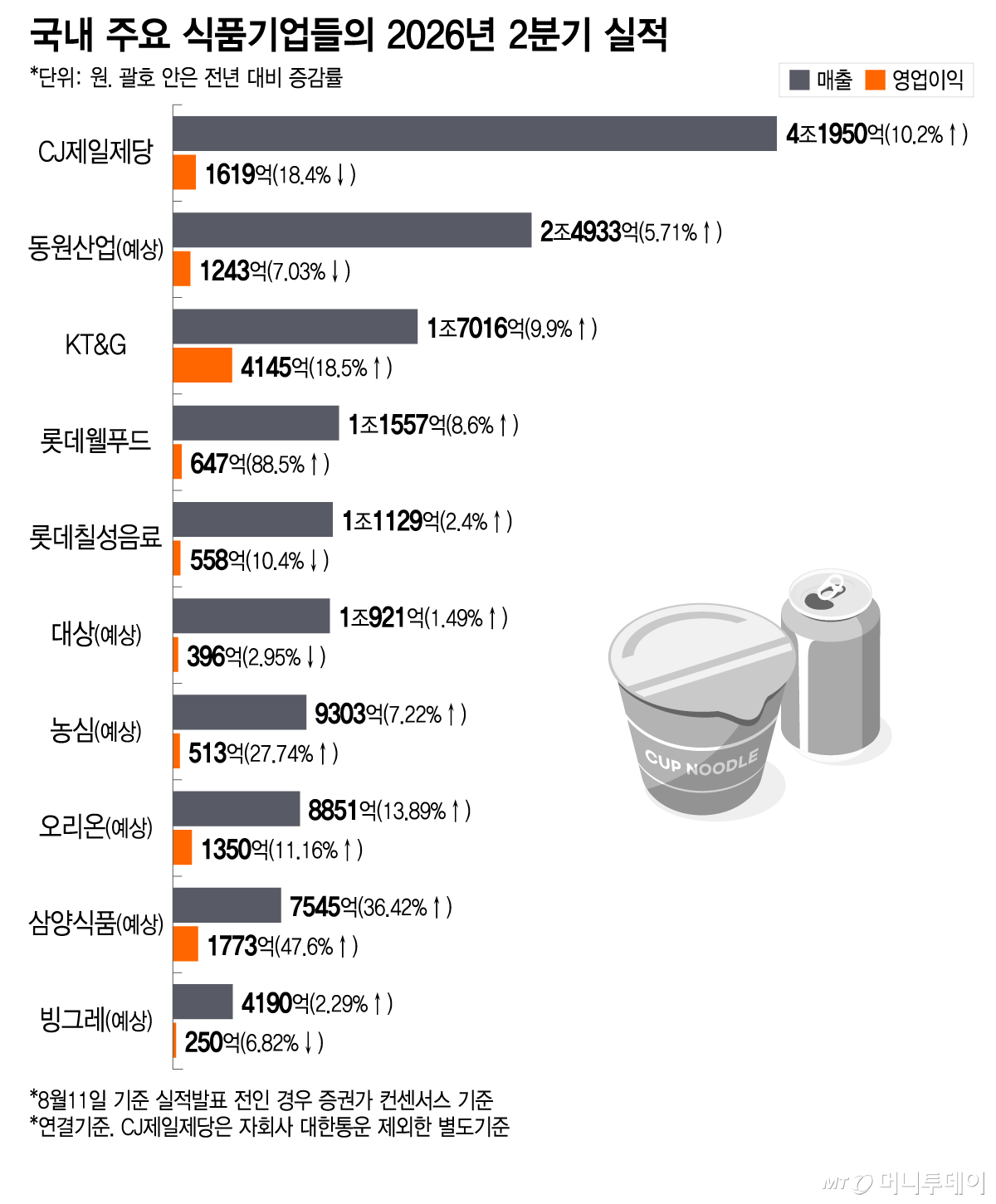
According to the food industry on the 11th, CJ CheilJedang, which released its results on this day, recorded sales of 4.195 trillion won and an operating profit of 161.9 billion won for the second quarter of this year. While sales increased by 10.2% compared to the same period last year, operating profit fell by 18.4%. Strong performance in overseas food sectors such as North America and Europe was offset by a slowdown in processed food sales due to weak domestic consumption and sluggish results in the bio sector, which negatively impacted overall profitability.
Lotte Wellfood achieved the most notable results, buoyed by the positive response to K-food. Lotte Wellfood's Q2 operating profit rose 88.5% year-on-year to 64.7 billion won. In particular, the operating profit of its overseas subsidiaries surged 133% to 29.6 billion won, driving overall performance growth. This was the result of products like 'Choco Pie' gaining significant popularity in emerging markets such as India and Kazakhstan.
Ramen manufacturers are also expected to continue their high-flying performance in the global market, fueled by the popularity of 'K-ramen'. Nongshim's Q2 operating profit is projected to rise 27.74% year-on-year to 51.3 billion won ahead of its earnings announcement on the 14th. The securities industry also expects Samyang Foods to post an operating profit of 177.3 billion won (a 47.6% increase), driven by the global popularity of 'Buldak Spicy Chicken Ramen'. Orion, another pillar of 'K-sweets', and KT&G, which benefited from strong overseas cigarette sales, also demonstrated stable growth. Orion's Q2 operating profit for this year is expected to reach 135 billion won, an 11.16% increase compared to the same period last year, ahead of its earnings announcement. KT&G, which has focused heavily on overseas markets, recorded a strong performance with a Q2 operating profit of 414.5 billion won, up 18.5% from the previous year.
Conversely, companies focusing primarily on the domestic market, including Lotte Chilsung Beverage (operating profit 55.8 billion won, -10.4%), Daesang (forecast operating profit 39.6 billion won, -2.95%), Dongwon Industries (forecast 124.3 billion won, -7.03%), and Binggrae (forecast 25 billion won, -6.82%), showed a downward trend. This is attributed to the full burden of cost pressures resulting from price hikes in packaging materials such as naphtha and increased costs for imported raw materials.
These burdens are expected to continue into the second half of the year. The price of naphtha, used for food packaging, remained 35.2% higher than at the beginning of the year as of the 7th, while international oil prices and shipping rates have yet to stabilize. Consequently, analysts suggest that the performance of the food industry in the second half will depend on how much companies can offset weak domestic market performance with gains from overseas markets. A food industry executive stated, "There are limits to improving profitability in the domestic market due to rising costs for imported raw materials and other expenses," adding, "The key to Q3 and Q4 results will be how well companies can defend against declining domestic market profitability through their overseas operations."

 in INDUSTRY
