

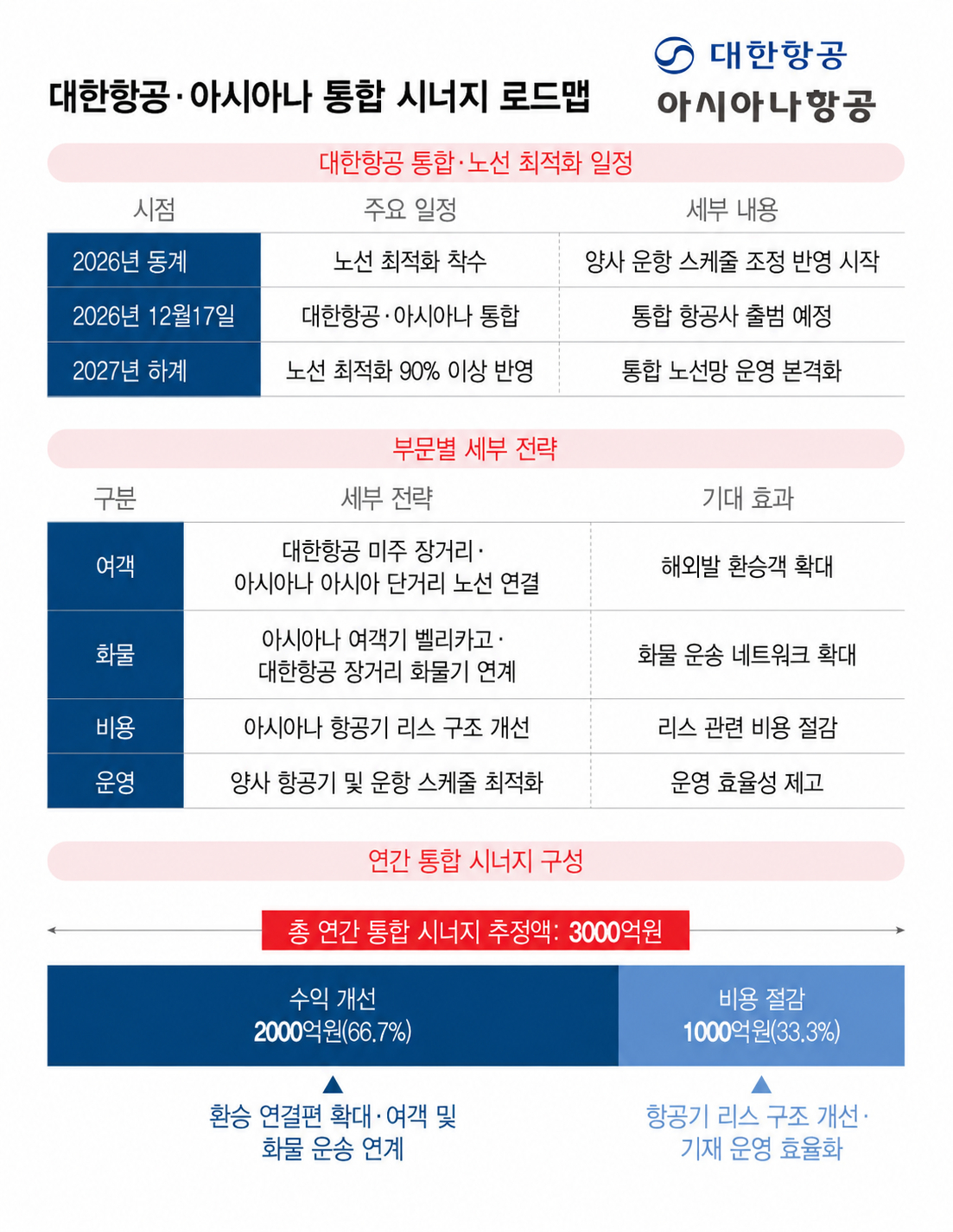
Korean Air is set to generate approximately 300 billion won in synergies through route optimization and other measures ahead of its integration with Asiana Airlines on December 17.
According to aviation industry sources on the 16th, Korean Air will begin optimizing routes for both carriers starting from this year's winter flight schedule. The approach involves adjusting overlapping flight time slots and linking long-haul and short-haul routes to expand the acquisition of connecting passengers. Most of the optimization plan is expected to be reflected in next year's summer schedule, with the entire process scheduled to be completed over approximately one year.
Korean Air previously estimated the annual synergy effect from its integration with Asiana Airlines at approximately 300 billion won, comprising a 200 billion won revenue improvement and a 100 billion won cost reduction. The strategy is to integrate the route networks and aircraft operating systems of both carriers to expand passenger and cargo revenues while reducing duplicate costs. It is expected that the pace of revenue improvement from the integration will accelerate once flight schedule restructuring is fully reflected starting next year.
The most significant change will be the expansion of the connecting network. By combining Korean Air's long-haul routes to the Americas with Asiana Airlines' short-haul routes in Asia, itineraries that were previously unconnected can be bundled into a single network. This involves dispersing flights from both carriers that had been concentrated in similar time slots to increase connecting options and broaden passenger choices.
Korean Air cited connecting flights from Hong Kong to the Americas as an example. The company explained that while combining three flights departing from Hong Kong with two flights to the Americas yields six possible connections, expanding these to six and four flights respectively would increase the combinations to 24. This was presented as a case to illustrate the connectivity effect resulting from route network integration, rather than the scale of increased flight frequency.
The expansion of connecting demand is already evident. A Korean Air official stated, "Connecting demand from the Americas to Southeast Asia, China, and Japan has been steadily increasing," adding, "This year's increase in flights on routes to Atlanta, U.S., and Vancouver, Canada, was also aimed at securing additional connecting passengers from the Americas to Asia." It is projected that the capacity to attract connecting passengers will grow further once Asiana Airlines' short-haul connections are added to the integrated network.
In fact, Korean Air's passenger revenue for the third quarter of this year reached 2.9174 trillion won, an increase of approximately 21% compared to the same period last year. Although passenger demand from South Korea was somewhat subdued, performance was driven by a significant increase in demand for flights from overseas to South Korea and connecting traffic at Incheon Airport. Korean Air plans to focus on efficiently utilizing Asiana Airlines' existing routes and flight frequencies rather than significantly increasing its own aircraft supply next year.
The core of the estimated annual cost reduction of approximately 100 billion won lies in improving the aircraft leasing structure of Asiana Airlines. Asiana Airlines has primarily relied on operating leases due to its relatively lower credit rating, whereas Korean Air is reported to have a proportion of financial leases and directly owned aircraft reaching approximately 90%. It is expected that restructuring Asiana Airlines' aircraft leasing and procurement structure based on Korean Air's credit rating after the integration will yield cost savings of approximately 100 billion won.
Efficiency in aircraft operations is also drawing attention. Korean Air expects that most of the aircraft to be introduced next year will be replacements for existing fleets, with the net increase on a standalone basis limited to one or two aircraft. The plan focuses on restructuring the route networks of both carriers and optimizing supply by efficiently utilizing Asiana Airlines' existing fleet rather than significantly increasing its own owned aircraft.

 in INDUSTRY
