

HD Hyundai's Southeast Asian shipyards are showing strong order momentum, emerging as forward bases for its global commercial ship market strategy. Southeast Asia is rising as a strategic hub to counter the price competitiveness of Chinese shipbuilders in the commercial ship market. HD Hyundai plans to expand its production footprint in Southeast Asia over the medium to long term.
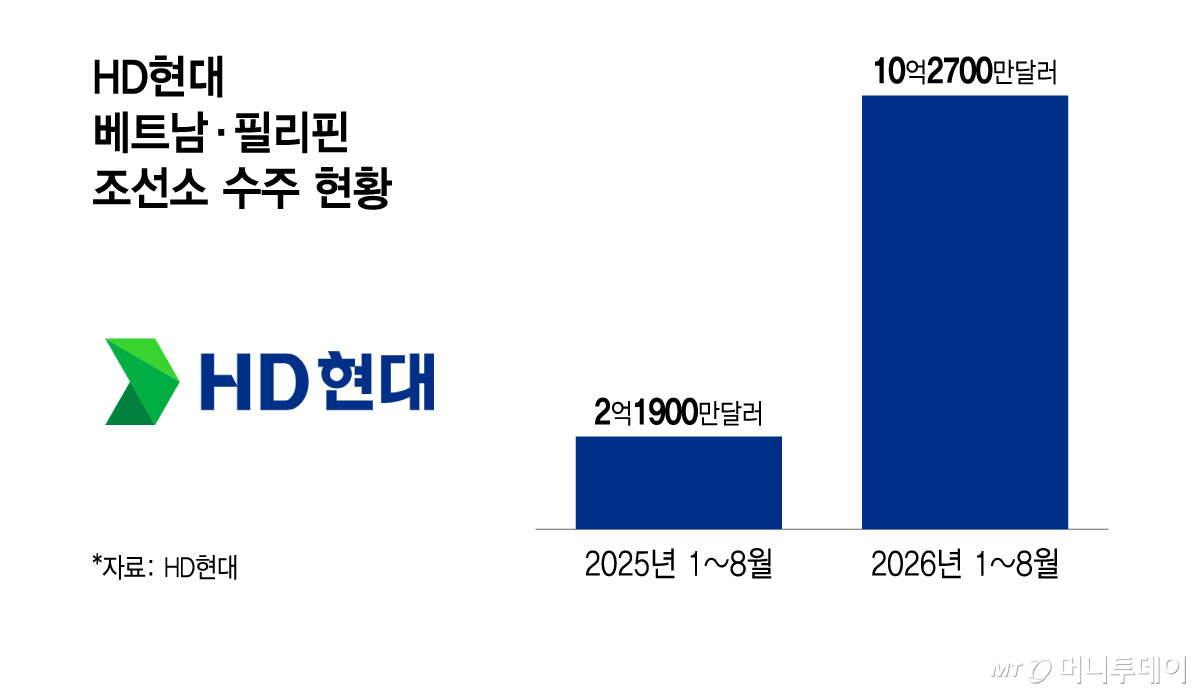
According to the shipbuilding industry on the 21st, HD Hyundai's Vietnam and Philippines shipyards secured orders for a total of 11 vessels from January to August, including seven petrochemical product carriers (PC ships) and four very large crude oil carriers (VLCCs). The order value reached $1.027 billion, amounting to 155.6% of the combined order target of $660 million for the two shipyards. This represents an increase of more than four times compared to the $219 million in orders during the same period last year.
It is assessed that HD Hyundai's strategy of strengthening its Southeast Asian production bases has translated into successful order results. HD Hyundai operates HD Hyundai Vietnam Shipyard, the largest in Southeast Asia, and in April agreed with Vietnamese authorities to extend the lease period of its production site by 20 years until 2066, laying the foundation for long-term operation of its local production base. In May last year, it established HD Hyundai Philippines, a local subsidiary in the Philippines.
These shipyards are hubs that HD Hyundai is cultivating to respond to the low-price offensive from China's shipbuilding industry. Rather than producing all vessel types domestically, HD Hyundai's strategy is to utilize overseas production bases to broaden its commercial shipbuilding foundation. In Vietnam and the Philippines, it will expand the production of vessels with relatively lower prices, such as oil tankers and container ships, while domestic shipyards will focus on high-value-added vessels like liquefied natural gas (LNG) carriers. The plan is to enhance price responsiveness in the commercial ship market where direct competition with Chinese shipbuilders exists, while strengthening the capability to build highly profitable vessels domestically.
The market environment is also contributing to the expansion of orders centered on oil tankers. According to UK shipping and shipbuilding market analysis firm Clarkson Research, a total of 177 VLCCs, or 54.5 million DWT (deadweight tons), were ordered worldwide in the first half of this year. The previous record was 32.6 million DWT recorded over the entire year of 2006, but this year's figure surpassed that within just six months. Newbuild prices for VLCCs have also risen to their highest level since 2008, exceeding $130 million per vessel. Lee Han-gyeol, a research fellow at Kiwoom Securities, predicted, "The strong newbuild order momentum for HD Hyundai's overseas subsidiaries will continue through the first half of next year."
HD Hyundai is also moving to expand production capacity in line with increased orders. It plans to increase the annual production capacity of its Vietnam shipyard from the current 15 vessels to 23 by 2030, and aims to expand it to 30 vessels annually over the medium to long term. The goal is to raise the Philippines shipyard's production capacity from 4 to 10 vessels per year. The company intends to build a foundation to respond to global commercial ship demand by increasing construction volumes at its overseas production bases. An industry official said, "I believe that expanding Southeast Asian production hubs will contribute to enhancing HD Hyundai's price competitiveness and order responsiveness in the commercial ship market."

 in INDUSTRY
