

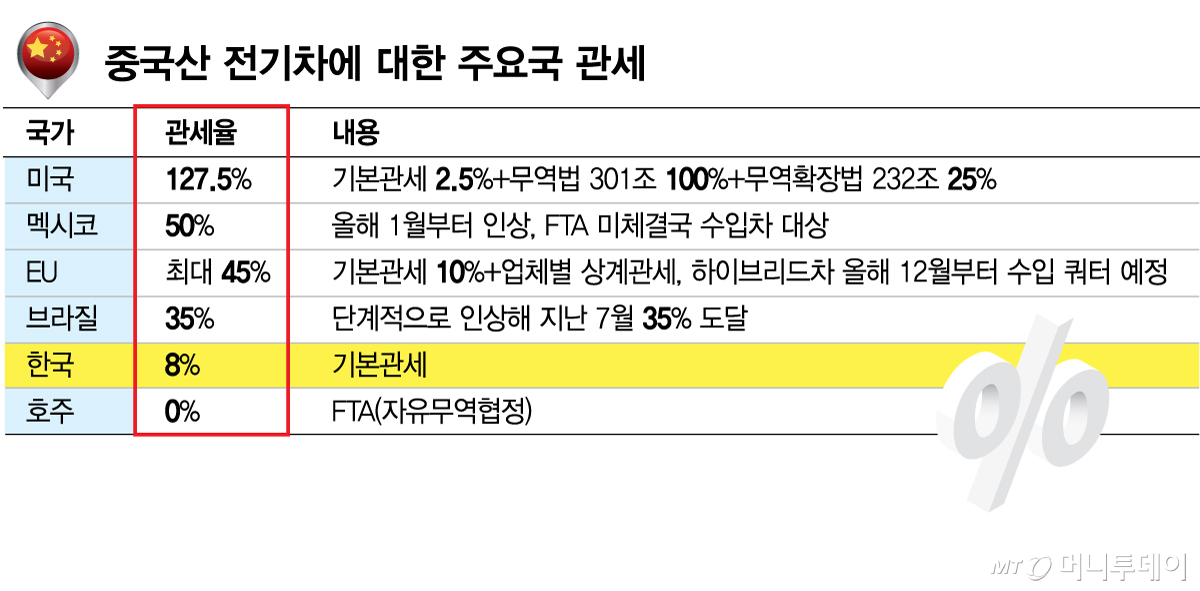
The only country that has effectively halted the Chinese EV offensive is the United States, which has erected high tariff barriers. Southeast Asia, South America, and Australia, where entry barriers were low, have already ceded their home markets. The European Union (EU), which has recently begun to lock the door, is also struggling to stop Chinese cars that are circumventing tariffs. This is why voices are emerging calling for South Korea to hurry in preparing defenses against Chinese EVs.
According to industry sources on the 22nd, the U.S. tariff on Chinese-made EVs reaches 127.5%, comprising a base tariff of 2.5%, a 100% tariff under Section 301 of the Trade Act, and a 25% imported vehicle tariff under Section 232 of the Trade Expansion Act. As a result, Chinese brands such as BYD have been unable to enter the U.S. market. The United States is effectively defending its home turf through tariffs.
In contrast, markets with low entry barriers have been rapidly eroded. According to market research firm MarkLines, 90.8% and 91.6% of EVs sold in Thailand and Indonesia, respectively, in the first half of this year were Chinese brands. Thailand was once known as a "Japanese car stronghold," where Japanese brand share reached as high as 90%. Australia does not impose tariffs on Chinese-made cars under its Free Trade Agreement (FTA). Last month, Chinese-made vehicles accounted for 35.5% of the Australian new car market, significantly outpacing Japanese-made (22.5%) and Korean-made (9.6%) vehicles.
Brazil locked the door late, but Chinese products have already dominated the market. Although Brazil gradually raised import tariffs on EVs to reach 35% in July last month, Chinese brands accounted for 93.4% of the Brazilian EV market in the first half of this year. BYD has even begun local production by purchasing the site of a factory abandoned by Ford. Mexico also raised tariffs on imported vehicles from countries without an FTA to 50% starting in January this year, but sales of new Chinese brand vehicles in the Mexican market increased by 27.7% year-on-year in the first half of this year. It is predicted that even with higher tariffs, it will be difficult to push out Chinese cars that have already taken root in the market.
The EU left a low barrier for HYBE lead vehicles and is now raising it late. Although it imposed tariffs of up to 45% on Chinese-made pure electric vehicles starting in October 2024, HYBE lead vehicles only had to pay the base tariff of 10%. As Chinese companies exploited this loophole, the share of Chinese-made vehicles in the EU plug-in HYBE lead vehicle market jumped from 2% in 2024 to 25% in the first half of this year. Ultimately, the EU agreed on the 9th last month to adjust exports of Chinese HYBE lead vehicles. Starting in December this year, imports of Chinese-made HYBE lead vehicles will be capped at 350,000 units annually for four years, with the cap increasing by 6% each year.
Chinese companies are breaking through even this barrier through local production. BYD entered its Hungary factory Yangsan in mid-year, and Changan Automobile plans to begin European production in early next year. Although the EU introduced the Industrial Acceleration Act (IAA) in March last month, which requires a 70% intra-regional component share to qualify for EV subsidies, Chinese companies are responding by building local supply chains even before regulations are finalized.
In the domestic market as well, it is not easy for Korean cars to compete with Chinese cars on price. China, with lower labor costs and production prices, is analyzed to have finished vehicle costs 30% to 40% lower than in other countries like South Korea. Lee Sang-soo, a researcher at iM Securities, stated, "EVs are a field where technical overtaking is relatively easier compared to internal combustion institutional investor vehicles," and predicted, "It will be difficult to compete with Chinese cars without policy support." He added, "Incentives for Korean cars alone are insufficient; penalties to block Chinese cars are also needed," and suggested that a "Korean version of the IAA" and exclusive policies similar to those in the U.S. are necessary together.

 in INDUSTRY
