

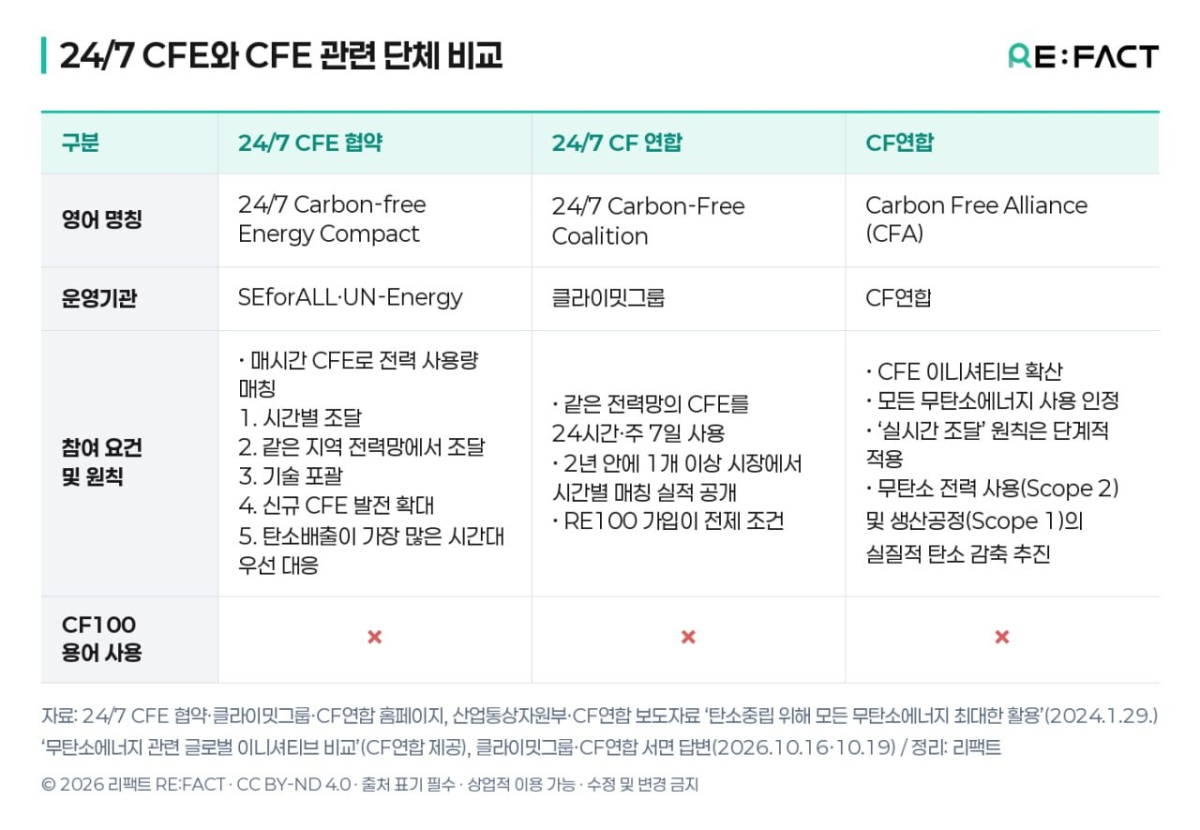
Google's electricity consumption surged 2.4-fold over the past five years due to the expansion of artificial intelligence (AI) services, yet the company has achieved 100% annual renewable energy matching (RE100) for nine consecutive years.
Statements from some government officials claiming that "Google also switched from RE100 to CF100" were found to be factually incorrect. The 'CF100' agreement itself does not exist, and the '24/7 CFE (Carbon-Free Energy around the clock)' that Google committed to implementing is an advanced goal based on RE100 with added real-time procurement conditions.
Google is a core member of RE100… 24/7 CFE is 'more difficult' than RE100
On the 22nd, fact-checking media outlet REFACT diagnosed this in its report titled "Did Google switch from RE100 to CF100? No, that's not true," which was verified by cross-referencing documents from Climate Group (the organizer of RE100), the Carbon-Free Energy Coalition (CF Coalition), and Google's environmental reports.
Minister of Trade, Industry and Energy Kim Jung-kwan made statements during a National Assembly hearing on the Ministry of Trade, Industry and Energy and SME Venture Committee on the 6th, responding to questions regarding RE100, including "Google also switched from RE100 to CF100" and "Most of the power used by Google or Amazon among US data centers is either gas combined cycle or nuclear."
Regarding the statement that "Google also switched from RE100 to CF100," REFACT noted, "Among credible organizations involving international bodies such as the United Nations, international groups, and governments, there is no organization running a 'CF100' campaign," adding, "Even the CF Coalition, launched under the leadership of the Korean government, does not officially use the term 'CF100.'"
The goal Google is pursuing is '24/7 CFE.' Going beyond RE100, which secures renewable energy procurement performance equivalent to annual electricity usage through methods such as certificate purchases or power purchase agreements (PPAs), it aims to align electricity consumption with carbon-free power supply on an 'hourly and same-grid' basis, making it more difficult to achieve than RE100.
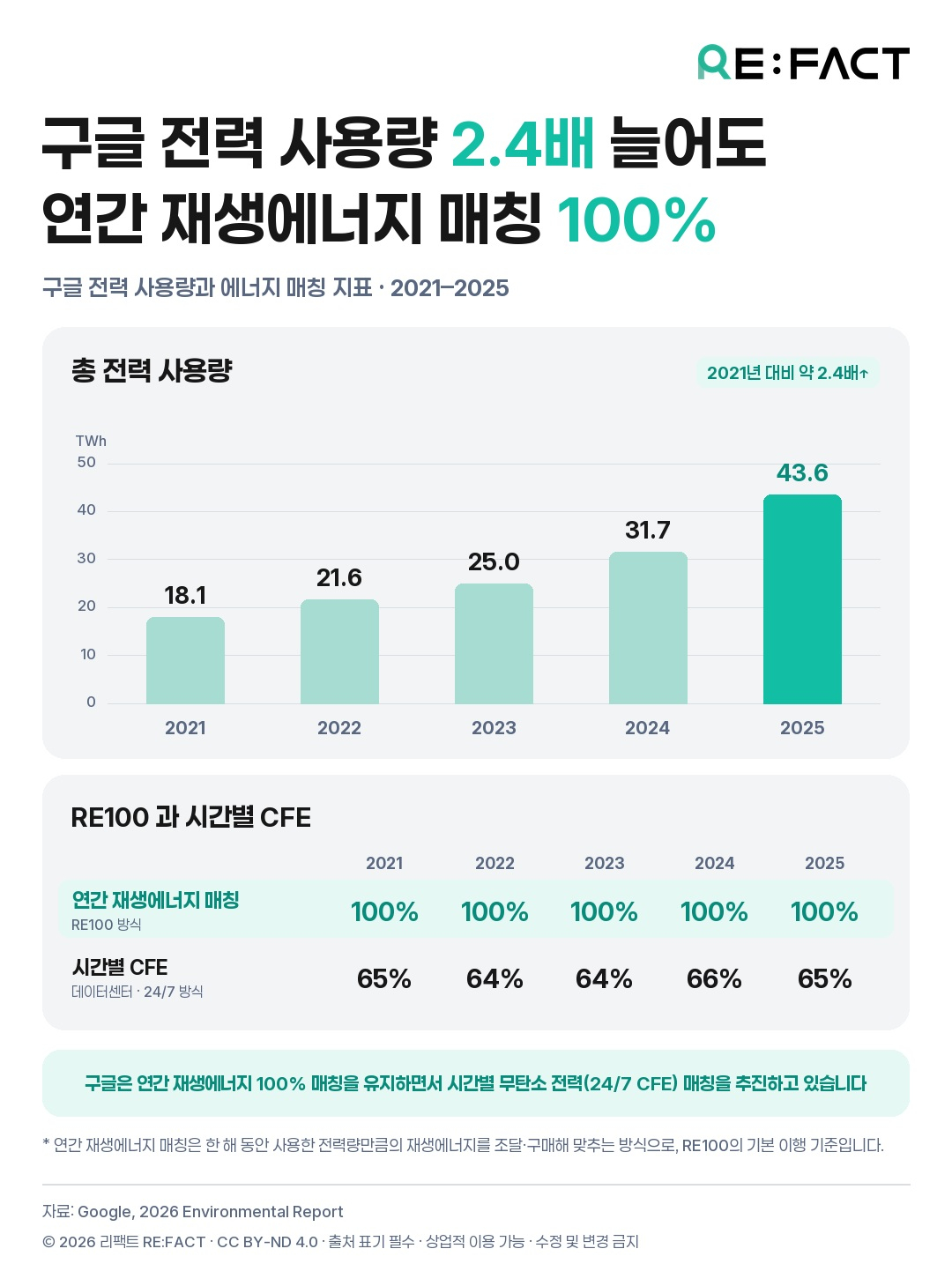
Google first announced this concept in 2021. In September 2021, at the UN Energy High-Level Dialogue held in New York, USA, Google, the United Nations Energy, and Sustainable Energy for All (SEforALL) launched the '24/7 CFE Compact' as a '24/7 CFE Agreement.' At the time, Google stated, "Our goal is to operate all data centers and office campuses worldwide with carbon-free energy every day by 2030."
Subsequently, in 2024, Google participated as a founding partner of the 24th/7 CF Coalition (Carbon-Free Coalition) launched by Climate Group. This coalition is an industry alliance where RE100 member companies join and operate. Oli Wilson, Head of RE100 at Climate Group, emphasized to REFACT, "Joining RE100 is a prerequisite for joining the 24th/7 CF Coalition," adding, "Pursuing 24/7 CFE aims for hourly and regional grid decarbonization on top of companies' commitment to 100% renewable energy transition."
Google also explained in its 2026 Environmental Report that "24/7 CFE adds the condition of using carbon-free power 'anytime, anywhere' in addition to RE100," noting, "It is based on wind and solar power, and supplements (renewable energy) gaps with power sources and storage devices available every hour."
Meanwhile, Google's RE100 compliance, having joined in 2015, has continued steadily. According to Google's announcement, the company has achieved 100% annual renewable energy matching for nine consecutive years since 2017. This was accomplished while data center demand electricity usage surged 2.4-fold from 18.06 terawatt-hours (TWh) in 2021 to 43.59 TWh in 2025. Climate Group clarified that "Google remains an active member of the RE100 campaign."
REFACT drew a clear line, stating, "Therefore, Kim (Minister)'s statement that 'Google switched from RE100 to CF100' is not true."
Google: 83% of electricity purchases are renewable energy
Furthermore, REFACT pointed out that "Kim (Minister)'s claim that 'Most data centers currently in the US, and most of the power used by companies like Google or Amazon, is for example gas combined cycle or nuclear' also differed from official corporate data."
The respective companies do not disclose the power sources for each data center. However, among Google's total purchased electricity in 2025, renewable energy sources accounted for 36.2 TWh (83%), while non-renewable energy sources accounted for 7.3 TWh (17%). Non-renewable energy sources include fossil fuels such as gas and nuclear power. In other words, even combining gas, nuclear, and coal-fired power, renewable energy purchases are approximately five times higher.
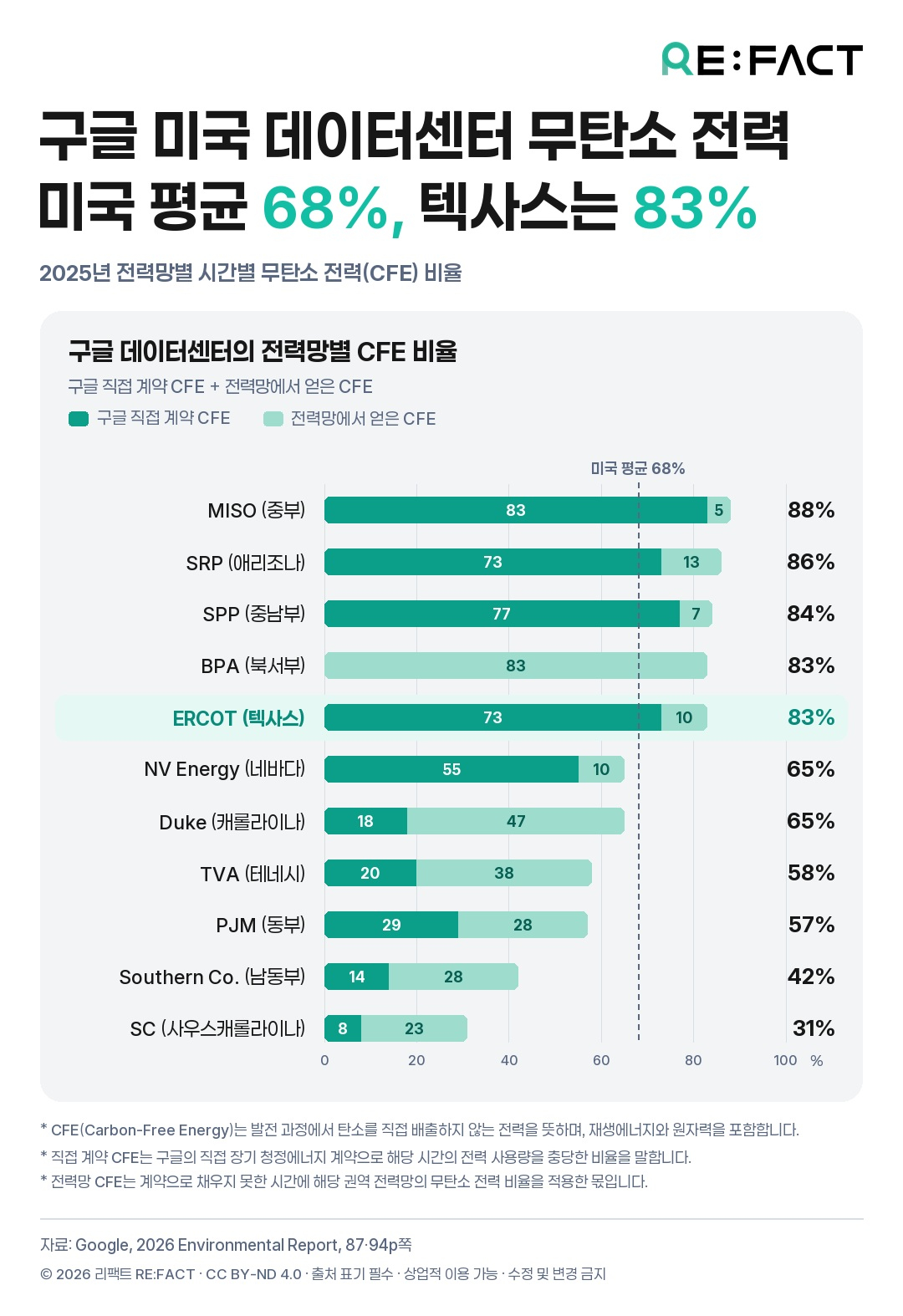
Previously, in its 2026 Environmental Report, Google disclosed that the hourly CFE ratio for data centers in 2025 was an average of 65% globally, 68% in the US, and 83% on the Texas power grid (ERCOT). This means that the share of carbon-free power supply in US data centers is higher than the global average. According to Google, carbon-free power refers to generation that does not directly emit carbon dioxide, such as solar, wind, geothermal, hydro, and nuclear power.
In Amazon's case, while it does not disclose electricity shares by power source or region, Amazon disclosed on its sustainability page that it has matched 100% of its used electricity with renewable energy for three consecutive years from 2023 to 2025.
Based on this, REFACT stated, "The statement that 'Most of the power used by Google and Amazon in US data centers is gas combined cycle or nuclear' cannot be substantiated in public materials from the respective companies."

 in INDUSTRY


