

Hyundai Motor identified energy efficiency and reducing on-site deployment costs as core challenges in commercializing physical AI (artificial intelligence). The company noted that for robots to become established in industrial settings and daily life, they must be able to perform assigned tasks safely and efficiently even with limited battery capacity.
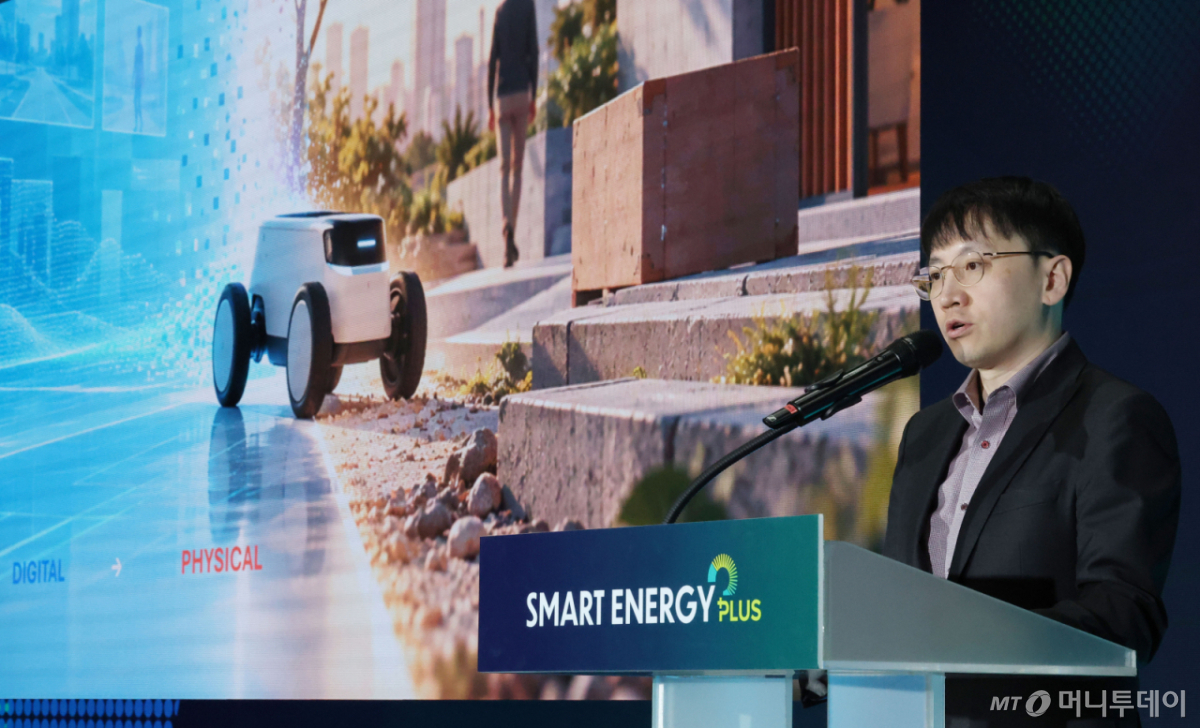
Kim Young-hoon, director of the Robotics Business Division at Hyundai Motor's Robotics Lab, gave a lecture on "The Current State and Future of Physical AI Business" at 'Smart Energy Plus (SEP) 2026,' held in Hall B of COEX in Samsung-dong, Seoul, on Wednesday. He said, "It is important to apply models suitable for the operating environment, rather than unconditionally using the latest or best models."
A robot must perform everything from movement and communication to sensor operation and AI computation with a single battery. If a large amount of power is consumed to enhance AI performance, the time available for moving and working is reduced. A robot that used to operate for three to four hours but can only function for two hours because it is running a massive AI model ultimately means its commercial viability has declined.
Enlarging the battery to increase operating time creates another problem. Moving the increased weight requires more force, potentially necessitating more expensive and robust drive mechanisms. Reducing charging time also requires solving heat generation and safety issues associated with fast charging, while a battery replacement method must be supported by durability that withstands repeated attachment and detachment.
Ultimately, using given energy efficiently becomes important. This is why Hyundai Motor is focusing on lightening AI models to suit the purpose of its robots. Offloading computation to an external cloud can reduce the burden on the robot, but judgment may be delayed while data is being exchanged. In particular, since functions directly related to safety must be processed in real time within the robot, it must be designed to operate even with limited computational performance.
Hyundai Motor applied this approach to its autonomous mobile robot platform, 'Mover.' The robot processes the process of recognizing its surroundings using LiDAR and cameras, judging floor conditions and wheel posture, and moving.
To achieve this, perception of the surrounding environment and autonomous driving algorithms were lightened. This method implements the necessary intelligence tailored to the tasks the robot will perform while reducing energy consumption.
The hardware was also designed to reduce the burden on AI. Mover was developed to pass through continuous steps up to 20 cm in height via its wheel structure. If obstacles can be directly crossed, issues such as software having to find detour routes or avoid obstacles are reduced. Director Kim emphasized that hardware and software must complement each other's limitations in this way.
In the process of getting customers to use robots developed in this manner, on-site deployment costs become important. Even if performance is established, if it takes a lot of time and cost to configure for the site, adoption may be hesitated upon.
Director Kim said, "How much the cost and time at the point when the robot is deployed to the site can be reduced is actually the biggest hurdle in getting robots adopted on-site."
Mover was designed to automatically create a map by driving around the site once using its own sensors, instead of separate specialized equipment. By changing the upper device, it can be used for delivery and patrol, or combined with a robotic arm for work. This reduces the burden of on-site configuration and allows utilization according to purpose.
In this commercialization process, what Hyundai Motor is aiming for is customer usability and manufacturer profitability. While providing stable operation, long usage time, and easy maintenance, costs and quality must also be managed. Kim said, "Creating more physical value with limited energy is the future expected of physical AI robots."

 in INDUSTRY
