

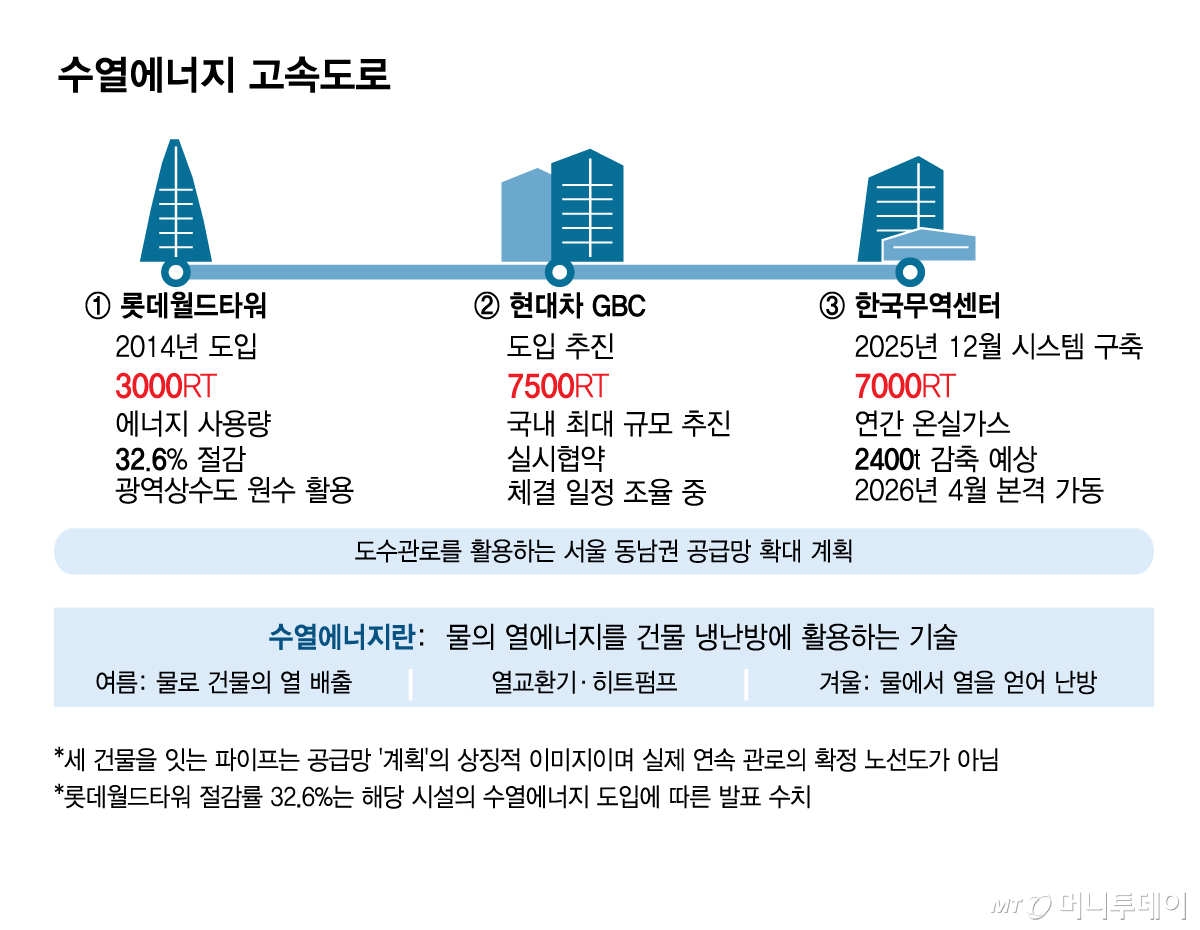
The hydrothermal energy supply system introduced at Seoul Jamsil Lotte World Tower and Samsung Dong Korea Trade Center will be expanded to the Hyundai Motor Group Global Business Complex (GBC). As the government promotes projects utilizing eco-friendly energy for heating and cooling in large-scale buildings, efforts are also being fully underway to build a so-called 'hydrothermal energy highway' connecting the southeastern part of Seoul.
Hydrothermal energy is a technology that utilizes the thermal energy contained in water, such as river water and raw tap water, for heating and cooling. Water has smaller temperature fluctuations than air, making it relatively cool in summer and warm in winter. By leveraging this temperature difference, energy consumption can be reduced compared to conventional heating and cooling methods.
The core equipment is the heat pump. In summer, it discharges heat generated inside the building into water for cooling, while in winter, it extracts heat from the water for heating. This method utilizes the heat of water supplied through existing pipelines via heat exchangers and heat pumps for heating and cooling.
Hydrothermal energy offers advantages such as higher energy efficiency than conventional heating and cooling equipment and reduced greenhouse gas emissions. In particular, it can improve space utilization by omitting certain equipment like cooling towers or outdoor units. This makes it suitable for ultra-high-rise buildings and complex facilities that generate large-scale heating and cooling demand.
Seoul Jamsil Lotte World Tower is a prime example. Lotte World Tower introduced a 3,000 RT (refrigeration ton) hydrothermal energy system in 2014. According to the Ministry of Climate, Energy and Environment, it achieved a 32.6% reduction in energy consumption compared to conventional heating and cooling methods. Effects such as savings in cooling water due to the omission of cooling towers and improved structural stability of the building were also confirmed.
Lotte World Tower utilizes the thermal energy contained in metropolitan raw tap water. By recovering heat using existing pipelines during the tap water supply process, it is possible to secure energy without installing separate large-scale water intake facilities.
The Korea Trade Center is also using hydrothermal energy. It completed the construction of a 7,000 RT hydrothermal energy system in December last year and began full operation from April this year. The system applied to the Trade Tower, COEX, and ASEM Tower has a cooling capacity capable of replacing approximately 7,000 air conditioners.
The government estimated that the introduction of hydrothermal energy at the Korea Trade Center could reduce greenhouse gas emissions by approximately 2,400 tons (t) annually. It explained that this would lower the cost burden associated with heating and cooling energy use while also reducing carbon emissions.
In addition, as the introduction of hydrothermal energy to Hyundai Motor Group's GBC is being promoted, the eco-friendly heating and cooling energy supply network in southeastern Seoul is expected to expand further. The capacity being pushed for supply to the GBC is 7,500 RT, which is 500 RT larger than that of the Korea Trade Center. If the project proceeds as planned, it is expected to become the largest-scale hydrothermal energy supply case domestically.
The government is promoting the construction of a 'hydrothermal energy highway' connecting Lotte World Tower, GBC, and the Korea Trade Center. The plan is to utilize existing water pipelines to supply hydrothermal energy to large-scale buildings and reduce reliance on fossil fuels for urban heating and cooling.
The scope of hydrothermal energy supply targets will also be gradually expanded. The government has set a goal to expand its application to major facilities such as the Yeongdong-daero Complex Transfer Center and Sejong National Assembly, and to supply 1 GW (gigawatt) scale of hydrothermal energy nationwide by 2030. As the introduction of hydrothermal energy expands centered on large-scale buildings, the transition to eco-friendly urban heating and cooling energy is also expected to accelerate.

 in INDUSTRY
