

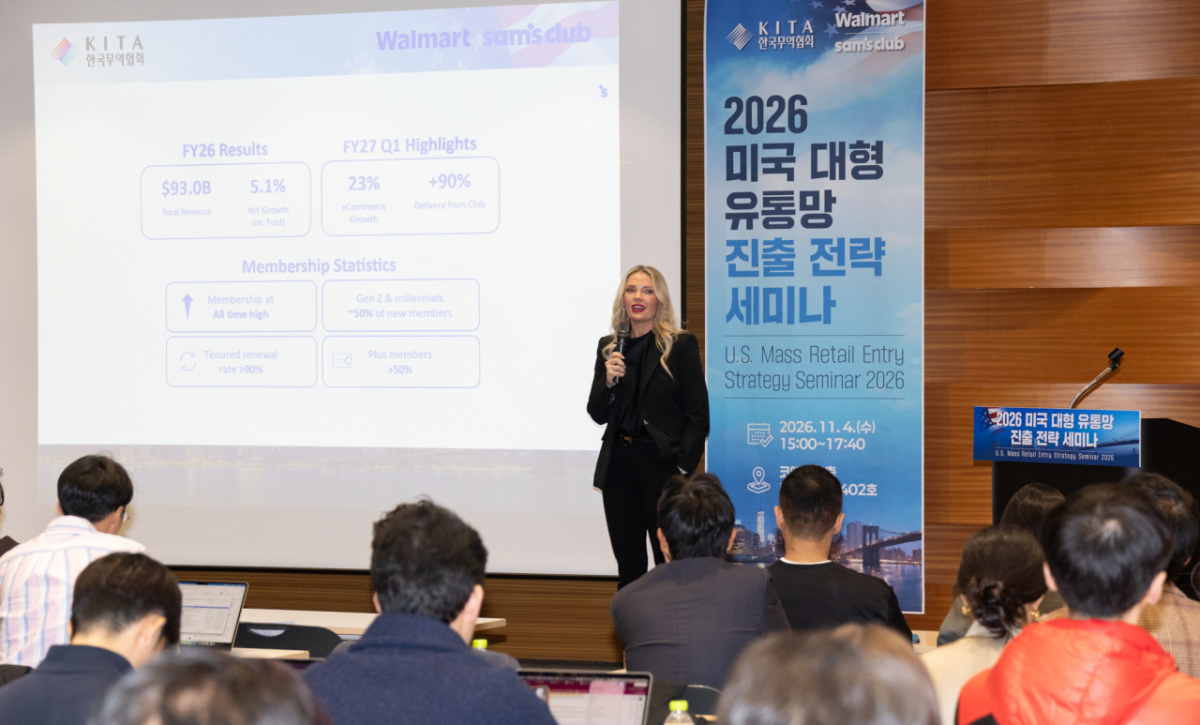
The Korea International Trade Association (KITA) has held the "2026 Seminar on Strategies for Entering Major US Retail Chains" at COEX in Songpa District, Seoul, Wednesday.
The event was organized to support domestic consumer goods companies entering the U.S. market, with approximately 200 company officials from the beauty, personal care, and wellness sectors in attendance.
The seminar focused intensively on strategies for securing shelf space at Walmart, the largest offline retailer in the United States, and its subsidiary Sam's Club. Sam's Club is a membership-based warehouse discount store operated by Walmart, ranking as the second-largest company in the U.S. industry with last year's sales of $93 billion.
Katie Whitmeyer, head of Purchasing for Beauty, Healthcare, and Baby Products at Sam's Club, introduced the latest trends in the U.S. consumer goods market, product evaluation criteria, and methods for managing inventory and supply chains after entry.
Whitmeyer said, "Securing a spot with major U.S. retailers is not the end, but the starting point. The ability to understand buyers' product evaluation criteria and stably manage inventory and supply chains after initial orders to secure reorders determines a brand's sustained growth."
Case studies of domestic companies that successfully entered the U.S. market were also shared. Three companies—Valenlife, Power Player, and Boosters—presented on local distribution channel selection, preparation for entry, and post-launch marketing strategies. Power Player and Boosters operate the skincare brands "Ongridients" and "Equalberry," respectively.
Choi Ga-hee, CEO of Valenlife, said, "Domestic distribution channel rankings and reorder history serve as performance evidence that U.S. buyers can read directly. Companies must prove demand through social media (SNS) reactions and domestic sales data before entry, and prepare product configurations tailored to U.S. regulations and local price ranges."
Jung Hee-cheol, head of the Overseas Marketing Division at KITA, said, "While the U.S. is a major export market for K-consumer goods, major distribution networks have strict entry criteria and require high operational capabilities, making it difficult for individual companies to enter."
He added, "We hope this seminar serves as an opportunity for domestic companies to understand the perspective of U.S. buyers and concretize their local market entry strategies."

 in INDUSTRY
