

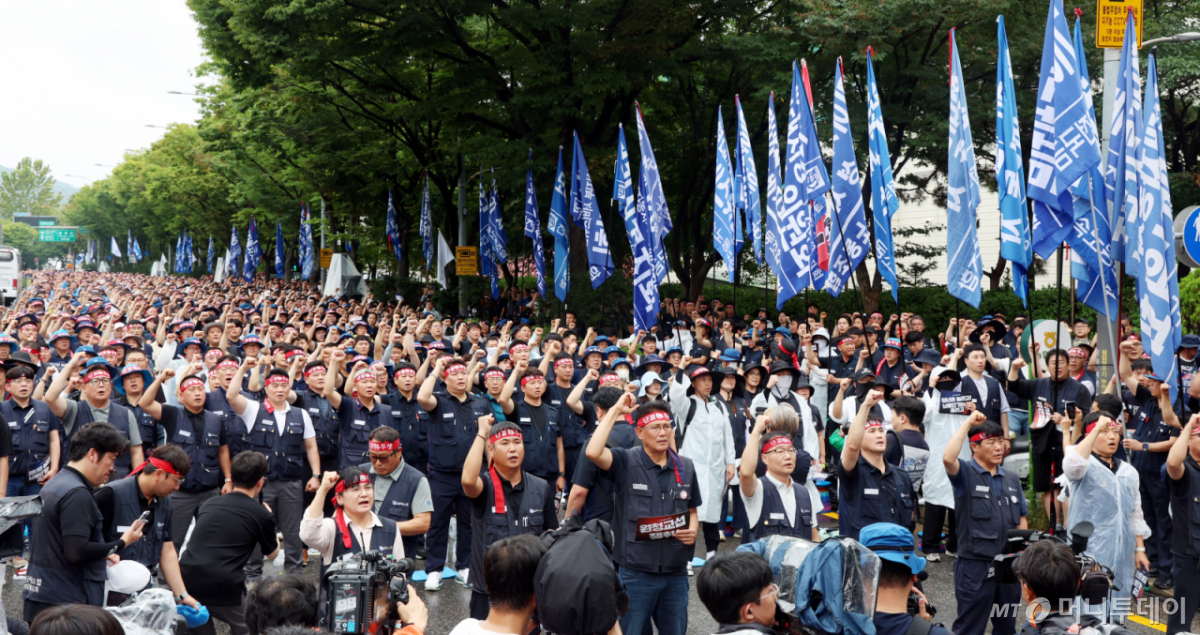
The number of labor disputes decreased this year, but work loss days increased instead as strikes over performance pay linked to business results dragged on at major facilities in the automotive and shipbuilding sectors. Concerns are emerging that conflicts at individual plants could spread across the entire industry, given the manufacturing sector's close ties with suppliers.
According to the "Status of Labor Relations in Key Manufacturing Industries, Including Automotive and Shipbuilding" released by the Federation of Korean Industries (FKI) on the 8th, labor disputes numbered 88 cases as of the end of September, down from 99 cases during the same period last year. In contrast, work loss days reached 489,190, a 45.2% increase from 336,800 days in the previous year.
The core issue in this year's negotiations was profit-linked performance pay. The unions at Hyundai Motor, HD Hyundai Heavy Industries, and Hanwha Ocean all demanded performance bonuses in addition to a base salary increase of 149,600 won. The Hyundai Motor union called for 30% of the previous year's net income, while the HD Hyundai Heavy Industries union demanded a minimum of 30% of operating profit. Demands that would raise fixed labor costs, such as expanding regular bonuses, extending the retirement age, and abolishing the wage peak system, were also raised.
The Hyundai Motor union carried out a full-scale strike in August for the first time in 10 years. The industry estimates production disruptions amounted to approximately 55,200 vehicles. Labor and management reached an agreement on a base salary increase of 100,000 won, performance bonuses of 400% plus 12.7 million won, and 15 shares of stock. In the shipbuilding industry, union leadership even resorted to high-altitude sit-ins. HD Hyundai Heavy Industries' second agreement was approved with 55.1% in favor on the 27th of last month, following the rejection of the first proposal. The Hanwha Ocean agreement barely passed on the 29th of last month with a 50.02% approval rate.
Conflicts are also ongoing in the parts industry. The HL Mando union has refused overtime and special work since the 9th of last month, demanding the regularization of a special bonus equivalent to 15% of operating profit, among other things. Following two partial strikes, the union has also warned of a designated strike. HL Mando supplies approximately half of the brakes and steering systems, as well as 75.8% of the suspension systems, for Hyundai Motor and Kia. The company has 292 domestic trading partners, employing approximately 40,880 people.
The steel industry is also experiencing prolonged labor conflicts. The POSCO union announced that a member vote on the tentative wage negotiation agreement held the previous day was rejected, with 48.3% in favor and 51.7% against. The agreement included a 2.6% base salary increase, a lump sum payment of 6 million won, and a special promotion of three pay grades. Although it was an improved offer compared to management's initial proposal (such as a 1% base salary increase), it failed to meet the members' threshold. The POSCO union has been conducting negotiations approximately 30 times since June and carried out two strikes in September, marking the first strikes since its founding.
The FKI pointed out that if fixed cost burdens become institutionalized on the basis of short-term performance improvements, companies' ability to respond to economic fluctuations and their capacity for future investment could be constrained. It further emphasized, "Labor and management need to form reasonable negotiation practices by comprehensively considering not only individual companies' short-term results but also industry cyclicality, global competition, the necessity of future investment, and impacts on suppliers."

 in INDUSTRY
