

LG Display is accelerating its acquisition of overseas patents. Amid intensifying pursuit by Chinese display makers in OLED (organic light-emitting diode) technology, the company is pursuing a strategy to protect core technologies and enhance its bargaining power in patent licensing negotiations.
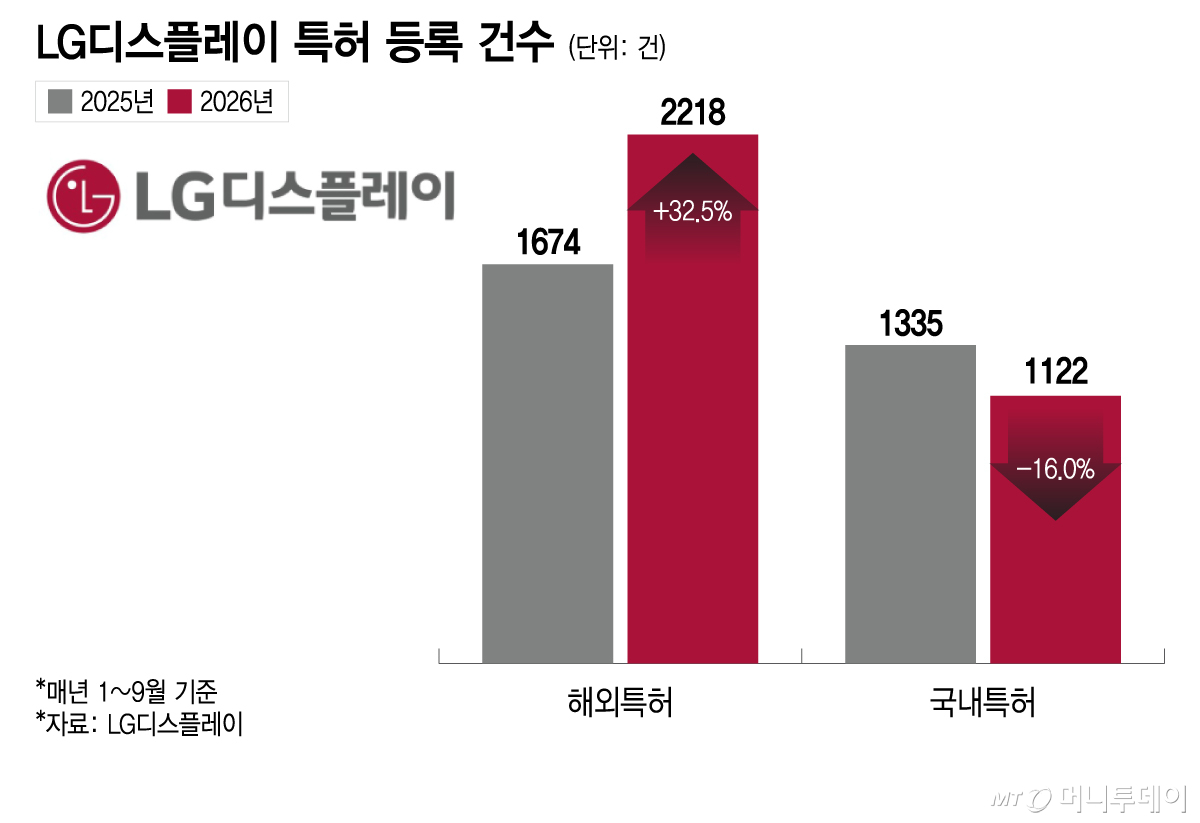
According to LG Display on Monday, overseas patent registrations from January to September this year totaled 2,218, a 32.5% increase compared with the same period last year (1,674). During the same period, domestic patent registrations decreased by 16%, from 1,335 to 1,122. Consequently, the share of overseas patents in total new registrations rose by 10.8 percentage points, from 55.6% to 66.4%.
Overseas patent registrations this year reached 98.3% of last year's annual performance (2,256) within just nine months. As of the end of September, cumulative registered patents totaled 73,664, comprising 40,897 overseas and 32,767 domestic.
The majority of held patents relate to LCD (liquid crystal display) and OLED technologies, representing assets already applied to key products or to be utilized as core technologies in the future.
The reason LG Display is increasing its share of overseas patents is that the competitive landscape in its main market, OLED, has expanded onto the global stage. Recently, Chinese companies have rapidly penetrated not only the smartphone sector but also the IT (information technology) OLED market for laptops and tablets.
Since patent rights take effect in the country where they are registered, the importance of securing local patents grows as Chinese firms expand their businesses into overseas markets. Based on this, LG Display can respond to technology infringement and assert its rights in licensing negotiations.
In fact, LG Display is actively checking technological infringement by Chinese companies by leveraging its secured overseas patents. Last year, the company filed an infringement lawsuit against China's Tianma over seven patents related to OLED and LCD in the United States.
This legal action was taken after patent licensing negotiations with Tianma, which began in 2011, failed to reach an agreement. Subsequently, the two companies signed a licensing contract in June this year, concluding the dispute.
LG Display is also pursuing patent cooperation with global corporations. The company has entered into patent implementation agreements with Japan's Semiconductor Energy Laboratory (SEL), Taiwan's AUO and HannStar, among others, to secure rights in its core and future business areas.
In particular, LG Display signed mutual patent usage agreements regarding LCD with AUO and HannStar, creating a business environment that lowers the possibility of disputes over technology use.
Furthermore, efforts to patent proprietary technologies are also yielding results. LG Display recently received the Patent Technology Award for its circuit design technology that reduces the bezel width of OLED TVs by approximately 34%. The relevant technology was also filed in the United States, Germany, and China in 2020.
LG Display stated that as a technology-centric company, it encourages employee inventive activities and continues to invest in securing patents. While operating a "speak up" culture where opinions are freely expressed, the company is actively allocating costs to secure domestic and overseas patents based on research and development outcomes.
An LG Display official said, "To solidify our global OLED technology leadership, we are building a dense patent portfolio across the world." The official added, "Through this, we plan to secure a firm technological advantage and build a moat that prevents competitors and latecomers from easily following high-difficulty OLED technologies."

 in INDUSTRY
