

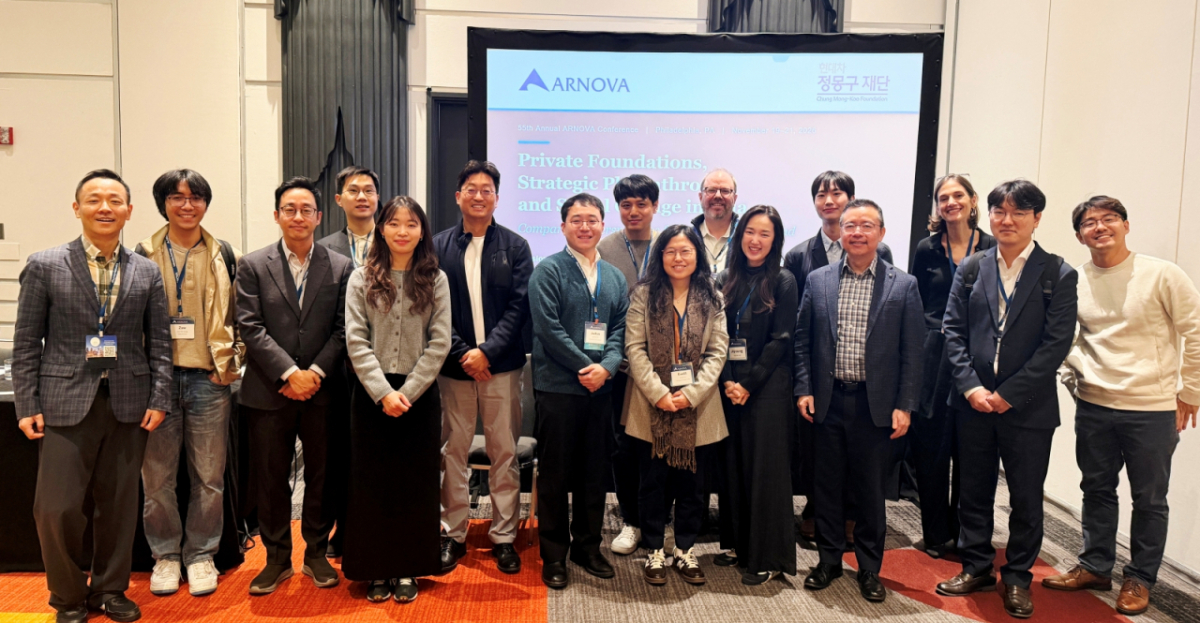
The Hyundai Motor Chung Mong-gu Foundation presented research findings on the changing social role of Korean public interest foundations at the world's largest international nonprofit academic conference.
The foundation announced on the 23rd that it held an independent session at the 55th ARNOVA Annual Conference, held in Philadelphia, U.S., on the 21st (local time), introducing research findings on the changing social role of Korean public interest foundations and innovation cases in the social welfare field.
ARNOVA is the world's largest international academic conference in the fields of nonprofit organizations, resource mobilization, and philanthropy (private donation and support activities for the public good), established in 1971. This year's annual conference was held from the 19th to the 21st under the theme "Awakening Civic Action: Grassroots Resource Mobilization and Democracy."
This year, the foundation conducted a study on "The Social Role of Korean Public Interest Foundations" in collaboration with the research team of Professor Lee Jong-seong of the Department of Social Welfare at Seoul National University. Noting that existing Korean philanthropy research has primarily focused on current status and individual cases, the study emphasized analyzing the historical development process of public interest foundations and their relationship with the public sector. The session featured presentations of three academic studies and one field project undertaken by trainees of the foundation's "CMK Social Welfare Innovation Leaders Academy."
Professor Jeong Bok-gyo of Kean University in the U.S. proposed an analytical framework comparing the institutional development characteristics of Korean and American public interest foundations, based on cases from 17 institutional investors including Carnegie, Rockefeller, and Ford. Professor Jeong and graduate student researcher Kim Jun-hee analyzed approximately 4.27 million domestic media reports since 1990. They presented findings that the role of Korean public interest foundations is expanding from traditional charity and support to solving diverse social issues such as talent development, climate, and care. Researcher Son Dong-young of the Seoul National University Institute of Social Welfare categorized the social roles of public interest foundations into "service-based field support," "problem-solving experimental," and "growth environment creation" types, analyzing the formation process and characteristics of each type.
Field practice cases were also introduced. The CMK Social Welfare Innovation Leaders Academy is a talent development program in the social welfare sector operated for the first time this year by the foundation in collaboration with the Ministry of Health and Welfare and the Seoul National University Center for Social Impact. Park Eun-ye (Public Sensibility), Song Jin-geun (Inha University), and Im Ju-chan (Korea Community Chest) were selected as an outstanding team among the first cohort of trainees and presented the "Hidden Expert Volunteer Page" project. The project was designed to allow individuals with experiences of isolation and withdrawal to directly participate in research and volunteer activities. They viewed these individuals not merely as recipients of support but as agents of social problem-solving, seeking ways to prevent re-isolation.
Professor Jeong stated, "Korean public interest foundations have played an important role not merely as auxiliary executors, but by complementing gaps in social welfare and experimenting with new social service models," adding, "Examining the development process and changing social roles of Korean public interest foundations is significant for understanding the characteristics and potential of Korean-style philanthropy."
Lee Ji-young, a part manager at the Hyundai Motor Chung Mong-gu Foundation who attended the conference, said, "This session was meaningful in that it introduced the social role and development process of Korean public interest foundations to the international academic community and allowed researchers and field practitioners to share their experiences together," adding, "We will continue to systematically highlight the experiences and achievements of Korean public interest foundations and expand opportunities to share them with the international community."

 in INDUSTRY
