

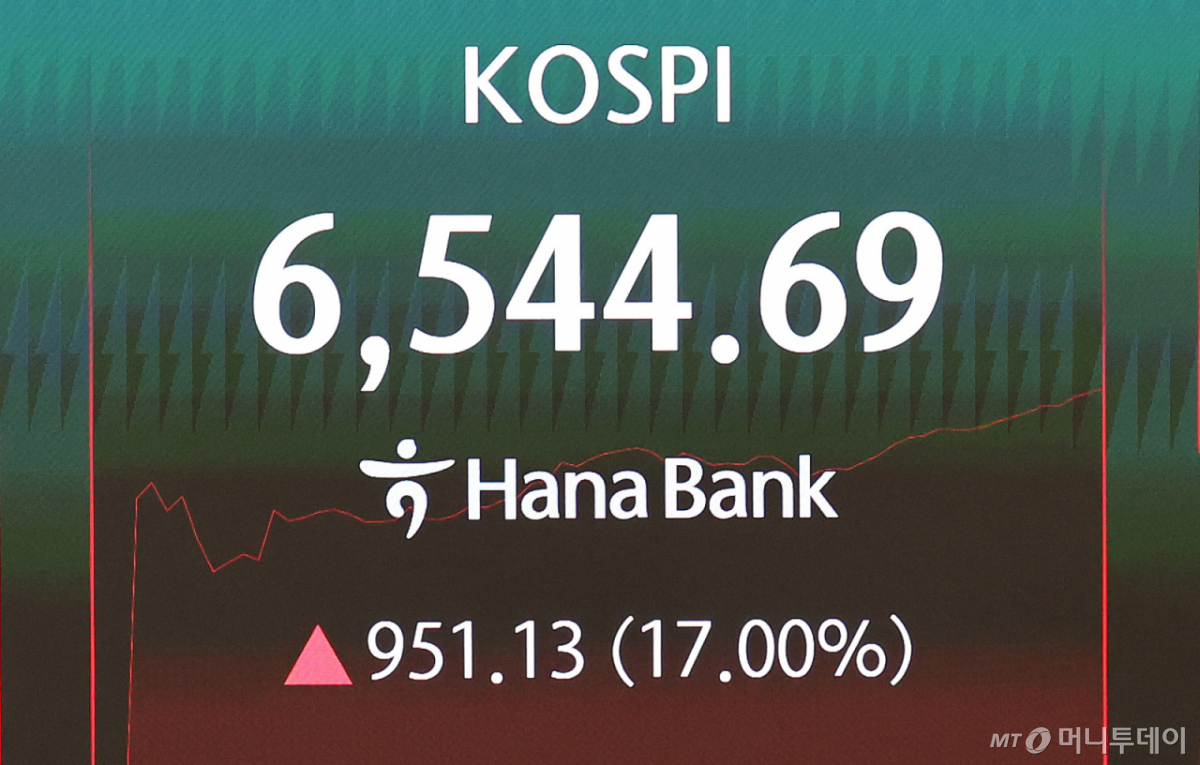
Foreigners, who had been continuing large-scale net selling of KOSPI, have turned to massive net buying. It is interpreted that foreigners, who had exited due to concerns over the sustainability and profitability of AI (artificial intelligence) investments, returned following the release of big tech earnings reports.
As of 10:58 a.m. on the 31st, foreigners were net buying 6.912 trillion won in the KOSPI market (based on Korea Exchange (KRX)). Including NextTrade (NXT), an alternative trading venue, the net buying volume reached 8.162 trillion won.
Foreigners shattered the record for the largest intraday net buy ever at the start of the session. As of 9:06 a.m., foreigners were purchasing 3.3281 trillion won. The previous record for foreign net buying was 3.14 trillion won, set on October 2 last year. This time, they executed a net purchase more than double the existing record in one go.
Thanks to the foreign net buying, the KOSPI index also shattered records for both the highest percentage increase and the largest point gain in history. At the same time, the KOSPI rose 788.02 points (14.09%) from the previous trading day to 6,381.58. During trading hours, the KOSPI climbed as high as 6,548.64, an increase of 955.08 points (17.07%). The previous record for percentage gain was 11.95%, set on October 30, 2008, and the record for point gain was 612.52 points, set on the 9th of last month.
Kim Dae-jun, a researcher at Korea Investment & Securities, explained, "Foreigners are triggering a sharp surge in the index by purchasing cash stocks, futures, stock futures, and ETFs (exchange-traded funds)."
Foreigners had recently engaged in large-scale net selling of KOSPI. From the 1st to the 30th, foreigners sold 17.1709 trillion won in the KOSPI market. In May, they net sold 4.719 trillion won, and in June, they net sold 4.9336 trillion won, consecutively breaking records for the largest monthly net sales.
The turnaround from selling to buying by foreigners is interpreted as a recovery in investment sentiment toward domestic semiconductor stocks after Microsoft (MS) and Amazon announced cloud earnings that exceeded market expectations. The big tech companies' investments in AI data centers have translated into actual revenue, alleviating concerns about slowing semiconductor demand.
On the 30th (local time), MS announced that its Azure cloud division grew 43% year-on-year and 40% from the previous quarter. Amazon also reported that sales of its AWS (Amazon Web Services) cloud division increased by 36.7% compared to the same period last year, achieving the highest growth rate in the past 18 months. The operating profit margin stood at 39.4%.
In the U.S. stock market as well, memory semiconductors such as Micron (18.4%) and SanDisk (26.0%) surged amid easing concerns about the AI industry. This led to the KOSPI 200 night futures hitting the upper limit (8.00%).
In fact, most of the foreign net buying was concentrated in Samsung Electronics and SK Hynix. According to Daishin Securities HTS (Home Trading System), as of 10 a.m., foreigners were net buying SK Hynix for 2.7455 trillion won and Samsung Electronics for 2.385 trillion won. Samsung Electric, which operates in the MLCC business and is cited as a semiconductor beneficiary stock, saw net buying of 352.9 billion won. SK Square, the largest shareholder of SK Hynix, recorded net buying of 337.5 billion won, while Samsung Electronics' subsidiary (Samsung Electronics 우) saw net buying of 105.7 billion won.
As a result, SK Square and Samsung Electric hit the upper limit price. Samsung Electronics and SK Hynix also showed strong gains of around 20%. In particular, SK Hynix, which ranks second in market capitalization and accounts for about 23% of KOSPI's total market cap, rose to nearly 28%, reaching just before the upper limit price.
The increased attractiveness of KOSPI valuations due to the recent large-scale correction also boosted foreign net buying. Lee Kyung-min, a researcher at Daishin Securities, explained, "With trust in AI restored, KOSPI and domestic Ban Do-che (CEO) stock valuations are formed at extremely low levels, making them highly attractive."
In the case of SK Hynix and SK Square, it is also interpreted that Chairman Choi Tae-won of SK Group's stock purchase had an impact. On the 30th, Choi (Chairman) disclosed that it purchased approximately 4.9 billion won (3,620 shares) of common stock on the exchange. This was a purchase up to the maximum amount allowed for immediate buying without violating the pre-disclosure rule for transactions within 30 days (less than 5 billion won). This marks the first time Choi (Chairman) has purchased SK Hynix stocks under a personal name.
Some analysts suggest that the liquidation of the U.S. hedge fund Situational Awareness Capital, a major player, may have had a positive impact on semiconductor supply and demand. The fund, led by Leopold Aschenbrenner, an OpenAI alumnus, had previously made large-scale investments in AI and semiconductor stocks through four times leverage.
Han Ji-young, a researcher at Kiwoom Securities, stated, "Leopold reportedly faced margin call pressures as stock prices continued to fall recently, and the hedge fund Citadel acquired most of their portfolio." She further explained, "While there was pressure from forced selling due to losses by leverage funds contributing to the recent sharp decline in semiconductor stocks, the deleveraging process (financial stabilization through debt repayment) has reached its latter stages following the liquidation of Leopold's fund."
A margin call refers to a situation where an investor is required by a securities firm to deposit additional funds into their account when the price of investment assets falls and the account's collateral value drops below the minimum threshold.

 in STOCK
