

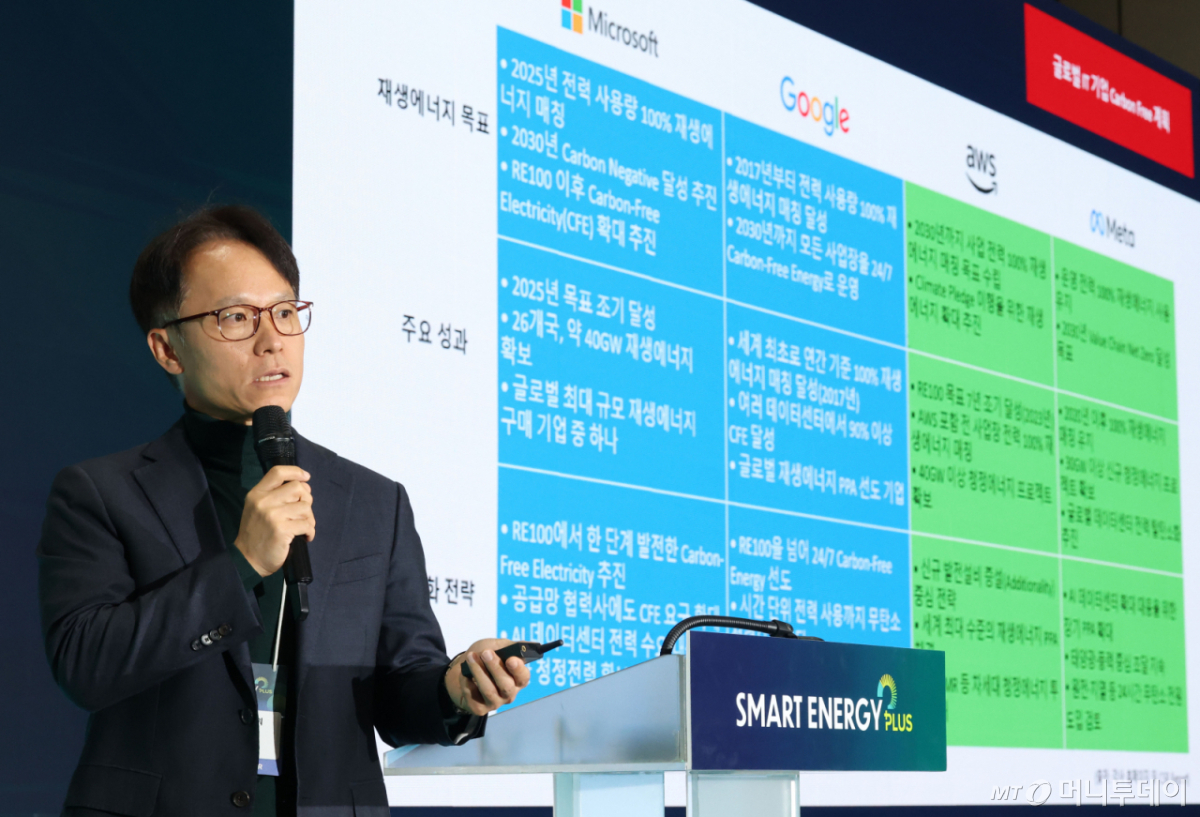
“To complement the intermittency of renewable energy and respond to rapid fluctuations in power demand, battery energy storage systems (BESS) and the power conversion technologies that control them will become core competitive advantages.”
Kim Seong-yeop, CEO of OCI Power, made these remarks at the “AI Gold Rush” conference of “Smart Energy Plus (SMART ENERGY PLUS·SEP) 2026,” held on the 30th in Hall B of COEX in Samsung-dong, Seoul Gangnam-gu.
Speaking on the topic of “The Importance of Renewable Energy and Battery Energy Storage Systems (BESS) in AI Data Centers,” Kim identified stable power supply and energy storage technologies as key factors determining the competitiveness of AI data centers.
Kim assessed that securing renewable energy has emerged as a core competitive element in the AI data center market. He stated, “Global companies such as Microsoft (MS) and Google are moving beyond RE100 (100% renewable energy) toward the concept of ‘Carbon Free Energy,’ which involves powering operations with zero-carbon emissions,” adding, “Going forward, major customers of AI data centers will place significant importance on whether they can secure power supply through renewable energy and power purchase agreements (PPAs).”
The intermittency of renewable energy and the volatility in power demand at AI data centers are challenges that must be addressed. Renewable energy sources have the limitation that generation output varies depending on weather and natural conditions.
Solar power generation is concentrated during daytime hours, while wind power output fluctuates significantly based on wind speed. In addition to supply issues, AI data centers also experience substantial fluctuations in power demand.
This is because accelerator-based servers equipped with GPUs and NPUs repeatedly perform large-scale computations and communications, causing power consumption to change drastically in millisecond (ms, one-thousandth of a second) increments.
Kim explained, “AI data centers have the characteristic of using power intensively when starting computations, followed by a sharp drop in power usage when entering the communication phase.” He added, “If such fluctuations repeat, they can affect voltage and frequency, potentially undermining grid stability.”
Kim proposed BESS as an alternative to address these issues. He stated, “In situations where data centers are built but service launch is delayed due to slow power supply, utilizing BESS can help reduce the burden of infrastructure construction timelines,” adding, “It is also possible to store power when renewable energy generation is high and supply it to data centers at times of need.”
He also pointed out that existing batteries alone may have limitations in responding to rapid changes in power demand at AI data centers. The alternative Kim proposed was HYBErid ESS, which combines ultracapacitors (ultra-high-capacity capacitors) with lithium iron phosphate (LFP) batteries.
Unlike batteries, which store energy through chemical reactions, capacitors are devices that utilize electric fields. While their energy storage capacity is relatively small, they have the advantage of rapidly charging and discharging power instantaneously.
Kim stated, “Power loads in data centers fluctuate on a millisecond scale, but conventional BESS has limitations in charge and discharge speeds.” He added, “The HYBErid approach, which combines supercapacitors with LFP batteries, can help respond to rapid power fluctuations.”
He also emphasized the importance of power conversion system (PCS) technology. He explained that in addition to battery performance, the technology for stably supplying stored power to the actual grid and data centers is crucial.
In particular, he predicted that “Grid-forming” technology, which allows voltage and frequency on the grid to be regulated independently without relying on external grids, will emerge as a core technology in the future.
Kim emphasized, “Batteries can be procured from anywhere, but the power conversion device attached to the front end of the battery serves as the brain of the system.” He stressed, “Ultimately, it is important to secure not only battery technology but also power conversion and grid configuration technologies.”

 in INDUSTRY
