

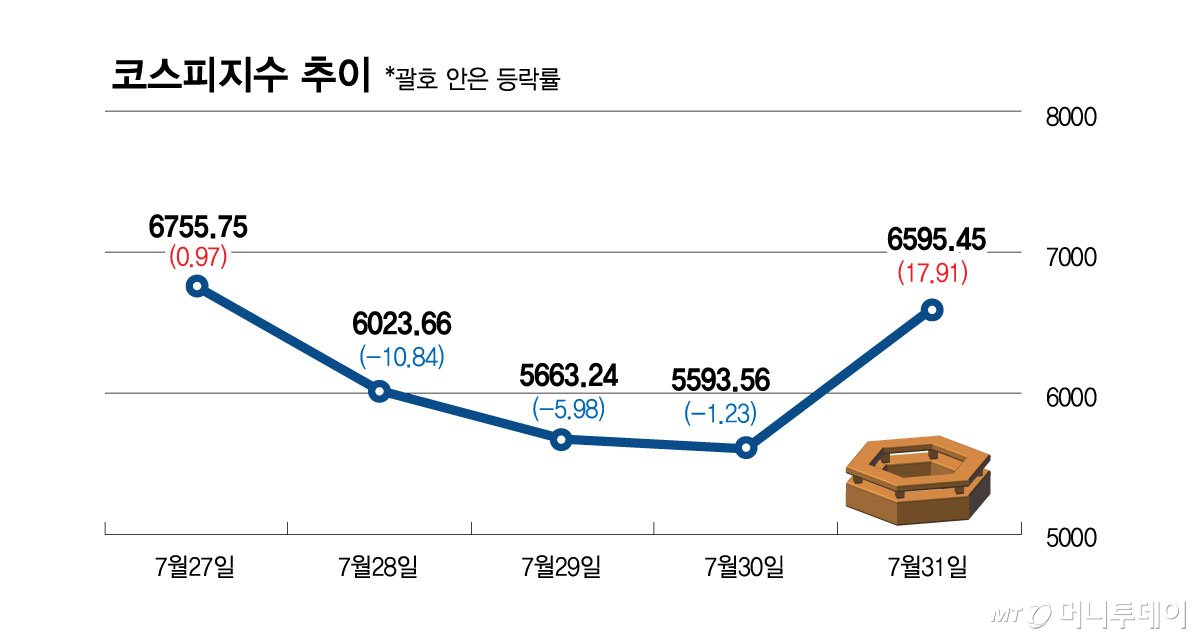
The KOSPI, having passed through unprecedented volatility, is entering the final phase of fluctuation. Securities firms express expectations of a rebound driven by undervalued attractiveness but caution that risks remain from upcoming U.S. big-tech earnings reports and potential deterioration in inflation indicators due to an extended war.
According to data from Korea Exchange on the 2nd, last week (the 27th–31) saw the KOSPI close at 6,595.45, down 95.17 points (1.42%) from the previous weekend's level of 6,690.62. During this period, institutional investors made net purchases totaling 2.825 trillion won, while retail investors and foreign investors sold off 5.3909 trillion won and 62.5 billion won respectively. On the final trading day of last week, July 31, foreign investors purchased 7.241 trillion won, setting a new record for net purchases, while retail investors sold 8.284 trillion won, breaking the previous record for net sales.
Last week saw numerous records set in the KOSPI market. From the 28th to the 30th, the KOSPI fell for three consecutive trading days, triggering circuit breakers for two consecutive days for the first time in history; however, on July 31 it surged by over 1,000 points, setting a record for the highest single-day gain. Samsung Electronics, the market capitalization leader, closed up 26.8%, while SK Hynix reached its daily price limit of 29.95%. SK Square and Samsung Electro-Mechanics, ranked fourth and fifth by market cap, also hit their daily price limits.
Kang Jin-hyuk, a researcher at Shinhan Investment Corp., explained the background for the KOSPI rebound: "Following Microsoft's strong earnings report, Amazon also announced solid results. With robust core businesses and free cash flow (FCF) confirming capacity for capital expenditure (CAPEX), there is growing recognition that leverage reduction is nearing completion after Leopard's Drilling & Environmental Awareness Fund acquired shares from Citadel amid margin call pressures." He added, "The purchase of SK Hynix shares by SK Group Chairman Choi Tae-won the previous day (the 30th) also stimulated buying at low prices."
Undervalued attractiveness fuels expectations for foreign investor purchases... Volatility remains high; caution is advised
Securities firms anticipate that August's stock market will improve globally, driven by investment appeal from lower valuations caused by last month's correction and the stability of corporate earnings. Additionally, regulations on single-stock leverage ETFs (exchange-traded funds), which had heightened domestic market volatility, took effect on the 31st, reducing the potential for further volatility expansion.
Yang Il-woo and Kwon Beom-seok, researchers at Samsung Securities, stated: "We project the August KOSPI range to be between 6,000 and 8,000." They added, "Investor sentiment toward not only Korean IT sectors but also U.S. IT sectors is expected to stabilize, potentially resuming foreign investor purchases. Foreign investors have shown buying tendencies when KOSPI falls below 7,200, so they likely do not consider current stock prices burdensome."
However, analysts warn that caution remains necessary during the week of the 3rd–7, as events such as profit-taking sales from the final phase of volatility, earnings reports from remaining big-tech firms including AMD, SanDisk, and Palantir, and interest rate direction following U.S. unemployment data releases are still pending. Na Jung-hwan, a researcher at NH Investment & Securities, projected next week's (the 3rd–7) KOSPI range to be between 5,200 and 6,500, suggesting it may remain below last week's closing price of 6,595.45.
Na researcher noted: "The VKOSPI (KOSPI 200 Volatility Index) reached a peak of 96.9 points in June before easing into the 70s range, but rose again to 87.8 points last week." He emphasized: "Although we have entered the volatility peak-out phase, it is crucial to monitor upcoming U.S. corporate earnings reports that will gauge AI hardware trends—Palantir on the 3rd (local time), AMD on the 4th, and SanDisk on the 5th—as well as potential interest rate hikes following the release of July U.S. unemployment data on the 7th."
Uncertainty surrounding AI investments due to deteriorating free cash flow (FCF) among big-tech firms remains a source of concern. Kim Sung-no, a researcher at BNK Investment & Securities, stated: "While the capital expenditure (CAPEX) scale of Big4 companies leading AI investments—Google, Amazon, Meta, and Microsoft—continues an upward trend, their growth rate is expected to peak in Q4 this year before entering a clear slowdown phase next year." He added, "Rapid investment increases have led to Google and Amazon's FCF turning into losses in Q2, raising concerns about cash flow."
With the resumption of U.S.-Iran tensions causing oil and commodity prices to rebound, fears of rising inflation are resurfacing. Kim researcher remarked: "While crude oil prices stabilized in June, leading U.S. consumer price indices to fall below market expectations, the collapse of ceasefire negotiations in July caused energy prices to rise again, presenting a variable factor." He continued, "With IT product price hikes expected in the second half due to rising semiconductor prices, core inflation is likely to remain at high levels."
He further added: "If major countries implement interest rate hikes in response to rising inflation during the second half, global liquidity is expected to continue its slowdown trend. This will negatively impact the inflow of market funds into global stock markets."

 in STOCK
