

The government has officially launched the recruitment of operators for an ultra-long-term technology investment fund, which will invest up to 16 years in cutting-edge technology sectors requiring long-term patience. To prevent concentration of investments, it is mandated that no more than 60% of the funds be invested in AI (artificial intelligence) and semiconductor sectors.
The Financial Services Commission announced on the 20th that it will begin operations of an 88 billion won fund starting with the recruitment announcement for operators of ultra-long-term technology investment funds. Proposal submissions from operators will be accepted until the 3rd of next month, followed by a review process to finalize selections in October. The schedule aims to commence fund deployment (investment) as early as year-end.
Considering the fund's focus on early-stage technologies and its purpose of identifying various promising companies, the application fields (leagues) will be divided into small leagues and medium leagues, selecting seven operators (three small league operators and four medium league operators). Of the total fund size of 88 billion won, 24 billion won will be allocated to the small league and 64 billion won to the medium league.
Taking into account the financial authorities' aim for long-term investment in high-quality technology companies, they have decided to recognize primary investments only in enterprises recognized for their technological capabilities by trusted institutional investors. Specifically, these include: (1) companies with a top five technology evaluation grades (TI5 or higher) based on Technology Credit Evaluation (TCB); (2) companies that have undergone technology evaluations under the Technology Transfer Act; and (3) companies that have received invention-related evaluations (IP value assessments) under the Invention Promotion Act.
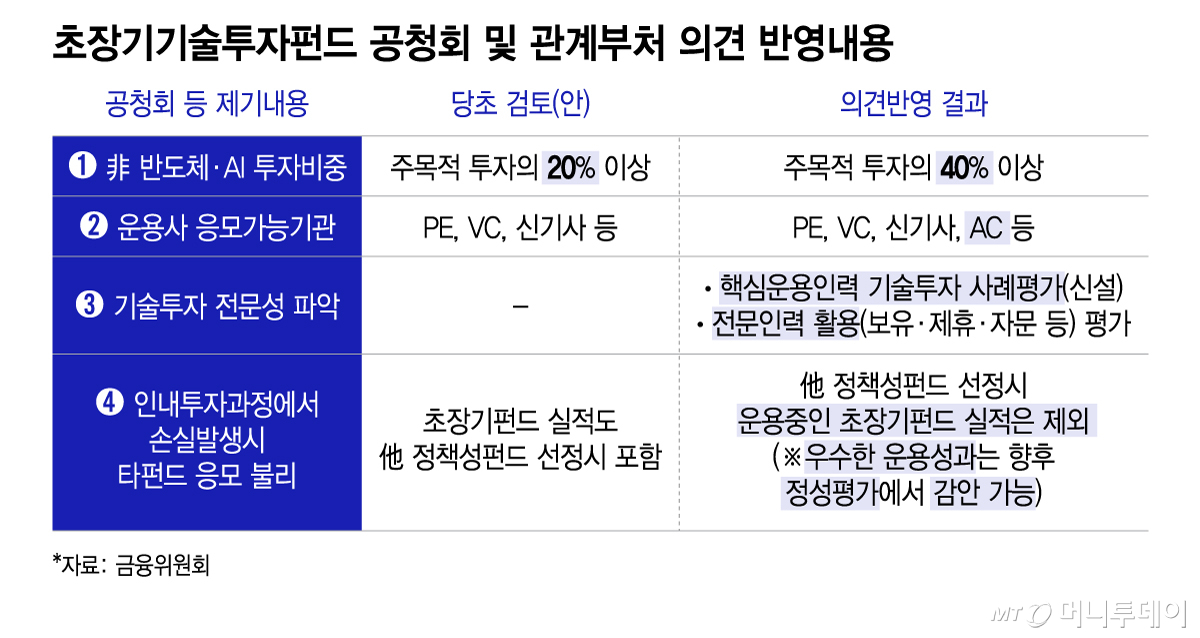
A mandatory investment ratio requiring over 40% of primary investments to be directed toward sectors other than AI and semiconductors has also been established. The initial proposal had set this ratio at over 20%, but after gathering opinions from public hearings and relevant ministries, it was raised to over 40%. This measure aims to prevent excessive concentration of investments in AI and semiconductor sectors. Consequently, funds are expected to be supplied to areas such as biotechnology and defense industries among the National Growth Fund's support targets, where long-term investment for technological development has historically been challenging.
Additionally, primary investment performance will be given preferential treatment through a weighting system when investments fall under the following categories: investments in startups that received support from fund of funds (Korea venture fund); domestic investments aimed at acquiring overseas technology companies; and follow-on investments in companies already invested in by this fund.
Startup incubators (ACs) are also included among institutional investors eligible to apply as entrusted operators. This measure aims to leverage the capabilities of startup incubators, which excel in identifying and nurturing early-stage companies, complementing the financial strength of private operators such as venture capital firms and private equity funds. It is expected that startup incubators and venture capital firms will apply as co-operating operators (Co-GP).
When selecting operators, evaluations of expertise in technology investment will be strengthened. Assessments will cover whether the operator has successfully commercialized technologies held by invested companies, whether they possess professional operational capabilities in primary investment sectors, and whether they effectively utilize networks of technical professionals.
Regarding the expansion of mandatory investment ratios for sectors other than AI and semiconductors, the financial authorities plan to revise the enforcement decree of the Korea Development Bank Act during the second half of this year to expand the National Growth Fund's investment targets to include cutting-edge industries such as aerospace.
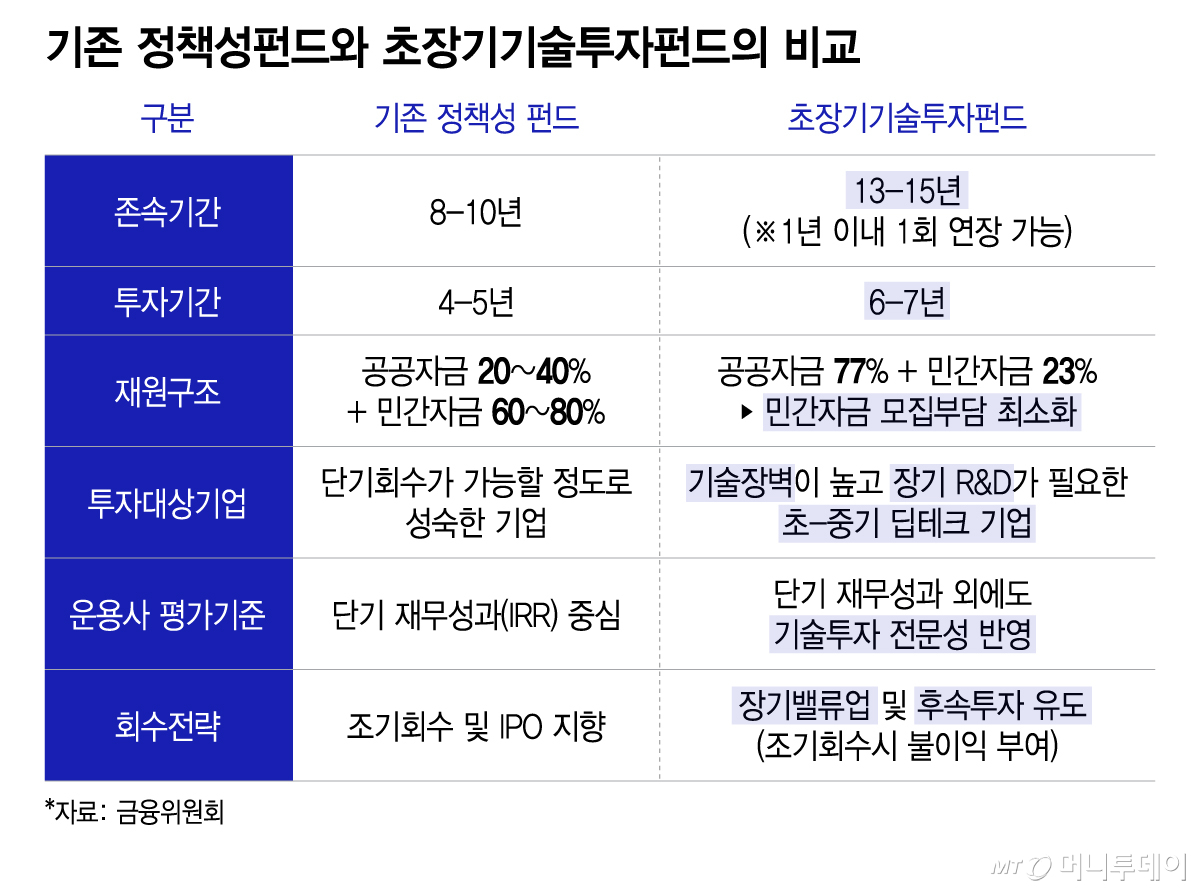
The ultra-long-term technology investment fund is an indirect investment program established under the National Growth Fund to provide long-term patient capital for up to 16 years to companies in cutting-edge and foundational technologies. The fund's duration ranges from 13 to 15 years, with one possible one-year extension, allowing it to be maintained for a maximum of 16 years. Accordingly, fund operators can execute investments within seven years and recover the remaining capital over the subsequent eight years.
As of this year, the target fund size is set at 88 billion won. More than three-quarters (68 billion won) of the total resources will be secured through the Strategic Industries Fund (60 billion won) and government budget (8 billion won). This measure aims to significantly reduce the burden on operators in raising and establishing private capital, given the high uncertainty associated with long-term investments.

 in STOCK

