

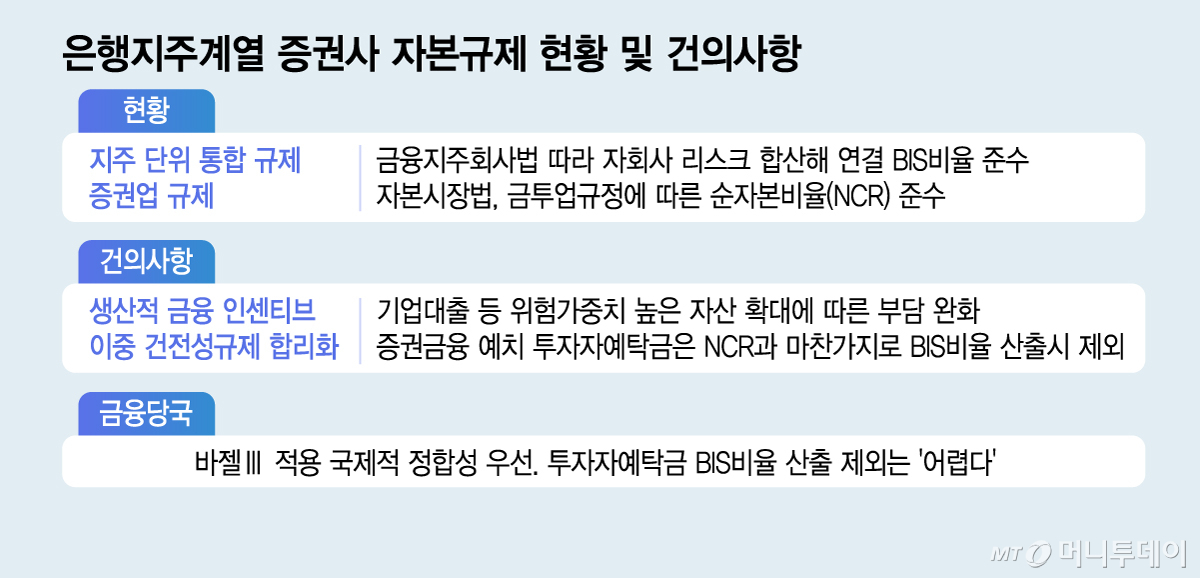
Concerns are raised that capital regulations applied separately to financial holding companies and brokerages are being doubly imposed on bank holding company-affiliated brokerages, creating an obstacle to expanding productive finance. Currently, as these brokerages increase risky capital investments such as corporate loans and venture capital with high risk weights, their risk-weighted assets rise, increasing the burden on the holding-linked BIS ratio. Although brokerages have requested that investor deposits be excluded at least from the calculation of holding company capital ratios, financial regulators have not accepted this, citing international consistency.
According to a MoneyToday investigation compiled on the 20th, financial regulators have decided not to grant exceptions for investor deposits under financial holding company capital regulations applicable to bank holding company-affiliated brokerages. A senior official from the financial authorities stated, "Rationalizing capital regulation must occur within the framework of international standards such as Basel III," and added, "Major global bank holding-affiliated brokerages also apply rules reflecting investor deposits uniformly, so it is difficult to exclude only South Korea."
Bank holding company-affiliated brokerages including KB Securities, NH Investment & Securities, and Shinhan Investment Corp have consistently urged for the rationalization of dual capital regulations aimed at expanding productive finance. These brokerages are subject to the consolidated BIS ratio (Basel III capital adequacy ratio) regulation under the Financial Holding Company Act. They must also comply with the NCR (Net Capital Ratio) standards applied to brokerages under the Capital Market Act and Investment Business Regulations.
The problem is that as brokerages supply more productive finance, their burden from capital ratio regulations has increased. Corporate loans, venture capital (VC) investments, and the formation and investment of master funds carry high risk weights; thus, the more risky capital brokerages supply, the greater their risk-weighted assets become. When calculating the consolidated BIS ratio for bank holding companies, risk-weighted assets of all subsidiaries, including brokerages, are aggregated. As risk-weighted assets increase, brokers must accumulate even more capital to meet regulatory ratios, creating a structure where the capital burden on bank holding companies rises vertically.
Bank holding company-affiliated brokerages have requested financial regulators to rationalize regulations at least regarding investor deposits. Investor deposits separately deposited with securities finance institutions are currently excluded from NCR calculations, and brokerages are asking for similar exceptions in the calculation of financial holding company consolidated BIS ratios.
Although investor deposits themselves do not carry high risk weights, their explosive recent growth has become a burden for brokerages. As of the 19th, investor deposits totaled 106 trillion 575 billion won, an increase of 18 trillion 746 billion won (21.34%) compared to the end of last year. Brokerages argue that although the risk level is not high, the sharp increase in scale this year could create "a kind of illusion" when calculating the holding-linked BIS ratio.
Bank holding company-affiliated brokerages complain that such dual regulation creates an uneven playing field compared to non-bank holding brokerages. An industry official stated, "High-yield risky capital investments such as acquisition financing and private equity fund contributions are structurally bound to shrink," adding, "While independent brokerages with ample capital can boldly lead deals, bank holding-affiliated brokerages may remain stuck in conservative investments to protect their capital ratios."
In this situation, bank holding company-affiliated brokerages are raising capital through rights offerings (paid-in capital increases). NH Investment & Securities decided in June on a third-party allocated rights offering (paid-in capital increase) totaling 400 billion won targeting its major shareholder, NH Agricultural Cooperative Financial Holding. Meanwhile, KB Securities completed a shareholder-allocated rights offering (paid-in capital increase) worth 1 trillion won last month.

 in STOCK
