

Although Samsung Electronics surpassed 100 trillion won in third-quarter preliminary operating profit, the semiconductor bellwether actually took a step back. This was due to a flood of sell-on (selling at peak) volumes following an earnings surprise. Meanwhile, semiconductor materials, components and equipment stocks and secondary battery stocks rose together, drawing market attention.
According to Korea Exchange on the 10th, KOSPI closed at 6,625.93 in the second week of October (the 5th–9th), down 377.81 points (5.39%) from Jeonju (7,003.74). The market was closed on the 5th, a substitute holiday for National Foundation Day, and on the 9th, Hangul Day. KOSPI traded for only three days this week and fell every single day.
Samsung Electronics announced third-quarter preliminary results exceeding market expectations on the 8th, but both Samsung Electronics shares and KOSPI declined. Samsung Electronics' third-quarter preliminary operating profit was 107.4 trillion won. This week, Samsung Electronics slipped 3.48%, and SK Hynix fell 8.69%. This was due to sell-on volumes and the fact that large semiconductor ETFs (exchange-traded funds) undertook rebalancing on the earnings release day.
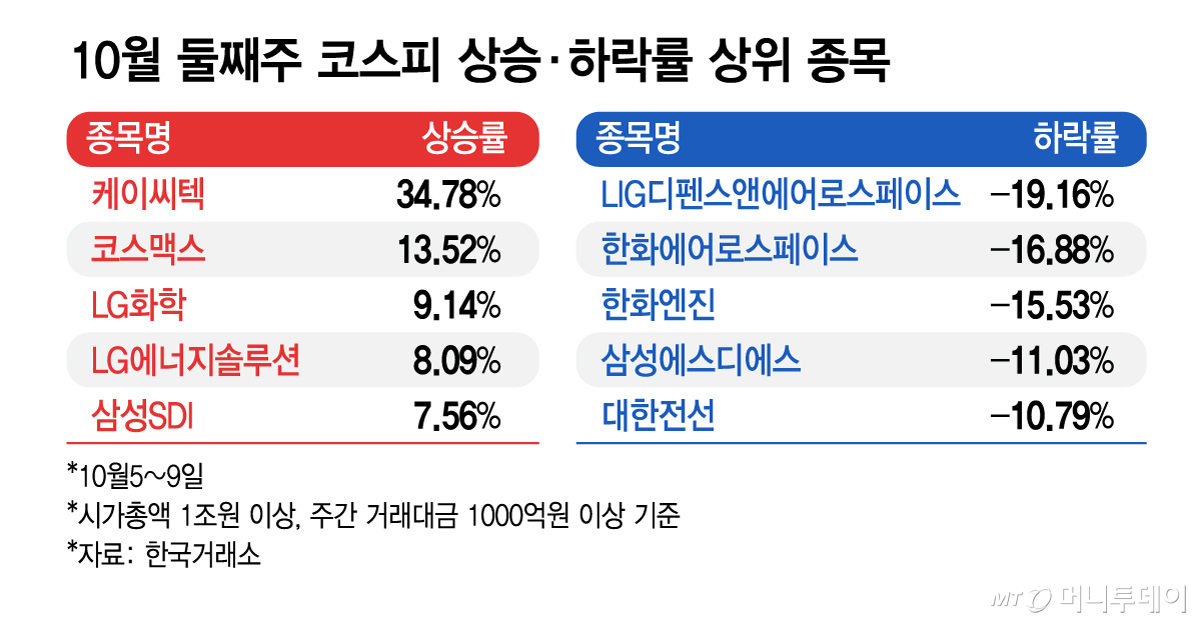
Conversely, semiconductor materials, components and equipment stocks surged. During this period, among KOSPI-listed stocks (based on market capitalization of 1 trillion won or more and weekly trading volume of 100 billion won or more), the top gainer was KC Technology, which rose 34.78%. Korea Circuit (change rate 6.92%), Daedeok Electronics (6.70%), and Isu Petasys (3.55%) also rose in tandem.
Kim Ju-yeon, a research analyst at Mirae Asset Securities, analyzed that "despite Samsung Electronics' strong results, large semiconductor stocks showed mixed performance, including a pullback due to concerns over ETF rebalancing volumes," adding that "however, materials, components and equipment stocks rose, reflecting expectations of increased investment."
Secondary battery stocks ran on the back of LG Energy Solution's third-quarter earnings surprise. LG Chem (9.14%), LG Energy Solution (8.09%), and Samsung SDI (7.56%) all made the list of top gainers.
On the 8th, LG Energy Solution disclosed that its third-quarter operating profit was preliminarily tallied at 756 billion won, a 25.7% increase year-on-year. This figure exceeded market consensus estimates by 132%. As a result, investment sentiment across the secondary battery sector improved.
Cosmax surged 13.52% during this period on expectations for third-quarter results. Oh Rin-a, a research analyst at LS Securities, forecast that "Cosmax's third-quarter results will show growth exceeding previous expectations, based on strong order flows in Korea and the United States."
On the other hand, space and aviation stocks fell across the board during this period. This was due to profit-taking selling centered on space and aviation stocks after Nuri, the Korean-made rocket, successfully completed its fifth flight on the 7th.
LIG Defense & Aerospace plunged 19.16%, while Hanwha Aerospace (-16.88%), Hyundai Rotem (-9.70%), and Korea Aerospace Industries (-9.06%) also saw their share prices decline.
Stocks with poor third-quarter earnings outlooks also fell. Hanwha Engine (-15.53%), Samsung SDS (-11.03%), and Daekorea Electric Power Corporation Line (-10.79%) ranked among the top losers, as reports indicated that their third-quarter operating profits would fall below market expectations.
Kang Gyeong-tae, a research analyst at Korea Investment & Securities, analyzed that "Hanwha Engine's operating profit will be 15% below consensus estimates," noting that "while low-speed engine performance is good, this is due to costs related to revenue sources." Analyst Kang also lowered Hanwha Engine's target price to 85,000 won, which is 22.7% lower than before.


 in STOCK

