

On Tuesday, when the KOSPI plunged by more than 5%, retail investors made net purchases of leveraged exchange-traded funds (ETFs) exceeding 600 billion won. Although this was a bet on a short-term rebound, the KOSPI continued to fall the following day. Forecasts suggest that it will take time for a trend reversal to emerge.
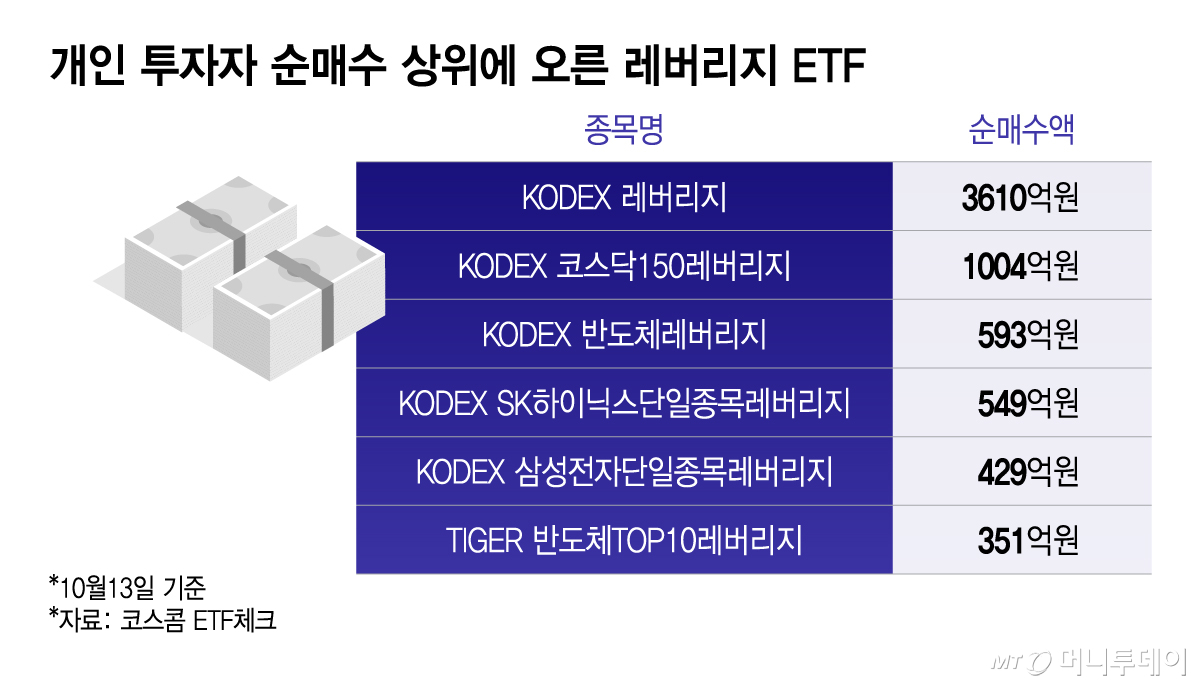
According to KOSCOM ETF Check on Wednesday, the most purchased ETF by retail investors on the 13th, when the KOSPI fell 5.46%, was KODEX Leverage, with net purchases of 361 billion won.
Other leveraged ETFs also ranked high in retail net purchases. Looking at net purchase amounts by ETF: "KODEX KOSDAQ150 Leverage" 100.4 billion won, "KODEX Semiconductor Leverage" 59.3 billion won, "KODEX SK Hynix Single Stock Leverage" 54.9 billion won, "KODEX Samsung Electronics Single Stock Leverage" 42.9 billion won, and "TIGER Semiconductor TOP10 Leverage" 35.1 billion won.
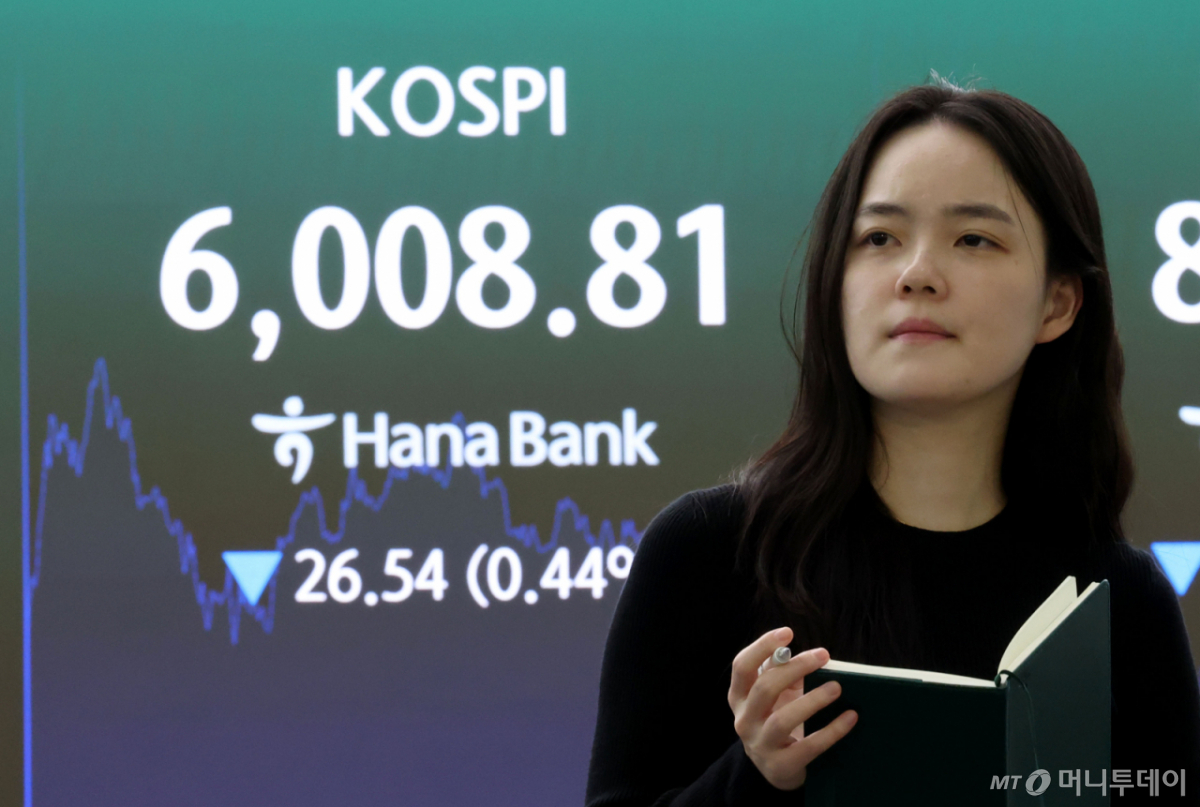
On Wednesday, the KOSPI showed signs of a rebound, rising to 6190.65 during trading, but was pushed back down near the close. The KOSPI closed at 6008.81, down 26.54 points (0.44%) from the previous day. This was due to overlapping factors such as rising international oil prices, controversy over artificial intelligence (AI) profitability, and caution ahead of the release of the U.S. September Consumer Price Index (CPI).
Samsung Electronics and SK Hynix also showed upward trends during trading but narrowed their gains just before the market close. Samsung Electronics closed flat, while SK Hynix fell 1.66%. Consequently, KODEX Leverage dropped 1.06%, and KODEX SK Hynix Single Stock Leverage fell 3.3%. KODEX Samsung Electronics Single Stock Leverage rose 0.43%.
The KOSDAQ also fell 1.57% on this day, causing KODEX KOSDAQ150 Leverage to drop 4.29%.
It remains uncertain whether the KOSPI, which has fallen for six consecutive trading days since the 6th, will successfully achieve a trend reversal. This is because negative factors such as the AI profitability controversy, supply-demand gaps, and high interest rates, which caused the sharp drop in the KOSPI, still persist.
In particular, experts in the financial investment industry are focusing on supply and demand. Hwang Su-uk, a researcher at Meritz Securities, said that "the direction of the KOSPI index will be determined by semiconductor stock prices, and semiconductor fundamentals remain solid," while adding that "stock prices are being driven more by investor sentiment and supply-demand than by fundamentals." He continued, "It will not be too late to judge the direction after observing whether foreign supply is entering on a trend basis, given that retail and institutional investor supply is failing to create a direction."
However, foreign investors also made net sales of 1.1814 trillion won in the KOSPI on this day. The scale of foreign net sales from the beginning of this month up to this day has reached 9.6455 trillion won.
Lee Kyung-min, head of the FICC Research Department at Daishin Securities, said that "while price indicators are in a bottom zone, supply-demand and profit signals are not yet there," adding that "one must confirm a combination where daily foreign net sales fall below 1 trillion won, program non-directional trading turns to net purchases, and Micron and the SOX index rebound first."
He said, "I see no practical benefit in selling below the KOSPI 6,000 line or at a forward price-to-earnings (PER) ratio of less than 5 times," and added that "a strategy of holding on or gradually making split purchases by utilizing volatility from the primary support line (the 5,800 to 5,900 range) is effective."

 in STOCK

