

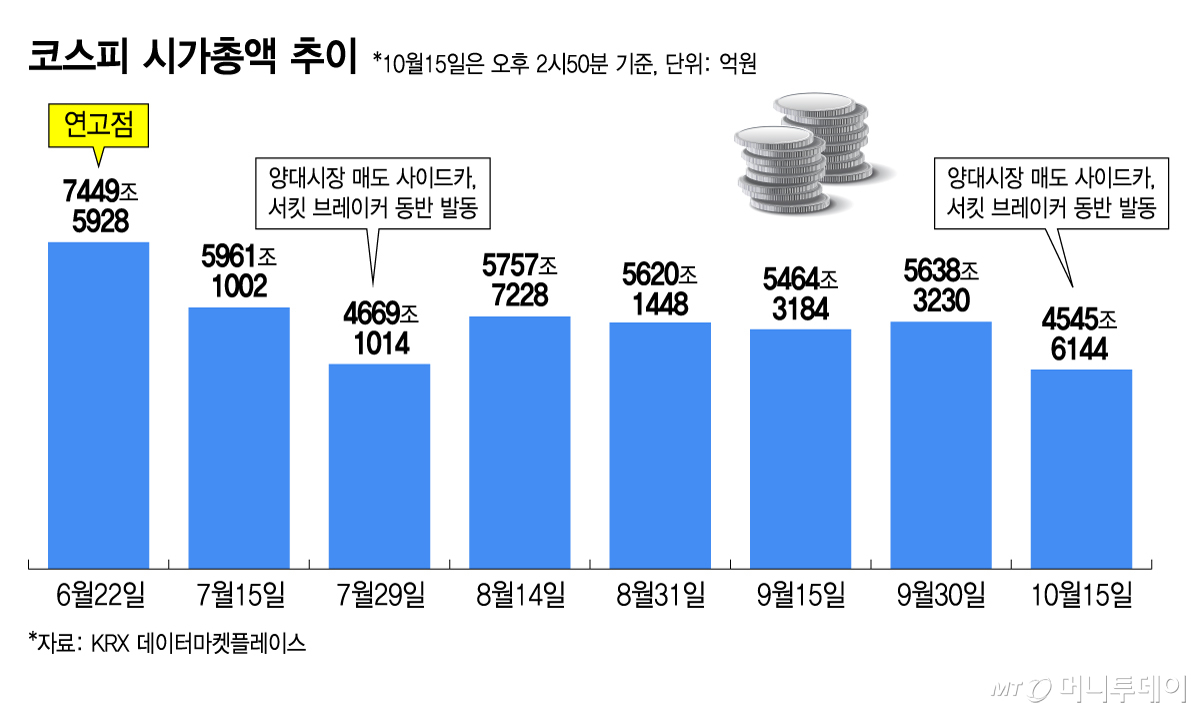
The KOSPI plunged 7.57% to close at 5,554.22 on the 15th. The sharp decline was driven by a U.S. inflation shock and AI (artificial intelligence) credit risks stemming from CoreWeave, which sent Samsung Electronics and SK Hynix down by around 10%. As these leading semiconductor stocks tumbled, sidecars (futures market circuit breakers) and circuit breakers were triggered in succession across both major markets.
On this day, the KOSPI ended regular trading on the Korea Exchange at 5,554.22, down 454.79 points (7.57%) from the previous session. This marked the first time the index had fallen below the 5,500 level since July 30 (5,593.56).
The KOSPI slid into the 5,600 range early in trading. Starting at 5,673.01, down 5.59% from the previous session, the index widened its losses as it failed to gain momentum against net selling by foreign investors.
According to data from the Korea Exchange, foreign investors sold a net 3.6254 trillion won worth of shares in the KOSPI market on this day. Institutional investors and retail investors made net purchases of 1.6907 trillion won and 1.2923 trillion won, respectively, but were unable to offset the selling pressure from foreign investors. Foreign investors had been net sellers in the KOSPI market for eight consecutive trading days since the 2nd of this month.
In the unprecedented plunge, market stabilization mechanisms were activated simultaneously in both major markets. As the futures index dropped sharply at the start of regular trading, a sell-side sidecar (futures market circuit breaker) was triggered for the first time in two and a half months since July 29. Sidecars (futures market circuit breakers) were activated at 9:07 a.m. for the KOSPI and 9:12 a.m. for the KOSDAQ, halting the validity of program trading orders for five minutes.
In the afternoon, even the Stage 1 circuit breaker was triggered. Circuit breakers were activated in the KOSDAQ market at 12:23 p.m. and in the KOSPI market at 12:38 p.m., halting all trading for 20 minutes. This marked the first time circuit breakers had been triggered simultaneously in both major markets since July 29, a span of 51 trading days.
Lee Kyung-min, a research analyst at Daishin Securities, analyzed, "Amid extreme volatility, including the triggering of a circuit breaker in the KOSPI market, the index has fallen by approximately 20% over the past six trading days." He added, "The burden of high interest rates was compounded by concerns over the sustainability of AI investment and intensifying memory competition, while foreign selling and domestic supply-demand imbalances widened the decline." Lee further noted, "As U.S. long-term bond yields rose, net selling by foreign investors intensified after the Chuseok holiday." He added, "In addition, three external shocks—short-term interest rate hikes driven by U.S. inflation, doubts over AI infrastructure profitability, and concerns about memory competition—all converged on 'Korean semiconductors.'"
The KOSDAQ ended regular trading at 760.82, down 63.06 points (7.65%). Starting at 784.45, a 4.79% drop from the previous session, the KOSDAQ also lost the 800th mark amid weakness in semiconductor substrate and materials, components and equipment stocks, along with net selling by retail investors and institutional investors. In the KOSDAQ market, foreign investors made net purchases of 215.9 billion won, while retail investors and institutional investors made net sales of 67 billion won and 163.1 billion won, respectively.
On this day, sectors across the AI value chain, including semiconductors, were broadly weak. In the KOSPI market, Samsung Electronics closed at 209,000 won, down 23,000 won (9.91%) from the previous session. SK Hynix closed at 1,258,000 won, down 161,000 won (11.35%). SK Hynix ended trading at 1,258,000 won, down 161,000 won (11.35%). SK Square plunged in the 10th% range, while Samsung Electro-Mechanics fell in the 15th% range.
In the KOSDAQ market, Jusung Engineering and Wonik IPS also plunged by more than 16%. Simmtech and HPSP dropped in the 13th% range, while IOTECH and RAINBOW Robotics fell in the 10th% range.
In the KOSPI, all industrial sectors were weak, except for food & tobacco and pharmaceuticals, which showed strength in the 2nd% range. In the KOSDAQ, publishing & media was strong by more than 16%, while all other industries declined.
Yoon Seok-mo, head of the research center at Samsung Securities, explained, "The U.S. September CPI (consumer price index) released on the previous day rose 3.7% year-on-year, exceeding market expectations (3.6%), and core CPI also came in at 2.6%, above expectations (2.5%)." He added, "As the Philadelphia Semiconductor Index plunged by more than 4% in the New York stock market, it acted as a strong downward pressure on the domestic stock market."
Center Head Yoon predicted, "In a situation where foreign selling is concentrated, the limited buying capacity of domestic institutional investors and retail investors to absorb these sales revealed a structural vulnerability where even small sell-offs sharply widen the index decline." He added, "Assuming that downward revisions to corporate earnings do not fully materialize, the KOSPI 5,000 level is expected to act as the primary support line."
In the Seoul foreign exchange market on this day, the won/dollar exchange rate stood at 1,344.6 won as of 3:30 p.m.

 in STOCK
