

Will the risks remain even if margin trading is blocked?... The fear of "short selling" lurking in a plunging market
As financial regulators move to curb "margin investing (investing with debt)"—or borrowing to invest—the risk of forced liquidations on existing credit loans has emerged as a new source of market instability amid heightened volatility, including recent sharp declines in the stock market. Although measures taking effect on the 19th aim to prevent excessive concentration of credit loans in specific stocks, this does not eliminate the risks already accumulated from margin investing (investing with debt).
Market participants are concerned that further declines in stock prices could trigger forced liquidations on existing loans, thereby exacerbating the downturn in the stock market. It is pointed out that, separate from efforts by financial regulators and securities firms to curb new borrowing, there is a growing need to manage the risks associated with existing margin financing.
◇New Margin Investing (Investing with Debt) Is Blocked, but Existing Risks Remain... The Dilemma of Regulation
According to the financial investment industry on the 18th, the Financial Services Commission held an emergency review meeting on the 15th in response to the sharp stock market decline and urged financial companies, including securities firms, to refrain from indiscriminate credit extension. Financial Services Commissioner Lee Eui-woon emphasized the risks of investing that relies excessively on debt and credit, and requested that all possible measures be taken for customer protection and risk management.
This directive from financial regulators aligns with the concentrated management measures for margin trading that take effect on the 19th. The Korea Financial Investment Association and 10 comprehensive securities firms formulated a plan last month to strengthen voluntary management of margin trading. The core of the plan is to impose stricter controls on new margin loans for specific stocks if margin lending for those stocks exceeds 15% of the firm's total margin lending portfolio.
Each investment firm can lower the loan limit per investor for a given stock or raise the margin requirement, which is the percentage of the purchase price that investors must cover with their own funds. The specific management methods are determined at the discretion of each securities firm.
A notable aspect is that the new measures apply only to new investments, not existing margin loans. The Korea Financial Investment Association explained that this was done to minimize market impact. Investors who previously borrowed money to buy stocks are not required to immediately repay their loans solely because of the implementation of the new standards. Existing loans will continue to be managed under the previous management system, including terms such as maturity dates and collateral maintenance ratios stipulated in the original agreements.
There is also a dilemma related to market stability in margin financing regulations. Just because margin investing (investing with debt) is considered risky, pressuring investors to reduce their existing loans all at once could force them to sell their held stocks to repay the debt. While the market may be able to absorb such selling volume during periods of stable stock prices, it is highly likely to act as additional selling pressure in situations where stock prices are plummeting.
◇Existing margin investing (leveraged investing) still carries the risk of forced liquidation... concerns over chain selling remain
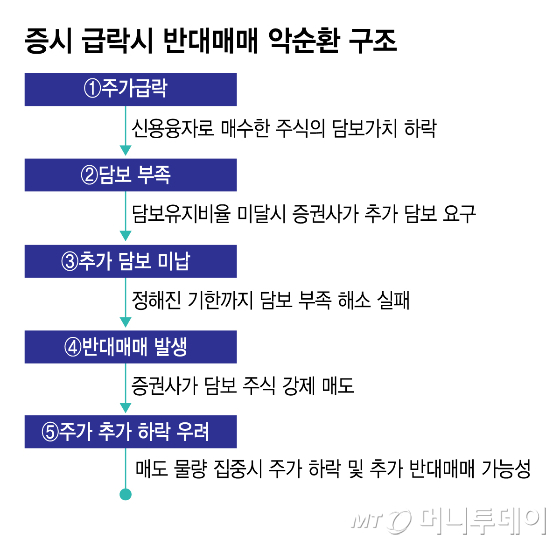
Even if new regulations do not apply to existing loans, the risk of forced liquidation remains. Credit financing is a transaction in which investors use borrowed funds to purchase stocks and other securities, providing them as collateral. If stock prices fall and the value of the collateral drops below a certain level, securities firms demand that investors replenish the shortfall. If an investor fails to deposit cash or additional collateral by the specified deadline, the securities firm initiates forced liquidation, selling the collateralized shares to recover the loan amount.
In particular, during a sharp market decline, the collateral values of multiple investors may fall simultaneously. If more investors fail to provide additional collateral, there is an increased likelihood that forced liquidation volumes will be dumped onto the market all at once. This can trigger a vicious cycle in which forced sales drive stock prices further down, leading to insufficient collateral among other investors and subsequent forced liquidations.
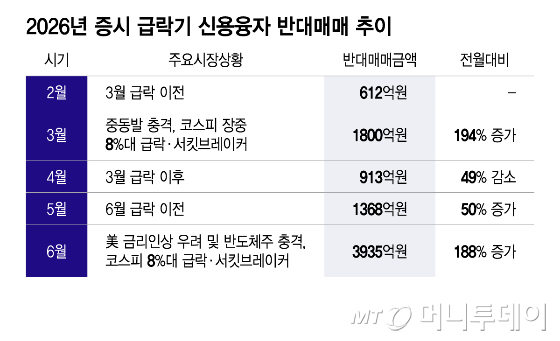
Credit margin forced liquidations surged even during this year's stock market crash. According to the office of People Power Party lawmaker Kim Sang-hoon, the total value of credit margin forced liquidation transactions at 10 major securities firms in March, when the market was significantly shaken by Middle East-related shocks, reached approximately 180 billion won, nearly tripling from the previous month (61.2 billion won). In June as well, the amount of forced liquidations increased by 188% to 393.5 billion won compared to the previous month (136.8 billion won).
There have been cases in which large-scale forced liquidations of margin trading occurred even during past market crashes. According to data from the Financial Supervisory Service, the total value of forced liquidations of margin loans at 10 major securities firms in August 2024 was 260.2 billion won, recording the highest monthly amount for that year. On August 5 of that month, the KOSPI index plunged by 8.8%, and the KOSDAQ index fell by 11.3%.
The risk of forced liquidation that can materialize in a sharp market decline is difficult to resolve solely through the stock-specific credit loan concentration management measures taking effect on the 19th. As these measures restrict new credit loans supplied to specific stocks to prevent further concentration of risk, the collateral shortfalls and forced liquidation risks associated with previously accumulated credit loans must be managed separately.
It is also difficult to suppress forced liquidations themselves. This is because if loans are not recovered even when the collateral value declines, the credit risk of securities firms may increase. On the other hand, analysts point out that there are challenges in risk management, as concentrated forced liquidations by multiple securities firms on specific stocks or at particular times can amplify downward pressure on the market.
Accordingly, as stock market volatility expands, it is pointed out that one must carefully examine not only the increasing trend in new margin loans but also the risk of insufficient collateral on existing loans and the possibility of forced liquidation.
A financial investment industry official stated, "It is necessary to assess how much additional margin calls have increased due to the sharp drop in stock prices and whether forced liquidations are likely to be concentrated at specific times or in particular stocks." The official added, "Investors should also recognize that the new regulations do not protect existing loans and need to verify the maintenance margin ratio applicable to them, the deadline for additional margin deposits, and the conditions for forced liquidation."
The shield that had been absorbing foreign investors’ selling pressure has vanished... KOSPI pushed down to 5,400; what is needed for a rebound
The domestic stock market is being shaken by supply-demand imbalances. As foreign investors dump their holdings, no clear buyer has emerged to absorb the selling pressure. Retail investors, who had previously absorbed foreign sell-offs, have seen their buying capacity weaken due to the burden of margin trading and a decline in investor sentiment. Moreover, the “breakwater” provided by share buybacks from Samsung Electronics and SK Hynix has also disappeared. The KOSPI index fell to the 5,400 level for the first time since July, while the KOSPI 200 Volatility Index (V-KOSPI) crossed the 50th-point threshold—marking the “fear zone”—for the first time since late August on the 15th.
According to the Korea Financial Investment Association on the 17th, investor deposits stood at 96.9121 trillion won as of the 15th. Deposits had fallen below the 100th trillion won mark for the first time since the 21st of last month, dropping from 97.4280 trillion won on the 14th. Investor deposits refer to cash remaining in securities accounts and are considered "ammunition" for stock investment. In contrast, the balance of credit trading financing was recorded at 32.7499 trillion won. This figure had decreased to the 27th trillion won range on August 4 before surpassing 34 trillion won on the 13th of this month, indicating an upward trend. Consequently, funds awaiting investment in the stock market have decreased, while the burden of leveraged investment has increased.
Expanding margin trading can act as a kind of "time bomb," as it may trigger forced liquidations when stock prices plummet. If share prices fall and the collateral value drops, securities firms demand additional collateral from investors. If investors fail to meet this requirement within the specified deadline, the firms can forcibly sell their held shares. This process can create a vicious cycle in which a flood of selling pressure hits the market, driving stock prices even lower.
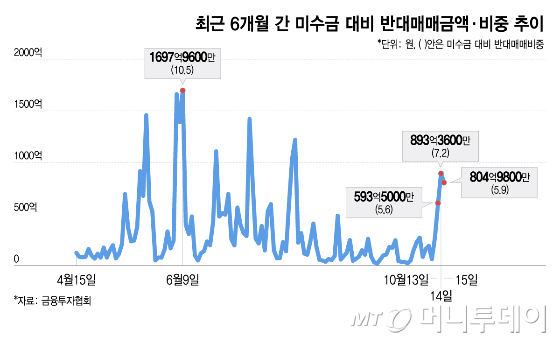
Forced liquidation activity was prominent over the three trading days following the activation of a sell-side sidecar (futures market circuit breaker) in the KOSPI market on the 13th. Both the amount and proportion of forced sales relative to margin call balances surged sharply. Margin call balances refer to amounts that investors failed to pay by the settlement date after purchasing stocks. The forced sale amounts (proportions) were as follows: 59.4 billion won (5.6%) on the 13th, 89.3 billion won (7.2%) on the 14th, and 80.5 billion won (5.9%) on the 15th. This marked the first time since late July that both the forced sale amount and proportion exceeded 80 billion won and 7%, respectively.
Lee Jun-young, a research analyst at Eugene Investment & Securities, stated, "The average purchase price for retail investors was formed in the range of the late 6,000s to the early 7,000s on the KOSPI index. However, following recent sharp declines that have pushed the KOSPI down by approximately 15% to 20%, it appears that liquidations have reached their largest scale since late July." He added, "For investors using margin trading, if the collateral maintenance ratio falls below the required threshold due to falling stock prices, they may face additional margin calls and forced sales."
Foreclosure sales also surged significantly in May and June, but the period stands in contrast to recent months because aggressive buying by retail investors was present at the time. From early May, foreign investors made net sales for 24 consecutive trading days, offloading a total of 76 trillion won, while retail investors made net purchases of 60 trillion won over the same period, defending the index. Expectations for a rise in semiconductor stocks were high, and the launch of single-stock leverage ETFs further fueled investment enthusiasm.
In contrast, investor sentiment in artificial intelligence (AI) technology stocks, including semiconductors, has recently frozen sharply due to factors such as the launch of new products by China's Changxin Memory and concerns over the financial soundness of cloud company CoreWeave.
The supply-side support from share buybacks by Samsung Electronics and SK Hynix has also declined. Samsung Electronics completed its share buyback on the 6th, while SK Hynix is in the final stages of its program. Pension funds, which have served as a key source of buying during market downturns, are currently struggling to increase purchases due to delays in rebalancing their asset allocations. This explains why there is a lack of clear buyers to absorb foreign selling pressure.
Opinions suggest that the circuit breaker triggered in the KOSPI market on the 15th was influenced more by the absence of buying entities than by damage to fundamentals. Lee Jae-won, a research analyst at Yuanta Securities, analyzed, "While 80% to 90% of cumulative net selling by foreign investors since the beginning of the year has been concentrated in Samsung Electronics and SK Hynix, share buybacks, which had supported the index bottom last month, decreased sharply after the end of purchases for Samsung Electronics." He added, "Retail investors, who made net purchases exceeding 10 trillion won since the start of the year, have seen their deposit growth stall, and the capacity of pension funds to defend supply and demand is also limited."
The researcher stated, "In the absence of a buyer to absorb foreign selling, a vicious cycle of selling similar to that seen during the leverage liquidation at the end of July is repeating itself." The researcher added, "For supply and demand to recover, it must be preceded by a calming of AI credit risk and a restoration of confidence in semiconductor earnings outlooks."
“Should have been blocked while lying down”: Leveraged ETFs that wiped out 2 trillion won of retail investors’ funds reignited at the Financial Supervisory Service’s National Assembly audit
The controversy over single-stock leveraged exchange-traded funds (ETFs) is expected to reignite at the National Assembly’s audit of the Financial Supervisory Service on the 19th. The broad opposition camp is focusing on the fact that while retail investors incurred losses from the introduction of single-stock leveraged ETFs, securities firms secured over 90 billion won in profits through fees. It is anticipated that the issue of whether these products ultimately only fattened the pockets of securities firms will be subject to intense scrutiny. A debate over the responsibility of regulatory authorities is also expected to be unavoidable.
According to the financial investment industry on the 16th, the National Assembly's Political Affairs Committee is set to conduct a national audit targeting the Financial Supervisory Service and other agencies on the 19th. As with the national audit of the Financial Services Commission, debate over policy responsibility for single-stock leveraged ETFs is expected to resurface.
At the time of the Financial Services Commission's National Assembly audit, the main issue was the debate over who bears responsibility for introducing the policy. It is predicted that at the Financial Supervisory Service's audit, post-implementation side effects will be the focus of intense scrutiny. Single-stock leveraged ETFs were introduced with the goal of stabilizing the exchange rate by attracting so-called retail investors in overseas stocks from foreign markets to the Korean market. The intent was to expand investors' choice of financial products and enhance the attractiveness of the Korean stock market, taking into account that various leveraged products are traded abroad.
As a result, retail investors flocked to single-stock leveraged ETFs, but most of them incurred losses. In contrast, securities firms collected trading fee revenue in exchange for brokering the products, leading to criticism that they ultimately only fattened their own profits.
According to documents submitted by the Financial Supervisory Service and reviewed by the office of People Power Party lawmaker Choi Eun-seok, retail investors have confirmed trading losses totaling 232.42 billion won in single-stock leverage and inverse ETPs (ETFs and ETNs). The figures are based on data aggregated from 10 comprehensive financial investment service providers covering the period from the products' launch on May 27 through August 14.
Conversely, securities firms reportedly earned 93.1 billion won in brokerage commissions over two months following the product launch. The figures were compiled by the office of People Power Party lawmaker Kim Jae-seop based on data submitted by the Korea Financial Investment Association (KOFIA), covering the period from the listing of 16 single-stock leveraged ETFs for Samsung Electronics and SK Hynix through the end of July last year.
Initially, there were discussions about the possibility of the National Assembly summoning a securities firm CEO (Chief Executive Officer) as a witness for the national audit, but all witness designations fell through.
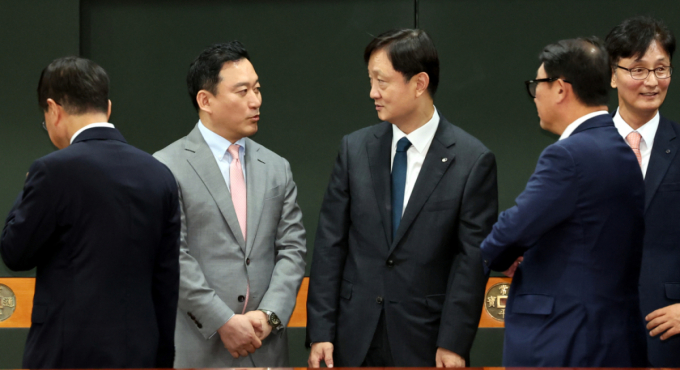
Supervisory responsibility is also expected to be pursued against Lee Chan-jin, head of the Financial Supervisory Service (FSS). In a regular press conference in June, FSS Chairman Lee stated that he regretted not having stopped single-stock leveraged ETFs "even if it meant lying down in front of them," sparking controversy. This was because the financial authorities acknowledged that the policy's effects had been minimal while its side effects had grown significantly. Following this, at a business report session before the National Assembly's Political Affairs Committee in July, he apologized, saying, "I deeply feel a sense of responsibility" and "I am sorry."
Measures to address margin investing (investing with debt) in response to recent stock market volatility have also emerged as a major issue. As of the 15th, the scale of credit trading financing, which refers to the amount investors borrowed from securities firms to purchase stocks, reached 32.7498 trillion won.
Following the Financial Supervisory Service's directive to securities firms to strengthen management of margin investing (investing with debt), the Korea Investment Association released a plan last month to enhance voluntary management of credit financing, in collaboration with 10 investment banks including Mirae Asset Securities and Korea Investment & Securities. The plan includes measures such as reducing the scale of credit extension from 100% to within 90% of a securities firm's own capital, and managing the proportion of credit financing for specific stocks to within 15%. The Financial Supervisory Service has stated that it will strengthen monitoring to ensure that securities firms comply with these voluntary management measures.

 in STOCK


