

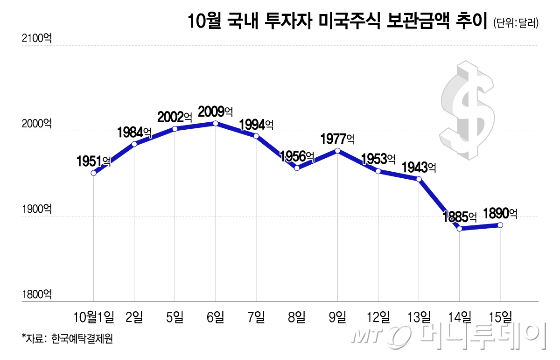
As volatility in the domestic stock market has increased, the number of retail investors in overseas stocks (U.S. stock investors) turning their attention to the U.S. stock market is growing. However, their U.S. stock holdings have recently plummeted. As net purchases of U.S. stocks have expanded this month while holdings have actually decreased, market attention is focused on this trend. Analysts note that even if investors shift their investment destinations overseas to avoid domestic market volatility, they are not free from the risk of losses.
According to the Korea Securities Depository (KSD) on the 19th, as of the 15th, the value of U.S. stocks held by domestic investors was $188.9 billion (approximately 251 trillion won), a decrease of $12 billion (approximately 16 trillion won) in just over a week from $200.9 billion (approximately 267 trillion won) on the 6th. The decline accounts for approximately 6% of total holdings.
The value of U.S. stock holdings is a figure aggregating the valuation of U.S. stocks held by domestic investors in dollars. Holdings exceeding $200 billion was the first time in about four months since early June. However, just days after surpassing $200 billion at the beginning of this month, it fell back to the $180 billion range.
It is notable that this phenomenon occurred amid increasing buying pressure for U.S. stocks by retail investors in overseas stocks. As of the 16th, net purchases of U.S. stocks by domestic investors this month were approximately $3.9 billion (approximately 5.2 trillion won). This represents a significant increase compared to approximately $1.9 billion in August and approximately $1 billion in September. While investment demand for the U.S. market has increased due to rising volatility in the domestic stock market, the valuation of held assets has actually decreased.
This is interpreted as being influenced by recent adjustments in the U.S. stock market, centered on technology stocks. Investor sentiment has weakened amid concerns over whether large-scale investments in the AI (artificial intelligence) industry will translate into actual corporate profitability, coupled with heightened uncertainty surrounding inflation and interest rate trajectories.
The fact that domestic investors' U.S. stock investments are concentrated in large-cap tech stocks and semiconductor-related ETFs (Exchange-Traded Funds) may also have had an impact. This is because stocks with high growth expectations can exhibit significant price volatility during adjustment phases.
Market observers point out that even if the investment region shifts from domestic to the U.S., risk diversification effects may be limited if investments are concentrated in similar sectors. This is because both domestic and overseas stock markets have recently reacted sensitively to growth expectations in the AI and semiconductor sectors, as well as global interest rate uncertainty.
A source in the financial investment industry said, "Rather than simply distinguishing between domestic and overseas markets, investment allocations should be divided by asset class and sector," adding, "Attention must also be paid to changes in asset value due to volatility in overseas stock markets." The source further added, "However, it should also be considered that the decrease in U.S. stock holdings may reflect not only falling stock prices but also changes in holding quantities due to trading activities."

 in STOCK
