

The scale of lawsuits filed by franchisees against headquarters for the return of differential franchise fees is expanding. Mega MGC Coffee (Mega Coffee) owners have increased their claimed amount to the 60 billion won range, while additional lawsuits are being prepared.
Since the final confirmation of Pizza Hut franchisees’ victory in January this year, litigation has spread across the entire food service franchise sector, with the specific contract terms for each brand and whether there was an agreement on receiving differential franchise fees cited as key issues that will determine future rulings.
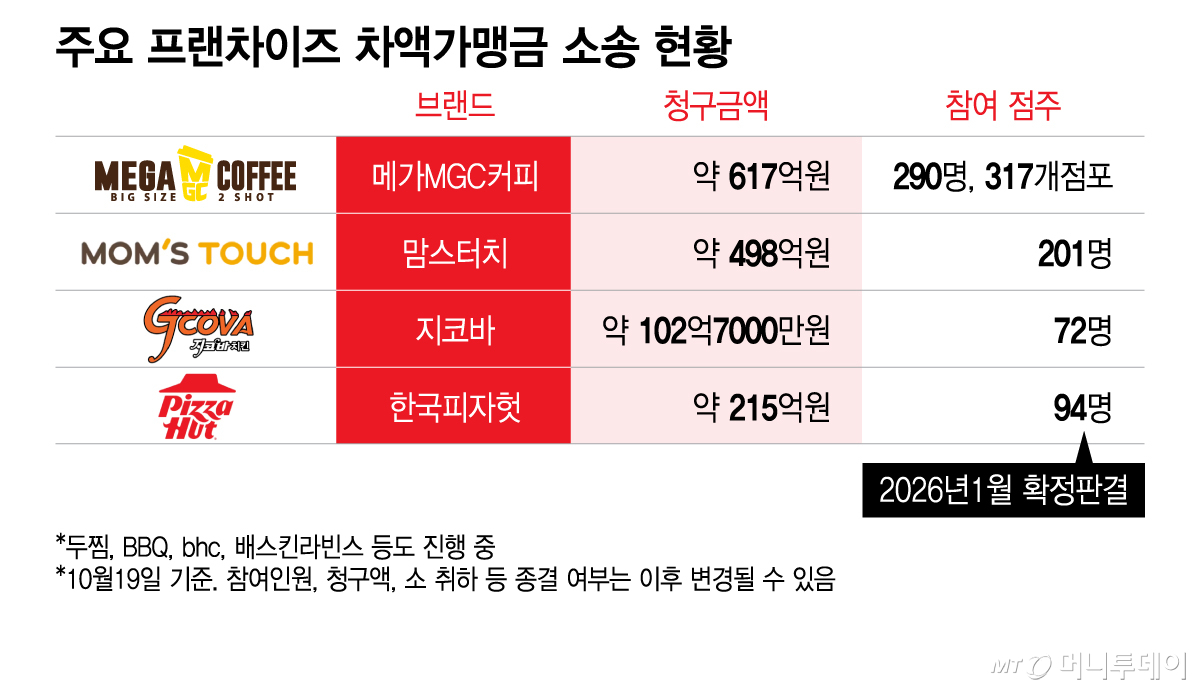
According to the franchise industry on the 19th, Mega Coffee franchisees have increased the total claimed amount in their ongoing unjust enrichment return claim lawsuit against headquarters MGC Global to approximately 61.7 billion won.
In this lawsuit, Law Firm Doa, representing the franchisees, submitted an application for a change of claims with such content on the 6th. The number of participating owners is 290, totaling 317 stores based on store count, with the claimed amount being 212.85 million won per owner and approximately 194.72 million won per store.
This lawsuit was filed in April last month, initially claiming a return of 0.1 billion won per person, but the claim amount was increased after securing additional materials that would serve as the basis for the claim.
Subsequently, reflecting partial withdrawal of suits and joint operation relationships, the plaintiff composition was adjusted from 323 people as of April to 290 people. According to Doa, the timing for submitting additional complaints is undetermined.
Lawsuits in the hundreds of billions of won range are continuing with other brands as well. 201 Mom’s Touch owners are demanding a return of approximately 49.8 billion won, and clashed with headquarters over whether to submit cost data at the first hearing in August last month.
72 Zico Ba owners also increased their claimed amount from the initial 720 million won to approximately 10.27 billion won. Owners of Du Jjim, BBQ, Gupne Chicken, bhc, and Baskin-Robbins have also filed lawsuits against headquarters for the return of differential franchise fees. The industry expects Zico Ba Chicken to be the subject of the second first-instance ruling on differential franchise fees.
Differential franchise fees are the portion exceeding the appropriate wholesale price among the amounts paid by franchisees for products or materials supplied from the franchisor. It is a type of distribution margin long considered customary in the industry, but the situation changed when the Supreme Court confirmed partial victory for Pizza Hut franchisees in their differential franchise fee return lawsuit in January this year.
The Supreme Court ruled that it constituted unjust enrichment because differential franchise fees were not explicitly stated in the Korea Pizza Hut contract and there was no specific agreement. The return amount was calculated based on factors such as the ratio of differential franchise fees to sales recorded in the information disclosure document.
The Mega Coffee lawsuit also hinges on whether there was an explicit agreement. The owners’ side claims that there were no separate provisions regarding payment of differential franchise fees beyond the monthly 150,000 won royalty. On the other hand, headquarters counters that implicit agreement was reached through the information disclosure document, amended contract, and continuous transactions. Even if return liability is recognized, the calculation period and method are expected to become issues.
Franchise brand companies are closely monitoring the impact of subsequent differential franchise fee rulings. In particular, brands with many franchisees like Mega Coffee are expected to face a line of additional lawsuits depending on the ruling outcome.
In the case of Mega Coffee, the number of franchise stores surpassed 4,500 as of this month. However, a franchise industry official drew a line by stating, “The situations for Pizza Hut and other food service brands are all different,” adding, “I understand that individual trial panels are looking at each brand’s situation rather than simply following the Pizza Hut ruling.”

 in LIVING

