

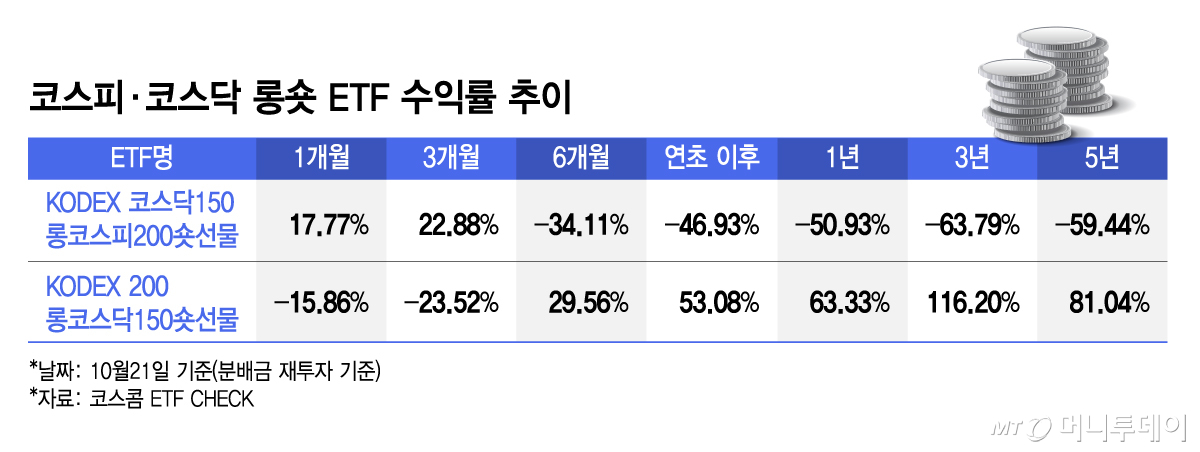
So-called "KOSDAQ Long, KOSPI Short" exchange-traded funds (ETFs), which buy KOSDAQ 150 futures and sell KOSPI 200 futures, recorded a return of over 20% in the past three months. Conversely, ETFs employing the opposite strategy, which had generated high returns in the first half of the year, suffered losses of more than 20% over the same period. This is attributed to the fact that KOSDAQ outperformed KOSPI as supply and demand, previously concentrated in Samsung Electronics and SK Hynix, dispersed into sectors such as materials, components and equipment, biotechnology, and secondary batteries.
According to KOSCOM ETF CHECK on the 21st, the three-month return (based on reinvestment of distributions) for the "KODEX KOSDAQ150 Long KOSPI 200 Short Futures" ETF as of that day was 22.88%. This ETF is a product that buys (longs) KOSDAQ 150 futures and sells (shorts) KOSPI 200 futures. The return for the "KODEX 200 Long KOSDAQ150 Short Futures" ETF, which employs the opposite investment strategy, was recorded at -23.52%.
The performance of the two ETFs reversed in the second half of the year. Over a longer period, the KOSPI long strategy had been dominant. Based on the past six months, the returns for the KODEX KOSDAQ150 Long KOSPI 200 Short Futures and KODEX 200 Long KOSDAQ150 Short Futures ETFs were -34.11% and 29.56%, respectively. Extending the period to five years, the returns widened to -59.44% and 81.04%, respectively.
The financial investment industry analyzes that while the sharp drop in share prices of Samsung Electronics and SK Hynix, which account for half of KOSPI market capitalization, dragged down the KOSPI index, the KOSDAQ index held up relatively well due to less concentration in specific sectors. As of the 21st, Samsung Electronics' share price had fallen by 13.7% and SK Hynix's by 29.5% compared to three months ago.
The difference is clear when viewed by index. According to the Korea Exchange, the KOSPI 200 index fell by 17% as of the 21st compared to three months ago. In contrast, the KOSPI 200 Ex-Large Cap index declined by only 10.74%, while the KOSPI Ex-KOSPI 200 index actually rose by 3.9%. The KOSDAQ 150 index also increased by 5.3%.
Yang Hyeon-gyeong, a research analyst at iM Securities, stated, "In the first half of the year, concentration in Samsung Electronics and SK Hynix was strong due to AI investments, among other factors, and there were supply-demand distortions caused by single-stock leverage ETFs." He added, "As the market lacks confidence in the growth potential of revenue and operating profit for AI semiconductor stocks after 2028, rotation into other sectors such as biotechnology and secondary batteries emerged in the second half."
Foreign capital, which determines the direction of the domestic stock market, also flowed out more from KOSPI than from KOSDAQ since July. Over the past three months, foreign investors made net sales worth 47.718 trillion won in the KOSPI market, while net sales in the KOSDAQ market amounted to only 3.162 trillion won. Lee Sang-yeon, a research analyst at Shin Young Securities, analyzed, "Retail investors have exhausted their cash reserves, and institutional investors are in an ambiguous situation regarding injecting new funds ahead of next year's budget execution, so it depends on foreign capital."
Advice is emerging from the securities industry to hold existing large semiconductor stocks while diversifying new funds into materials, components and equipment for semiconductors or sectors with low volatility. The analyst said, "Depending on investment style, one can add supportive industries with low volatility and dividends, such as financials or insurance stocks." He added, "Given the distorted supply and demand, it would be good to pay attention to sectors like secondary batteries that foreign investors or institutional investors are buying."

 in STOCK
