

Securities firms that earned several hundred billion won in fee income through target-conversion type discretionary wrap accounts in the first half of this year are now in a bind. The KOSPI, which was approaching 10,000 points as recently as early June, has been cut in half, causing valuation losses to accumulate in funds whose portfolios consist of stocks. In particular, criticism is emerging that some securities firms may have failed to implement soft closing—a practice of raising funds only up to a manageable limit—despite having reached their targets without redeeming the accounts.
According to financial investment industry sources on the 28th, sales of stock target-conversion type wrap products exceeded several hundred billion won per firm in July last month, just before the market slump. In July alone, Korea Investment & Securities sold 200 billion won worth, KB Securities sold 160 billion won, Shinhan Investment Corp sold 85 billion won, NH Investment & Securities sold approximately 50 billion won, and Samsung Securities sold approximately 45 billion won. Earlier in the first half of the year, each firm had also recorded sales in the trillions of won on a monthly basis.
Target-conversion type products are characterized by automatically converting high-risk assets such as stocks or exchange-traded funds (ETFs) into safe assets like bonds and money market funds (MMFs) once a pre-set target return rate (5% to 7% annually) is reached. It is reported that while the assets convert to safe holdings upon achieving the return, the majority of customers do not hold these safe assets but instead realize their profits through product hedging.
However, as the stock market turned downward, the returns on these products also declined. Valuation losses occurred in some accounts where the target conversion did not take place. Consequently, customer complaints have been increasing. In fact, consumer complaints alleging improper management methods have arisen at Shinhan Investment Corp, following similar issues at KB Securities. As both companies have banks as their core affiliates, they are also under suspicion of having engaged in incomplete sales by referring deposit customers from bank branches.
The industry has long expressed concerns over the indiscriminate sales practices of some securities firms. According to an official in the wrap and trust sector of a securities firm, products sold in an "Nth round recruitment" format have seen several hundred billion won raised in each individual round. The consensus in the industry is that such volumes are beyond the capacity of a single company's wrap personnel to handle.
Generally, investment funds are accepted for set periods per round. Closing the sales book by accepting only enough funds to redeem stocks upon target achievement is known as "soft closing." For example, if 300 billion won was raised in the first round of a target-conversion type Product A, and the product portfolio includes items with a daily trading volume of less than 100 billion won, it would be impossible to sell all the stocks from accounts that have reached their targets. This is because there are not enough buyers.
In reality, at KB Securities, approximately 10 accounts enrolled in last month's "Chesley Advisory Target-Conversion Type Wrap" product failed to be redeemed despite reaching the target return rate. Some of these investors have filed complaints with the Financial Supervisory Service, citing a lack of consistency in management as the reason why only their own accounts were not redeemed.
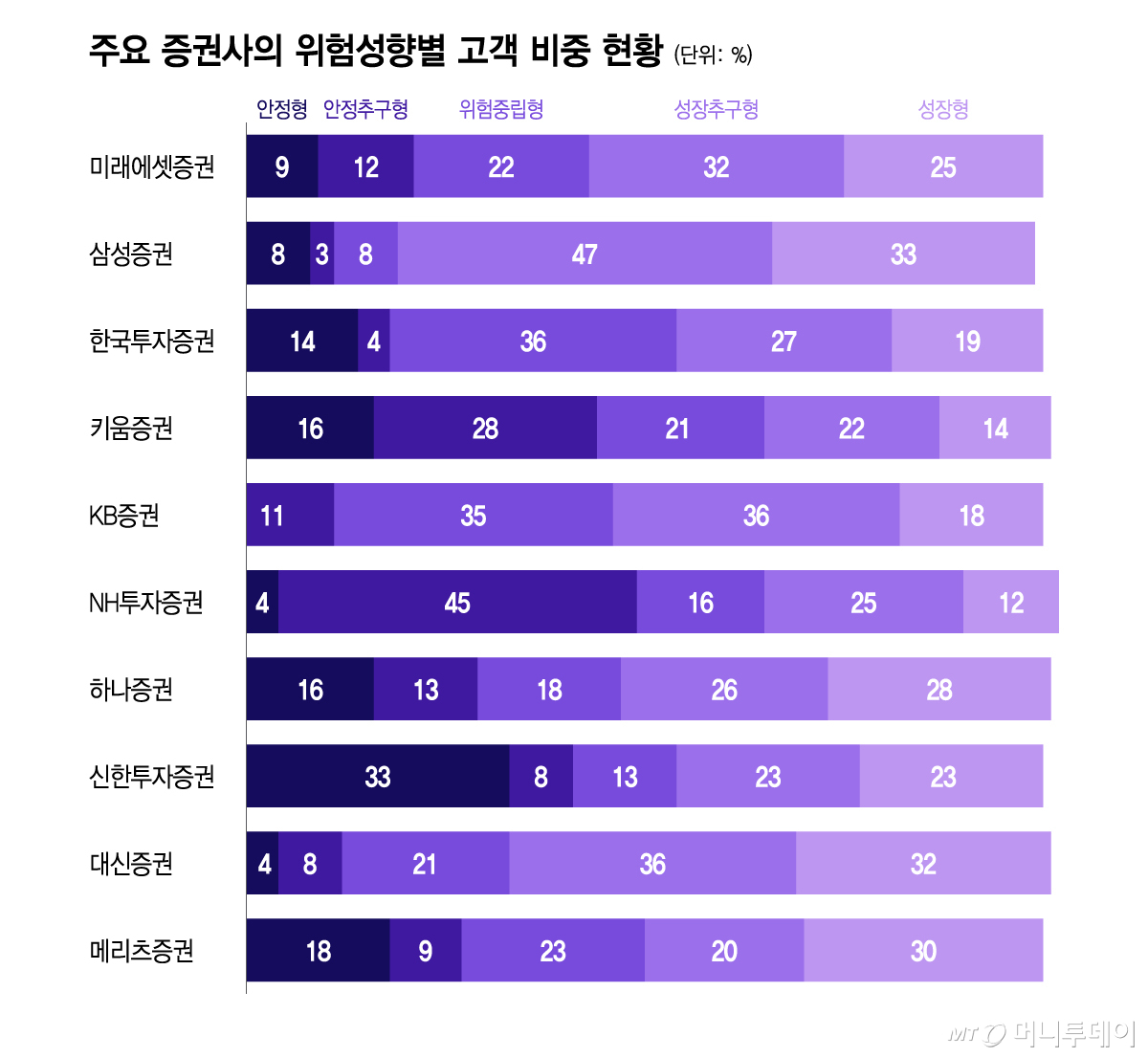
Meanwhile, aggressive sales tactics are reflected in various metrics. According to documents submitted by the Financial Supervisory Service to the office of Democratic Party of Korea lawmaker Park Hong-bae, a member of the National Assembly's Political Affairs Committee, some securities firms had stable-type customers accounting for less than 10% of their customer risk profile composition. Customer risk profiles are verified through two methods: mobile and in-person enrollment. Stable-type customers are not eligible to enroll in stock-based products such as target-conversion type wraps. To enroll in a product, one must set their own profile with a focus on the product's characteristics. KB Securities had the lowest proportion of stable-type customers at 0% (2,894 people). This was followed by NH Investment & Securities and Daishin Securities at the 4% range, Samsung Securities at the 8% range, and Mirae Asset Securities at the 9% range.
Currently, wrap and trust management personnel are in a state of mass departure following sanctions from financial authorities after the Legoland incident, with stock operation experts all stepping down. The head of the Customer Asset Management Division at one securities firm was found to be in charge of corporate finance operations with no experience in stock operations. At another securities firm, division heads had previously served as regional headquarters directors, or branch personnel had been transferred to the headquarters.

 in STOCK
