

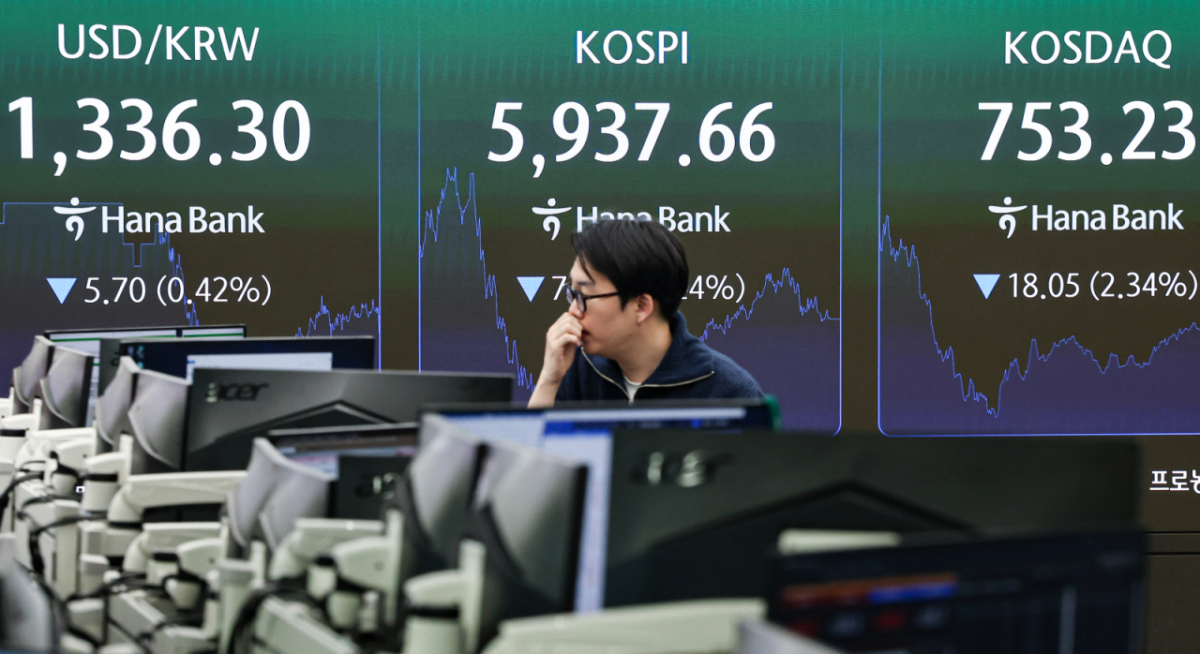
Domestic securities firms predicted that the impact of the U.S. October Federal Open Market Committee (FOMC) meeting on the stock and bond markets would be minimal, assessing it as within the range already priced in by the market. The market’s focus is shifting to the sustainability of artificial intelligence (AI) capital expenditure (CAPEX) and oil price volatility stemming from the Middle East.
According to the financial investment industry on Thursday, the U.S. Federal Reserve (Fed) maintained the base rate at 3.75% to 4.00% per annum at the October FOMC meeting held on the 27th and 28th (local time).
During the meeting, two committee members voted against by advocating for a 25bp (0.25 percentage point) increase, but the majority of members supported holding rates steady, resulting in a conclusion that aligned with market consensus estimates.
The three major U.S. stock indices (Dow Jones 30, S&P 500, and NASDAQ) closed higher overnight, lending weight to assessments within the securities industry that market concerns over tightening had eased.
Han Ji-young, a researcher at Kiwoom Securities, said, “Federal Reserve Chair Kevin Warsh noted last month (September FOMC) that financial conditions have tightened following the rate hike and that inflation decisions would be made after reviewing additional data.”
She explained, “Considering that the probability of a December FOMC interest rate hike has not changed according to the Chicago Mercantile Exchange (CME) FedWatch tool, this meeting is a neutral event that will not significantly impact the stock market.”
Overseas investment banks (IBs) expressed mixed reactions regarding Chair Warsh’s ambiguous stance at the press conference again. Bank of America (BoA) assessed that the lack of clear additional information or guidance evoked memories of the July FOMC, highlighting doubts about the Fed’s commitment to price stability.
Morgan Stanley analyzed that the rationale for the Federal Reserve’s hold was unclear and thus lacked persuasiveness, suggesting that Chair Warsh employed a delay strategy to review additional data and Task Force (TF) results.
With the FOMC meeting ending lacklusterly, fortunes diverged among stocks in domestic and overseas markets based on big tech CAPEX trends, earnings, and shareholder returns rather than interest rates.
Notable examples include Oracle, which surged 10.73% during regular trading after announcing that CAPEX would turn to a downward trend starting from fiscal year 2029, and Alphabet (Class A), which plunged 9.97% in after-hours trading due to the impact of weak quarterly revenue. Samsung Electronics also saw its stock price slip during the confirmed earnings conference call, falling 4.13% in regular trading.
Amid high oil prices, with rate hikes to suppress inflationary pressure being postponed, experts cited Middle East uncertainty and the direction of long-term interest rates as short-term variables.
It was pointed out that the Israeli general election ended in a deadlock without any party securing a majority, leaving unclear whether Prime Minister Benjamin Netanyahu, a hardliner against Iran, would step down, while U.S. midterm elections are also approaching.
Park Sang-hyun, a researcher at iM Securities, said, “The possibility that Prime Minister Netanyahu will continue to remain in power can no longer be ruled out, which inevitably has a negative impact on oil prices as it increases the probability that follow-up operations to the ‘Magnificent Fury’ mentioned by U.S. President Donald Trump after the midterm elections will be carried out.” He added, “The duration of the operation and whether President Trump will pursue an exit strategy are key factors.”
Regarding the Federal Reserve’s monetary policy, domestic securities firms placed weight on the forecast that the tightening cycle has effectively reached its final stages. Analysts assessed a high probability of returning to a hold stance after a December rate hike.
Kang Seung-won, a researcher at NH Investment & Securities, said, “According to the dot plot, the U.S. neutral interest rate estimated by the most hawkish Federal Reserve committee members is 3.75% to 4.00%. If rates reach 4.00% to 4.25% with a December hike, all committee members will perceive it as ‘restrictive.’”
He stated, “The current pace of Federal Reserve interest rate hikes is once per quarter. The Federal Reserve will review at least three months’ worth of data after the December hike, and considering the period of war and surging oil prices (March), a base effect in the data will also begin to appear.” He concluded, “Further hikes are not easy.”

 in STOCK
