

Investors could receive proceeds from stock sales as early as the next trading day starting in 2028, under a roadmap unveiled by financial market institutions to transition to a T+1 (one-business-day) settlement system. The shift would mark the first change to the settlement system since its introduction in 1972, more than 50 years ago.
Securities-related institutions, including Korea Exchange, the Korea Securities Depository, Korea Securities Finance Corporation, and the Korea Financial Investment Association, announced on Monday a draft "Roadmap for Shortening Settlement Cycles in the Securities Market" centered on these contents.
Shortening settlement cycles is a measure to enhance the efficiency of investors' fund management and reduce settlement risk. Currently, it takes two trading days after selling stocks to withdraw the proceeds, but with shortened settlement cycles, withdrawals will be possible from the next trading day. Stocks, ETFs (exchange-traded funds), and ETNs (exchange-traded notes) are among the targets for shortening.
The United States transitioned to a T+1 settlement system in May 2024, while the EU and the United Kingdom are pushing for implementation in October 2027. However, domestically, sufficient preparation time has been secured considering factors such as time zone differences for foreign investors, won currency exchange issues, and the burden of overhauling computer systems on financial companies.
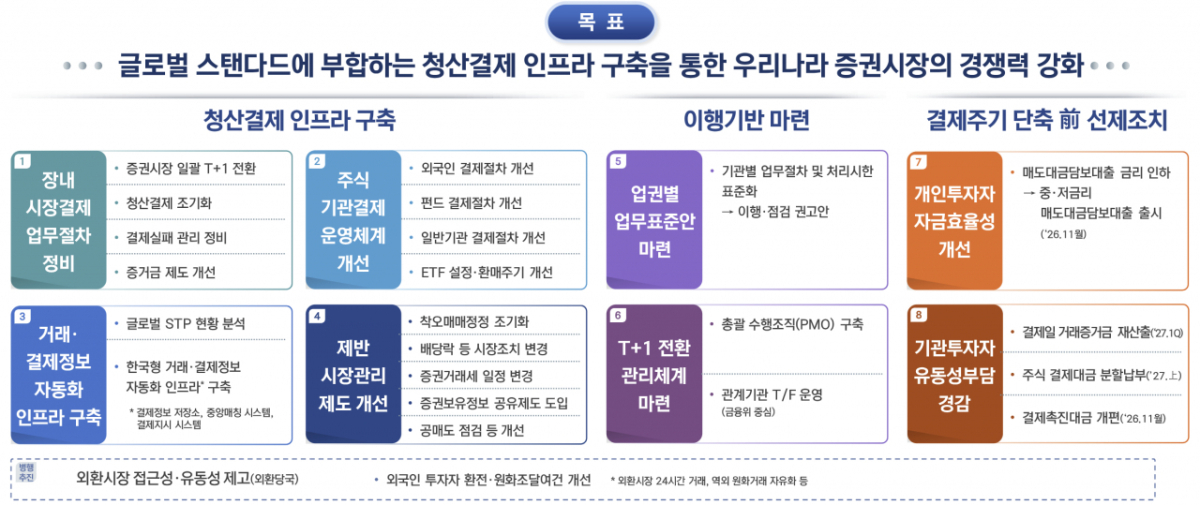
The roadmap consists of 22 tasks across eight key areas, including building clearing and settlement infrastructure, establishing industry implementation foundations, and supporting investors prior to the transition.
Specifically, the settlement cycles for stocks, ETFs, and ETNs will be uniformly shifted to T+1, and accordingly, the settlement approval deadlines for foreign investors, collective investment managers (funds), and general institutional investors will be moved up. For foreign investors, the deadline will shift from 3 p.m. two days after trading to 9 a.m. on the next trading day, while for funds and general institutions, it will move from 4 p.m. on the next trading day to 10 p.m. on the day of trading. Additionally, the introduction of automated systems and improvements to domestic ETF creation and redemption cycles are also being pursued.
Settlement failure management and the calculation system for transaction margin will also be reorganized. Erroneous trade corrections, ex-dividend and ex-rights dates, securities transaction tax, and short selling management systems will also be adjusted. To prevent settlement failures, sharing of securities holding information among brokerages and the introduction of an automatic lending system are also being promoted.
The time zone issue for foreign investors is planned to be resolved through automation of settlement operations. The Depository will develop its own system and link it with the system of the US DTCC (Depository Trust & Clearing Corporation) to reduce foreign investor settlement processes from the existing 12 steps to five. Business standard drafts by industry sector are expected to be prepared, and implementation checklists provided, within next month.
In addition, to alleviate the settlement liquidity burden on institutional investors, the Depository's settlement promotion funds will be reformed this month, and from January next year, it is planned to allow recalculation of intraday transaction margin during trading hours through the exchange. From the first half of next year, split payment of settlement proceeds will also be permitted.
Alongside shortening settlement cycles, foreign exchange authorities are also pushing for institutional improvements to enhance access and liquidity in the foreign exchange market, including an offshore won settlement system aimed at operation starting in January next year, following the 24th-hour opening of the foreign exchange market implemented last July.
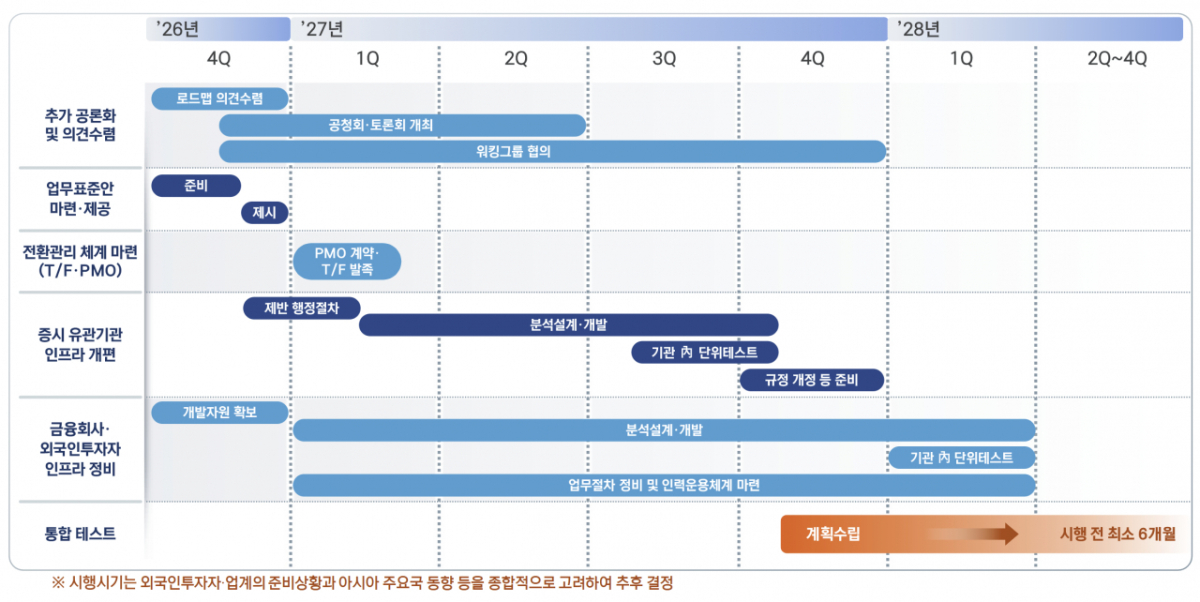
Securities-related institutions plan to complete the overhaul of clearing and settlement infrastructure for shortening settlement cycles by October 2027. They will support domestic and international financial companies and foreign investors in finalizing computer development and business system overhauls by the first quarter of 2028. Subsequently, integrated testing will be conducted for at least six months to check system stability.
Accordingly, shortening settlement cycles is expected to be implemented as early as during 2028. The final transition timing will be determined after consultations with financial authorities, domestic and international financial companies, and foreign investors.
Prior to shortening settlement cycles, the interest rate on sale proceeds collateral loans for retail investors will also be lowered to enhance investor benefits.
Current sale proceeds collateral loans have a short loan period of one to two days, and since repayment funds are essentially secured through the exchange's settlement performance guarantee, the risk is low; however, brokerages have been raising and supplying their own funds, resulting in interest rates of around 7.5% to 10% per annum. If the interest rate is lowered to the mid-5% range with medium-to-low interest rate sale proceeds collateral loan products, investors will be able to secure funds quickly even before settlement cycles are shortened, and interest burdens can be reduced by approximately 25%.
Mirae Asset Securities launched a medium-to-low interest rate product on this day, and Kiwoom Securities is scheduled to launch one on the 20th.
Securities-related institutions plan to gather opinions from market participants on the roadmap until the 18th of next month, then identify supplementary tasks through public hearings and task forces (TFs) to refine the roadmap.

 in STOCK

